
Evidence-based valuation and advisory across aviation businesses, aircraft, and airport real estate.

Each engagement pairs doctoral real estate research with aviation-specific expertise, delivered for the people who underwrite, litigate, and invest in aviation businesses and real estate.
Independent appraisals of aircraft hangars and airport improvements, grounded in doctoral research and the reference textbook on the subject. Hangars look like industrial warehouses but trade on different fundamentals: aircraft capacity, airport ground leases, FAA grant assurances, and the years remaining before improvements revert to the airport.
County assessors routinely value hangars from generic commercial cost tables, ignoring ground lease term, reversion, functional obsolescence, and airport use restrictions. We prepare the independent appraisal that anchors an appeal, rebut the assessor's methodology, and provide testimony if the matter escalates.
Fair market rent studies for airport hangars and ground leases. We set supportable rental rates using comparable lease evidence and a rate of return on underlying land value, the analysis airport sponsors and tenants rely on for rent resets, lease renewals, through the fence agreements, and FAA rate and rental structure compliance.
Independent review of the whole rate schedule rather than the hangar line alone: aeronautical land, hangars by type, tiedowns, FBO and fuel flowage fees, terminal space, and non-aeronautical parcels. Built for federally obligated sponsors who have to show how each rate was derived, and delivered as a report a board can adopt and a tenant can be shown.
Business valuations for privately held aviation companies: FBO, MRO, charter, parts, and flight training operators. For fixed base operators the analysis separates the business enterprise from the underlying leasehold, pricing fuel volumes and margins, hangar and ramp revenue, and the operating agreement with the airport sponsor.
Opinions of value for employee stock ownership plans at aviation companies, including the annual updates an ESOP trustee requires. An ESOP valuation must hold up to Department of Labor scrutiny of adequate consideration, and aviation operators carry value drivers a generalist appraiser rarely prices.
Retained testifying and consulting expert work in hangar and airport valuation disputes: condemnation and eminent domain, ground lease termination, property tax litigation, insurance coverage, and ownership disputes. We serve attorneys on both sides of the docket, nationwide.
Three conditions separate an aircraft hangar from the industrial building it resembles. Each one moves value in a direction a generalist appraisal will not capture, and each one is where our work concentrates.



Source-grounded calculators, maps, directories, and trackers for anyone who owns, buys, finances, or litigates an aircraft hangar or airport property.
Estimate what an aircraft hangar is worth using the income approach, airport quality tiers, and the ground-lease reversion most valuations miss.
Open the estimator →What it costs to build a hangar by type, door, systems, and region, with a full component breakdown and how cost compares to value.
Open the calculator →Known and suspected firefighting-foam contamination at U.S. airports, with risk tiers for buyers, lenders, and FBO transactions.
Open the map →Every public-use airport in America, by state, with runway, fuel, control tower, on-field repair, Part 139, ILS, elevation, and acreage, the facility detail that anchors what a hangar on the field is worth.
Browse the database →87 verified U.S. hangar and airport condemnation, inverse-condemnation, and avigation-easement cases with award data.
Open the tracker →A running log of U.S. hangar and airport valuation rulings, 2021 to 2026: property tax appeals, takings, and FAA Part 16 rent disputes, each tied to a primary source.
Open the tracker →The first quarterly market-rent benchmark for US general aviation hangar storage. The Index closes the gap that has frustrated every appraiser, airport sponsor, and FBO acquirer working in this niche: until now there was no independent benchmark for what hangar space actually rents for.
Most aviation market data tracks aircraft. Our indexes track the companies that maintain, fly, and service them, built entirely from public data and published each quarter. The read is reported by segment, so it applies whether you run an MRO, an FBO, a parts business, or a flight school.
The story this quarter is the maintenance crunch. Nearly 74% of the pre-owned business-jet fleet for sale is now 16 years or older, up from 70% a year earlier, and the certificated mechanic workforce is aging toward retirement. The scarcity index is elevated, which is durable pricing power for MRO and repair-station owners.
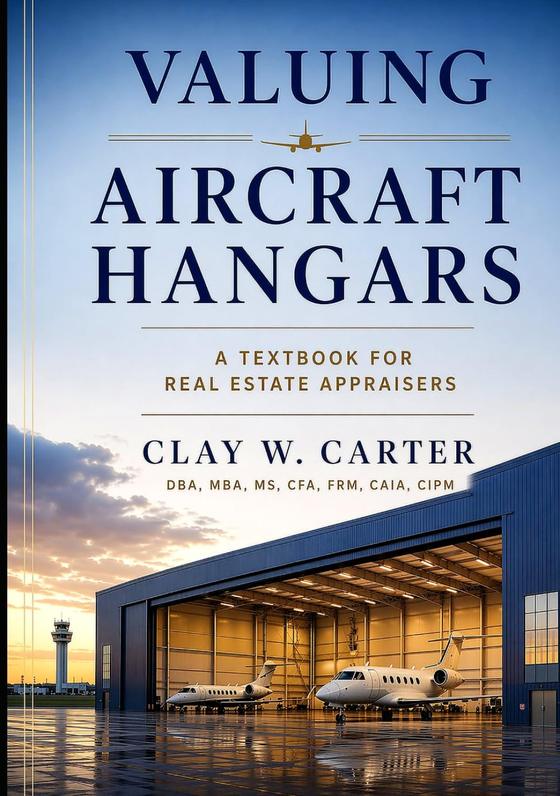
The definitive academic reference for aircraft hangar valuation, covering the federal regulatory framework, airport ground lease structures, and the cost, income, and sales-comparison approaches adapted for aviation-specific conditions. Dedicated treatment of PFAS contamination, USPAP-compliant reporting, Standard 3 review, and specialty properties including T-hangars, FBOs, MRO facilities, vertiports, and sustainable aviation fuel infrastructure.
Grounded in aeronautical expertise, doctoral real estate research, and a credential depth unmatched in the field. Required reading for aviation lenders, appraisers, airport authorities, and institutional investors entering the hangar market.
Dr. Clay W. Carter holds the DBA, MBA, MS, CFA, FRM, CAIA, and CIPM designations. He serves as Assistant Professor at an aeronautical university in Daytona Beach, Florida, where his research focuses on hangar valuations. He has authored a textbook on the subject along with several other aviation-related books.
As founder of Valuation Takes Flight LLC, he applies this research to consulting services for aviation lenders, airport authorities, private equity funds, and litigation attorneys who need rigorous analytical support alongside traditional appraisal work.
Rigorous analytical support for the people who underwrite, litigate, and invest in aviation real estate.Begin an Engagement
Twenty federal authorities decide what an airport may charge and what a hangar is worth, and most of them are not in the Code of Federal Regulations. We mapped each one to the problem it creates and the engagement that answers it.
Explore the 20 Authorities
Reach out to discuss litigation support, a ground lease analysis, or institutional performance verification.
Additional books exploring aviation economics, markets, and investment history.