Preface
This document holds two of the Wexley Field Airport Authority's primary management and compliance documents: the Leasing Policy in Part I and the Rents and Fees Policy in Part II. The Leasing Policy states the terms on which the Authority leases airport property. The Rents and Fees Policy states how each rent and fee is set, adjusted and applied.
The two are adopted together because each depends on the other. A lease refers to the schedule for its rent, and the schedule refers to the lease for when and how that rent changes.
Part III records the basis for the economic terms: how the term schedule, the adjustment terms and the rates were derived, and where each federal review question is answered. Part III is supporting analysis. The Board adopts Parts I and II.
Clauses are numbered within each section. A summary of the economic terms follows this preface. The addenda list the authorities cited and the exhibits.
Summary of Economic Terms
The table states the economic terms in one place. The clause named in the last column controls.
| Term | Provision | Clause |
|---|---|---|
| Ground lease term | 5 to 30 years, set by the lessee's investment per square foot of the area it develops | 8.1 |
| Options and maximum term | Up to two options of five years, each with Board consent and rent at the current Schedule rate. 40 years in all | 8.2, 8.3 |
| Extension during the term | Only for added investment that meets the term schedule, by Board action | 8.4 |
| Aeronautical ground rent | $0.45 per square foot per year for improved land and $0.30 for unimproved land | 9.1, Section 24 |
| Rent for Authority-owned hangars | $365 to $450 per month for a T-hangar unit and $9.60 to $12.00 per square foot per year for a box hangar | 9.2, Section 24 |
| Non-aeronautical rent | Fair market value by appraisal, and not less than $0.75 per square foot per year for land | 9.3 |
| When ground rent starts | The earlier of the certificate of occupancy or 12 months after commencement | 9.4 |
| Annual adjustment | Consumer Price Index each July 1. No decrease, and no increase above 4 percent in one year | 10.1 |
| Reset | To the Schedule rate every fifth year, on the date a rent study takes effect. An increase above 15 percent is phased in over two years | 10.2, 10.3 |
| Improvements | The lessee holds title during the term. Title passes to the Authority at expiration without payment | 11.2, 11.3 |
| After reversion | A facility lease at market rent, offered first to the former lessee as a practice of the Authority | 11.4, 11.7 |
| Assignment and financing | Assignment with consent. Leasehold mortgage with notice. The lender receives notice of default and time to cure | Section 13 |
| Holdover | 150 percent of the last rent | 17.2 |
| Fuel flowage fee | $0.12 per gallon delivered, at one rate for every seller and self-fueler | 26.1 |
| Hangar waiting list | A $250 deposit for each position. Units offered in order of deposit date. No preference for residents | Section 28 |
| Exceptions | By Board resolution with written findings | 29.2 |
Exhibit 1. Summary of the economic terms in this document. Sample provisions and illustrative rates for a sample airport.
Part I. Leasing Policy
1. Purpose
1.1 This policy governs every agreement by which the Authority grants a right to occupy or use land or improvements at Wexley Field.
1.2 The Authority leases airport property to put it to aeronautical use, to make the airport as self-sustaining as possible, to treat similarly situated parties alike, and to keep the rights and powers it needs to meet its federal obligations.
1.3 This policy states what the Authority offers and approves. It applies to each new agreement and, under Section 19, to an existing agreement when it is amended, extended, assigned or replaced.
2. Relationship to the other documents
| Document | What it governs |
|---|---|
| Rules and Regulations | Conduct on the airport by all users |
| Minimum Standards for Commercial Aeronautical Activities | Qualifications a commercial operator must meet to do business on the airport |
| Leasing Policy, Part I of this document | The terms on which airport property is leased |
| Rents and Fees Policy, Part II of this document | How rents and fees are set, adjusted and applied |
| Development Standards | Design and construction of improvements on leased premises |
Exhibit 2. The Authority's primary management and compliance documents. Sample provisions.
2.1 Where this policy conflicts with a federal obligation, the federal obligation controls. Where an agreement is silent, this policy applies.
2.2 The rent, fee and minimum investment terms in the Minimum Standards are kept the same as the terms in this document. Where the two differ, this document controls until the Board conforms them.
3. Federal obligations
| Authority | Effect on leasing |
|---|---|
| Grant Assurance 5, Preserving Rights and Powers | No agreement may deprive the Authority of the rights and powers it needs to comply with the assurances. Every agreement is subordinate to them |
| Grant Assurance 22, Economic Nondiscrimination | Terms must be reasonable and applied without unjust discrimination among users making the same or similar use |
| Grant Assurance 23, Exclusive Rights | No agreement grants an exclusive right to conduct an aeronautical activity |
| Grant Assurance 24, Fee and Rental Structure | Rents and fees must make the airport as self-sustaining as possible under local circumstances |
| Grant Assurance 25, Airport Revenues | Revenue from airport property is used for airport purposes |
| Grant Assurance 29, Airport Layout Plan | Leased premises and improvements must conform to the approved plan |
| Grant Assurance 38, Hangar Construction, 49 U.S.C. 47107(a)(21) | Where the Authority and an aircraft owner agree that the owner will build a hangar at its own expense, the Authority grants a long-term lease on the terms the Authority sets |
| FAA Order 5190.6C, paragraphs 17.9 and 17.11 | Aeronautical rents may be set at fair market value. Non-aeronautical use pays at least fair market value |
| FAA Order 5190.6C, paragraph 18.18(a) | Rates are set by a consistent method across comparable aeronautical users |
| FAA Order 5190.6C, paragraph 12.3.b(3) | A term should not exceed the period reasonably needed to amortize the tenant's investment. Terms of 30 to 35 years are generally sufficient for major facilities. A term over 50 years may be treated as a disposal of the property |
| FAA Order 5190.6C, paragraphs 12.3.b(4) and 9.5.e | A lease of more than five years should provide for periodic adjustment of rent, by a recognized index or by appraisal |
| FAA Order 5190.6C, paragraph 12.3.b(5) | The FAA asks whether title to tenant facilities vests in the sponsor at expiration, and whether an extension or option carries facility rent once it has |
| FAA Order 5190.6C, paragraph 9.5.d | Rates that differ between tenants must be justified by differing circumstances. The paragraph names seven |
| FAA Order 5190.6C, paragraph 9.7.b | Where adequate facilities are available for lease, a sponsor is not compelled to lease vacant land for a private hangar |
| FAA Order 5190.6C, paragraph 9.10 | No preference in hangar assignment or in rates for residents or local taxpayers |
| FAA Order 5190.6C, paragraph 8.8.b | A competitive offering does not relieve the sponsor of its obligation to give access on reasonable terms, without an exclusive right |
| FAA policy on non-aeronautical use of airport hangars | Storage of active aircraft is aeronautical use. Other hangar use pays non-aeronautical fair market rent |
| Advisory Circular 150/5190-8, Minimum Standards for Commercial Aeronautical Activities | Federal guidance on minimum standards. The economic terms that apply to commercial operators are kept consistent with it |
Exhibit 3. Federal authorities that bear on leasing. Summaries, not legal advice.
3.1 Paragraph numbers refer to FAA Order 5190.6C, the Airport Compliance Manual, effective February 20, 2026. Addendum A gives each source.
4. Definitions
| Term | Meaning in this document |
|---|---|
| Aeronautical activity | An activity that involves, makes possible, or is required for the operation of aircraft |
| Agreement | Any lease, rental agreement or permit covered by this policy |
| Board | The Board of Commissioners of the Wexley Field Airport Authority |
| Commercial operator | A person that offers an aeronautical service to the public for compensation |
| Consumer Price Index | The Consumer Price Index for All Urban Consumers, U.S. city average, all items, not seasonally adjusted, published by the U.S. Bureau of Labor Statistics |
| Development area | The part of the leased premises on which the lessee builds, with the apron, vehicle parking and setbacks those improvements require, as shown on the approved site plan |
| Fair market value | The meaning given in Appendix G of FAA Order 5190.6C |
| Improvements | Buildings, pavement and utilities built on leased premises |
| Investment in improvements | The documented cost of permanent improvements, including design, permitting, site work and utilities. It leaves out aircraft, equipment, furnishings, financing costs and the lessee's own overhead |
| Lessee | The party to an agreement with the Authority |
| Market rent | The rent a property would bring in a current open market transaction, as concluded in the Authority's most recent rent study |
| Non-aeronautical use | A use that is not an aeronautical activity and does not need to be on an airport |
| Rent study | The independent study of market rent that the Authority commissions under Section 27 |
| Schedule | The Schedule of Rents and Fees in Part II |
| Similarly situated | Making the same or similar use of the same or similar property |
5. Types of agreement
| Agreement | Used for | Who builds | Typical term |
|---|---|---|---|
| Ground lease | Land on which the lessee builds a hangar or other aeronautical facility | Lessee | By the term schedule in Section 8 |
| Facility lease | A building the Authority owns, leased to one occupant | Authority | Up to 5 years |
| Hangar rental agreement | A T-hangar or box hangar unit the Authority owns | Authority | Month to month or 12 months |
| Commercial operating permit | A commercial operator that does business on the airport without leasing premises | Not applicable | 1 year |
| Non-aeronautical lease | Property the airport layout plan designates for non-aeronautical use | Either | Set by appraisal and Board approval |
| Commercial operator lease by solicitation | A fixed base operator or other commercial leasehold that combines land, Authority-owned facilities and the right to operate | Lessee, as the solicitation requires | Set in the solicitation under 8.8 |
Exhibit 4. Types of agreement. Sample provisions.
6. How property is offered
6.1 The Authority publishes a list of property available for lease and keeps it current.
6.2 An applicant submits the intended use, a site plan, the proposed investment, a construction schedule, and evidence of financial capacity.
6.3 Where two or more qualified parties seek the same premises, the Authority offers the premises by competitive solicitation with published criteria.
6.4 Units the Authority owns are offered in order from the hangar waiting list under Section 28.
6.5 The Authority responds to a complete application within 45 days.
6.6 Where the Authority receives a proposal for premises that are not on the published list, it posts notice of the proposal for 30 days and invites other interest before it acts.
6.7 The Authority may decline to lease vacant land for a private hangar where adequate hangar facilities are available for lease on the airport. It may hold land the airport layout plan reserves for another aeronautical need.
6.8 A solicitation publishes its criteria, weights and financial method with the request, and they are applied without change. The Schedule rates are the minimum for any rent or fee a proposer is asked to state.
6.9 An award by solicitation closes no part of the airport to other qualified operators. The Authority continues to make suitable property available on reasonable terms.
7. Who may lease
7.1 An applicant must be in good standing with the Authority: no amount past due and no uncured default under any agreement.
7.2 An applicant that proposes to build shows that it can pay for the improvements, by financial statements, a financing commitment, or both.
7.3 A commercial operator must meet the Minimum Standards for its activity before the agreement takes effect.
7.4 The Authority states its reason in writing when it declines an application. The reasons are that the applicant does not qualify under this section, that the use does not conform to the airport layout plan, that the premises are not available, or that 6.7 applies.
8. Term
8.1 The term of a ground lease is no longer than the lessee needs to recover its investment and earn a reasonable return. The Authority sets the term from the lessee's investment in improvements, by the schedule below.
| Investment in improvements per square foot of leased premises | Initial term, up to |
|---|---|
| No new investment | 5 years |
| At least $15 | 15 years |
| At least $30 | 25 years |
| At least $50 | 30 years |
Exhibit 5. Term schedule for ground leases. Sample provisions.
8.2 A ground lease may carry up to two renewal options of five years each. Each option requires Board consent, rent at the Schedule rate then in effect, and the lessee's compliance with the agreement.
8.3 No term, including options, exceeds 40 years.
8.4 A term may be extended during the lease only in exchange for additional investment that meets the schedule in 8.1, and only by Board action.
8.5 Investment is measured against the development area. Where the premises include land or buildings the lessee does not develop, such as a building the Authority owns or ramp the lessee operates but does not rebuild, those areas are left out of the measure.
8.6 The lessee certifies the cost of its improvements within 120 days after completion, with invoices and proof of payment. Where the certified cost falls below the tier on which the term was set, the term is reduced to the tier the cost meets.
8.7 Construction begins within 12 months after the commencement date and is complete within 24 months, unless the agreement or a solicitation sets other dates. Failure to meet a date is a default.
8.8 A solicitation states one term for all proposers. The Authority sets it from the minimum investment the solicitation requires, by the schedule in 8.1, so that offers are compared on the same term.
8.9 An extended term under 8.4 counts toward the 40 years in 8.3.
9. Rent
9.1 Ground rent for aeronautical use is the Schedule rate for the class of land.
9.2 Rent for improvements the Authority owns is the Schedule rate for the type of unit, or market rent set by the most recent rent study where the Schedule has no rate.
9.3 Rent for non-aeronautical use is fair market value set by appraisal, and not less than the Schedule minimum.
9.4 Ground rent begins on the earlier of the certificate of occupancy or 12 months after the commencement date.
9.5 In a solicitation a proposer may offer more than a Schedule rate. An offer below a Schedule rate may be accepted only by exception under 29.2.
9.6 The Authority grants no rent credit, abatement or free rent, except for work the Authority would otherwise have to perform at its own cost. The Board approves the credit by resolution that states the work, the amount and the period.
9.7 A lessee posts the security deposit in the Schedule at signing.
9.8 A commercial operator pays, in addition to rent, the fees the Schedule sets for its activity and any percentage of revenue its agreement sets.
10. Rent adjustment
10.1 Rent is adjusted each July 1 by the change in the Consumer Price Index for the prior calendar year, with no decrease and no increase above 4 percent in one year.
10.2 Every fifth year, rent is reset to the Schedule rate then in effect for the class of land or unit.
10.3 Where a reset raises rent by more than 15 percent, the increase is phased in over two years.
10.4 The change for a calendar year is measured from December of the year before to December of that year.
10.5 The reset falls on the July 1 on which a Schedule based on a new rent study takes effect under Section 27. Every agreement in a class moves to the new rate on that date, whatever its commencement date. A reset may lower rent as well as raise it.
10.6 Under 10.3, half of the increase takes effect on the reset date. The balance takes effect the next July 1, together with that year's adjustment.
10.7 Where the Bureau of Labor Statistics does not publish the index for a month this policy uses, the nearest earlier published month is used. Where the index is discontinued, the Authority adopts the successor the Bureau designates.
10.8 Rent under a non-aeronautical lease adjusts as that lease provides, with a new appraisal at least every fifth year.
10.9 A lessee that believes its premises were placed in the wrong class at a reset may ask the Board for review within 60 days after notice of the new rent. The Board decides on the record of the rent study. The new rent is paid while the review is pending.
11. Improvements and reversion
11.1 Improvements are built to the Development Standards and in conformity with the airport layout plan.
11.2 The lessee holds title to the improvements it builds during the term.
11.3 At expiration or termination, title to all improvements passes to the Authority without payment.
11.4 After reversion the Authority may offer the former lessee a facility lease at market rent before offering the building to others. This is a practice of the Authority and not a right of the lessee.
11.5 The Authority may instead require removal of improvements that are not in a condition to be leased.
11.6 The Authority inspects the improvements 12 months before expiration and gives the lessee a list of repairs. The lessee surrenders the improvements in good repair, ordinary wear excepted.
11.7 No agreement lets a party occupy improvements after title has passed to the Authority without paying rent for the improvements as well as the land. An option or extension that runs past a reversion carries facility rent at the Schedule rate.
12. Expiration and new agreements
12.1 No agreement renews by itself. Apart from an option granted under 8.2, a lessee holds no right to a further term.
12.2 A lessee may apply for a new agreement between 36 and 12 months before expiration. The Authority then decides whether to offer a facility lease under 11.4, to grant a new ground lease for new investment, or to offer the premises by solicitation.
12.3 A new ground lease to a former lessee is granted only for new investment that meets the schedule in 8.1. Rent under it includes rent for improvements that have passed to the Authority, unless the new investment replaces them.
12.4 The Authority gives each lessee written notice of the expiration date and of this section 36 months before expiration.
13. Assignment, subleasing and financing
13.1 A lessee may not assign an agreement or sublease the whole of the premises without the Authority's written consent, which is not unreasonably withheld.
13.2 A lessee may sublease space for aircraft storage. A sublessee is bound by this policy and by the Rules and Regulations.
13.3 A lessee may mortgage its leasehold with notice to the Authority. The Authority gives the lender notice of default and a period to cure.
13.4 A transfer of control of the lessee is an assignment. An assignee must qualify under Section 7 and pays the consent fee in the Schedule.
13.5 A leasehold mortgage may not run past the term. The Authority does not subordinate its own interest in the land and does not join in the mortgage.
13.6 A lender that holds a leasehold mortgage has 30 days beyond the lessee's cure period to cure a default. Where an agreement ends for a default the lender cannot cure, the lender may take a new agreement on the same terms for the rest of the term, on payment of all amounts due.
13.7 The Authority gives a statement of the status of an agreement within 20 business days after a lessee or lender asks for one.
13.8 A sublease is subject to the agreement and ends with it. A lessee reports its subleases to the Authority each year, with the registration number of each aircraft stored.
14. Use
14.1 Leased premises are used for the aeronautical purpose stated in the agreement.
14.2 Non-aeronautical use of a hangar requires the Authority's written consent and non-aeronautical rent under 9.3.
14.3 Aeronautical use of a hangar means storage of active aircraft, final assembly of aircraft under construction, non-commercial construction of amateur-built or kit-built aircraft, maintenance, repair or refurbishment of aircraft, and storage of aircraft handling equipment, tools and materials. It does not include indefinite storage of aircraft that are not operational.
14.4 Other items may be kept in a hangar that is used primarily for an aeronautical purpose, so long as they do not interfere with that use.
14.5 The Authority leases a vacant hangar for an interim non-aeronautical use only with the approval of the Federal Aviation Administration, at non-aeronautical fair market rent, and on terms that let the Authority recover the hangar on 30 days notice for an aeronautical user.
14.6 Commercial activity on leased premises requires an agreement or permit that authorizes it and compliance with the Minimum Standards.
14.7 The Authority inspects the use of each hangar on the airport at least once a year.
15. Costs the lessee carries
15.1 Each agreement states who pays each cost of occupancy. Unless the Board approves otherwise, the allocation is the one below.
| Cost | Ground lease | Facility lease | Hangar rental agreement |
|---|---|---|---|
| Taxes on improvements and on the leasehold | Lessee | Lessee, on its leasehold | Authority |
| Utilities | Lessee | Lessee | Authority, for ordinary use |
| Building insurance | Lessee | Authority | Authority |
| Liability insurance | Lessee | Lessee | Tenant, as the Rules and Regulations require |
| Structure, roof and building systems | Lessee | Authority | Authority |
| Interior, doors and routine maintenance | Lessee | Lessee | Authority, except damage by the tenant |
| Pavement inside the premises | Lessee | Authority | Authority |
Exhibit 6. Costs of occupancy by type of agreement. Sample provisions.
15.2 Rent under a ground lease is net to the Authority. The Schedule rates for Authority-owned hangars include the costs the Authority carries in the table.
16. Condition of the premises
16.1 The Authority and the lessee record the condition of the premises at commencement in a baseline report. The lessee pays for the report on premises it will develop.
16.2 The lessee bears the cost of any release caused by its use of the premises, or by its sublessees, during the term.
16.3 The lessee delivers an exit assessment at surrender. A condition the baseline report shows was present at commencement is not charged to the lessee.
16.4 Fuel storage on leased premises requires the Authority's written approval under the Rules and Regulations.
16.5 This section allocates cost between the parties. It does not decide liability under any environmental law, which is for counsel.
17. Default and holdover
17.1 A lessee in default has 30 days after written notice to cure, or a longer period the Authority approves where cure cannot be completed in 30 days.
17.2 A lessee that remains after expiration without a new agreement pays holdover rent at 150 percent of the last rent.
17.3 A failure to pay rent or a fee is cured within 10 days after written notice. The late charge in the Schedule applies from the due date.
18. Subordination and reserved rights
18.1 Every agreement is subordinate to the Authority's present and future agreements with the United States, including the grant assurances.
18.2 No agreement grants an exclusive right to conduct an aeronautical activity. A provision that would have that effect is void.
18.3 The Authority reserves the right to develop and improve the airport as it sees fit.
18.4 Where the Authority needs leased premises for airport development shown on the airport layout plan, it may end the agreement on 12 months notice. It then pays the lessee the cost of the lessee's improvements less straight line amortization over the initial term, or relocates the improvements at the Authority's cost.
19. Existing agreements
19.1 An agreement signed before the effective date of this policy continues on its own terms.
19.2 This policy applies when such an agreement is amended, extended, assigned or replaced.
19.3 An existing agreement of more than five years that has no provision for periodic rent adjustment is brought to the Schedule and to Section 10 at its next amendment, option or assignment.
Part II. Rents and Fees Policy
20. Objectives
20.1 The Authority sets rents and fees to make the airport as self-sustaining as possible, to charge similarly situated users alike, and to show how each rate was derived.
20.2 Each rate has a stated basis. No rate is set or changed by negotiation with one user.
21. Pricing principles
21.1 Aeronautical land and facilities leased for one user's exclusive use are priced at market rent.
21.2 Charges for airfield facilities used in common do not exceed the Authority's cost of providing them. The Schedule carries no landing fee.
21.3 The fuel flowage fee is a charge for use of the airfield. The Authority sets it by survey and tests it against airfield cost at each rent study.
21.4 Non-aeronautical use pays fair market value or more.
21.5 A rate set on cost leaves out the share of cost paid by federal and state grants.
21.6 Each category of rate is set by one method, applied to every comparable user.
22. Classes of property and user
22.1 The Schedule states a rate for each class. A class is defined by the property or by the use, and never by who the user is.
22.2 A difference in rate between two users rests on one or more of the factors in the table below, and on no other ground.
| Factor | How this document uses it |
|---|---|
| Minimum investment requirements | The term schedule in 8.1 ties the length of a ground lease to the investment required |
| Demand | Rates are stated by type of unit. The waiting list for each type is tracked under Section 28 and tested under 27.6 |
| Location | Improved and unimproved land carry different rates. A rent study may conclude a premium for a location |
| Capital investment risk | Ground rent starts after the construction period under 9.4 |
| Ownership of facilities | A lessee that builds pays ground rent. An occupant of an Authority-owned building pays rent for the building |
| Time remaining on contract terms | An agreement signed before this policy keeps its terms until it is amended, under Section 19 |
| Condition of facilities | Existing and new hangar buildings carry different rates in the Schedule |
Exhibit 7. Grounds for a difference in rates named in FAA Order 5190.6C, paragraph 9.5.d, and where this document uses each. Sample provisions.
22.3 Residence in the Authority's district, or payment of local taxes, is not a ground for a different rate or for a preference.
22.4 Tiedown rates differ for based and transient aircraft because the use differs: a based aircraft holds an assigned space by the month.
23. How each rate is set
| Category | Basis | Method | Adjusted |
|---|---|---|---|
| Aeronautical land | Market rent | Rent study: comparable ground leases at competing airports, tested against a rate of return on land value | CPI each year, rent study every fifth year |
| Authority-owned hangars | Market rent | Rent study: comparable hangar rents by type, adjusted for age and condition | CPI each year, rent study every fifth year |
| Tiedowns | Market rent | Survey of competing airports | With the rent study |
| Terminal and office space | Market rent | Rent study | With the rent study |
| Fuel flowage fee | Market fee | Survey of fees at competing airports, per gallon delivered | With the rent study |
| Commercial operating permit | Cost recovery | Cost of administering the permit | Each year |
| Non-aeronautical property | Fair market value | Appraisal | By the lease |
| Application and consent fees | Cost recovery | Staff and counsel time for the review | Each year |
| Deposits and late charges | Set by this policy | Not applicable | By amendment |
Exhibit 8. Basis and method by rate category. Sample provisions.
24. Schedule of rents and fees
| Item | Rate | Unit |
|---|---|---|
| Aeronautical land, improved | $0.45 | Per square foot per year |
| Aeronautical land, unimproved | $0.30 | Per square foot per year |
| Non-aeronautical land, minimum | $0.75 | Per square foot per year |
| T-hangar unit, existing buildings | $365 | Per month |
| T-hangar unit, new buildings | $450 | Per month |
| Box hangar, existing buildings | $9.60 | Per square foot per year |
| Box hangar, new buildings | $12.00 | Per square foot per year |
| Tiedown, based aircraft | $85 | Per month |
| Tiedown, transient | $15 | Per night |
| Terminal and office space | $18.00 | Per square foot per year |
| Fuel flowage fee | $0.12 | Per gallon delivered |
| Commercial operating permit | $600 | Per year |
| Hangar waiting list deposit | $250 | Per position |
| Late charge | 5 percent | Of the amount due, after 10 days |
| Holdover rent | 150 percent | Of the last rent |
| Security deposit, ground lease or facility lease | 3 months | Of rent at commencement |
| Security deposit, hangar rental agreement | 1 month | Of rent |
| Lease application fee | $500 | Per application |
| Consent to assignment, sublease of the whole premises, or leasehold mortgage | $750 | Per request |
| Returned payment | $35 | Per item |
Exhibit 9. Schedule of rents and fees, effective July 1, 2026. Illustrative rates for a sample airport.
25. Billing, payment and deposits
25.1 Rent is due in advance on the first day of each month. Ground rent may be paid for the year in advance.
25.2 A fuel flowage report is due by the 15th day of the month after delivery, with the supplier's delivery records and payment of the fee.
25.3 The Authority may audit flowage and revenue reports for three years. Where an audit finds fees underpaid by more than 3 percent, the operator pays the cost of the audit.
25.4 Deposits are held without interest. A deposit is returned within 45 days after surrender, less any amount due.
26. Fuel flowage and commercial fees
26.1 The fuel flowage fee applies to every gallon delivered into storage on the airport, whether the fuel is sold to the public or used by the party that receives it.
26.2 One flowage rate applies to every seller and every self-fueler.
26.3 A based aircraft operator may fuel its own aircraft with its own employees and equipment, under the safety rules in the Rules and Regulations. It pays the same flowage fee as a commercial seller.
26.4 A percentage of revenue is charged only where a solicitation set it and the agreement states it.
26.5 The commercial operating permit fee recovers the cost of administering the permit and is reviewed each year.
27. Review and adjustment
27.1 The Schedule is adjusted each July 1 by the change in the Consumer Price Index, on the terms in 10.1.
27.2 The Authority commissions an independent rent study every fifth year, and sooner if it adds a class of property the Schedule does not cover.
27.3 A proposed Schedule is published 60 days before its effective date. The Board takes public comment before adopting it.
27.4 The rent study, the proposed Schedule and the Board's action are kept as a public record.
27.5 The rent study compares the airport with competing airports and with property off the airport, and states the evidence for each rate. An appraisal of non-aeronautical property follows FAA Compliance Guidance Letter 2018-3.
27.6 The Board considers an interim review of a rate when the waiting list for a type of unit has exceeded one quarter of the units of that type for four quarters in a row, or when vacancy in a type has exceeded 10 percent for four quarters in a row.
28. Hangar waiting list
28.1 A person who owns or leases an aircraft, or holds a contract to buy one, may hold one position on each list: T-hangar and box hangar.
28.2 A position requires the deposit in the Schedule. The deposit is credited to the first month's rent.
28.3 Units are offered in order of the date the deposit was received. A person has 10 business days to accept an offer.
28.4 A person who declines two offers moves to the end of the list. A person who declines three forfeits the deposit and the position.
28.5 Each person confirms its position in writing once a year. A position that is not confirmed is removed and the deposit refunded.
28.6 A position may not be sold or transferred. The Authority publishes the number of positions on each list every quarter.
28.7 No preference is given for residence in the Authority's district or for payment of local taxes.
28.8 Each list is open to inspection at the Authority's office, in the order in which offers will be made.
28.9 A tenant keeps an active aircraft that it owns or leases in the unit. A tenant without one has 90 days to place an aircraft in the unit or give the unit up.
28.10 A hangar rental agreement may not be assigned and does not pass with the sale of an aircraft. The unit returns to the list.
28.11 A tenant that wants a different unit holds a position on the list on the same terms as any other person.
29. Uniform application, exceptions and amendment
29.1 The Schedule applies to every user in a class. Differences between classes rest on a stated basis.
29.2 An exception to this policy or the Schedule requires a Board resolution with written findings that state the reason and why it does not unjustly discriminate.
29.3 This document is amended by Board resolution after the notice in 27.3.
29.4 The Authority keeps a register of every agreement whose rent or fee differs from the Schedule. Each entry names the factor in 22.2 on which the difference rests. The Board reviews the register each year.
Part III. Basis for the Economic Provisions
Part III shows where the numbers in Parts I and II come from. A board that adopts a term schedule or a rate should be able to say why the number is what it is, and a tenant or a federal reviewer should be able to check it. The analysis uses the same airport facts as the Authority's other studies and a rate of 6.50 percent, which the Authority applies to its own projects.
30. How the term schedule was derived
Federal guidance gives a term one job. It should run long enough for the lessee to recover its investment and earn a reasonable return, and no longer. FAA Order 5190.6C, paragraph 12.3.b(3), asks whether a term exceeds the period reasonably necessary to amortize the tenant's investment. It states that ground leases of 30 to 35 years are generally sufficient to retire a tenant's initial financing and provide a reasonable return on major facilities, and that a lease of more than 50 years may be considered a disposal of the property. In a Director's Determination of March 13, 2026, Docket No. 16-24-05, the FAA described the 30 to 35 year figure as a recommendation left to the sponsor's discretion.
The schedule in clause 8.1 applies that test to this airport. We modeled a lessee that takes an 8,400 square foot site at the Schedule ground rent of $0.45, builds a 3,600 square foot box hangar for $582,176, and earns the Schedule rent for new box hangars, $12.00 per square foot. Vacancy and collection loss is 3 percent and expenses are 18 percent of income. Rent, expenses and ground rent grow 2.75 percent a year. A capital renewal of 10 percent of building cost falls in year 20. At expiration the hangar passes to the Authority and the lessee receives nothing for it. The investment is $69.31 per square foot of site, which is the top tier.
| Lease term | Lessee's internal rate of return | Present value of the lessee's income at 6.50 percent | Share of the investment recovered |
|---|---|---|---|
| 15 years | (0.49) percent | $339,171 | 58.3 percent |
| 20 years | 2.21 percent | $396,590 | 68.1 percent |
| 25 years | 4.34 percent | $461,924 | 79.3 percent |
| 30 years | 5.52 percent | $516,538 | 88.7 percent |
| 35 years | 6.24 percent | $562,191 | 96.6 percent |
| 40 years | 6.71 percent | $600,352 | 103.1 percent |
Exhibit 10. Return to a lessee that builds a box hangar on a ground lease, by length of term. Illustrative figures for a sample airport.
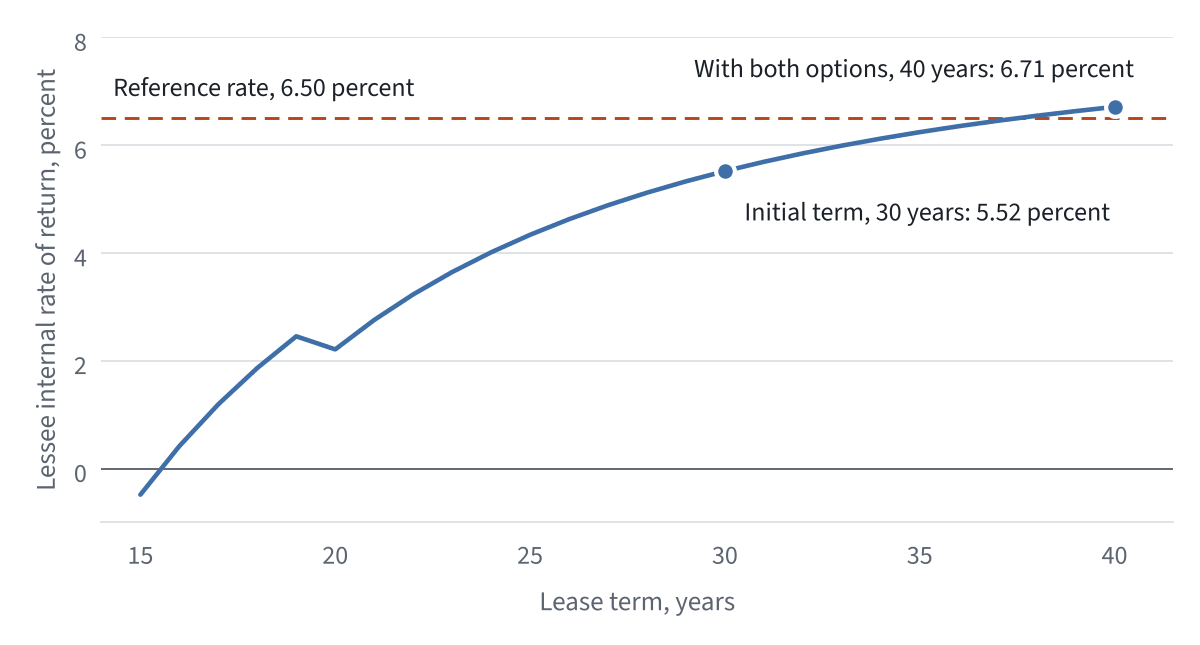
At 30 years the lessee earns 5.52 percent. The return passes 6.50 percent, the rate the Authority uses for its own projects, in year 38, and reaches 6.71 percent at 40 years. The schedule follows that curve. The top tier is 30 years, the low end of the range the Order calls sufficient. The two options carry a lessee to 40 years, where the return has reached the reference rate, and they stop there. Each option needs Board consent and rent at the current Schedule rate, so the added years go only to a lessee in compliance, at current rent.
The lower tiers follow the work a smaller investment buys. A lessee that replaces doors or a roof has less to recover than one that builds, and the work wears out sooner.
| Tier | Investment on an 8,400 square foot site | Work of that scale | Initial term, up to |
|---|---|---|---|
| No new investment | $0 | Occupancy of an existing improvement | 5 years |
| At least $15 per square foot | $126,000 | Replacement of doors, roof or apron pavement | 15 years |
| At least $30 per square foot | $252,000 | Major renovation, or a small new building | 25 years |
| At least $50 per square foot | $420,000 | New hangar construction. The modeled hangar costs $69.31 per square foot of site | 30 years |
Exhibit 12. What each tier of the term schedule represents on a typical hangar site. Illustrative figures for a sample airport.
The 40 year maximum in clause 8.3 sits ten years inside the point at which the Order treats a lease as a possible disposal. Clause 8.5 measures investment against the area the lessee develops, so that a lessee does not earn a long term on a large tract by building on a corner of it, and a lessee that takes over Authority-owned buildings is measured on what it builds.
31. What term and reversion are worth
Term is value. A leasehold is worth a share of what the same income would be worth if it ran forever, and the share falls as the term shortens. The table uses a 9 percent discount rate and 3 percent income growth, the assumptions in the firm's paper on ground lease reversion risk.
| Years of term | Share of perpetual value |
|---|---|
| 5 | 24.7 percent |
| 10 | 43.2 percent |
| 20 | 67.8 percent |
| 30 | 81.7 percent |
| 40 | 89.6 percent |
| 50 | 94.1 percent |
Exhibit 13. Value of a leasehold as a share of perpetual value, by years of term. The share is one minus the ratio of one plus growth to one plus the discount rate, raised to the number of years.
Two things follow. A lessee late in its term holds an asset that loses value each year, which is why lessees ask to extend well before expiration and why clause 8.4 grants an extension only for new investment. And the last years of a long term add little: going from 40 years to 50 adds 4.5 points of value to the lessee and brings the lease to the edge of what the Order treats as a possible disposal.
The reversion is the other side of the same arithmetic. The example below takes four box hangar sites of 8,400 square feet each, leased for 30 years at the Schedule ground rent, with the hangars passing to the Authority at expiration and renting at market for the ten years of building life that remain.
| What the Authority receives | Present value at 6.50 percent | Share |
|---|---|---|
| Ground rent, years 1 to 30 | $265,642 | 41.4 percent |
| Building rent after reversion, years 31 to 40 | $376,696 | 58.6 percent |
| Total | $642,337 | 100.0 percent |
Exhibit 14. Present value to the Authority of a 30 year ground lease on four box hangar sites, split between rent and reversion. Illustrative figures for a sample airport.
On this example the reversion is worth more to the Authority than thirty years of ground rent. Paragraph 12.3.b(5) of the Order asks two questions about it: whether title to tenant facilities vests in the sponsor at expiration, and whether an extension or option carries added facility rent once it has. Clause 11.3 answers the first and clause 11.7 answers the second. A new lease that left the buildings with the former lessee at ground rent alone would give up 58.6 percent of what the Authority was to receive.
The same arithmetic prices an option. On this example a five year option that moves the reversion from year 30 to year 35 lowers the present value of the Authority's interest from $642,337 to $459,727. The Board weighs that cost when it considers consent under clause 8.2.
32. How the adjustment terms work
The Order expects a long lease to adjust. Paragraph 12.3.b(4) states that a lease of more than five years should provide for periodic adjustment of rates. Paragraph 9.5.e adds that a ground lease of five years or more should adjust by a recognized index, and gives the reason in one sentence: "This will facilitate parity between new and established lessees." Section 10 uses both of the tools the paragraph names, an index each year and a study every fifth year.
The index is the Consumer Price Index for All Urban Consumers, measured December to December. The table applies clause 10.1 to the nine calendar years 2017 through 2025.
| Calendar year | Change in the index, December to December | Adjustment the next July 1 | Rent index with no cap | Rent index under the policy |
|---|---|---|---|---|
| 2017 | 2.1 percent | 2.1 percent | 102.1 | 102.1 |
| 2018 | 1.9 percent | 1.9 percent | 104.1 | 104.1 |
| 2019 | 2.3 percent | 2.3 percent | 106.4 | 106.4 |
| 2020 | 1.4 percent | 1.4 percent | 107.9 | 107.9 |
| 2021 | 7.0 percent | 4.0 percent | 115.5 | 112.2 |
| 2022 | 6.5 percent | 4.0 percent | 122.9 | 116.7 |
| 2023 | 3.4 percent | 3.4 percent | 127.1 | 120.6 |
| 2024 | 2.9 percent | 2.9 percent | 130.7 | 124.1 |
| 2025 | 2.7 percent | 2.7 percent | 134.2 | 127.4 |
Exhibit 15. The annual adjustment in clause 10.1 applied to 2017 through 2025. Rent index is 100.0 before the first adjustment. Source: U.S. Bureau of Labor Statistics, Consumer Price Index for All Urban Consumers, U.S. city average, all items, not seasonally adjusted, December index values.
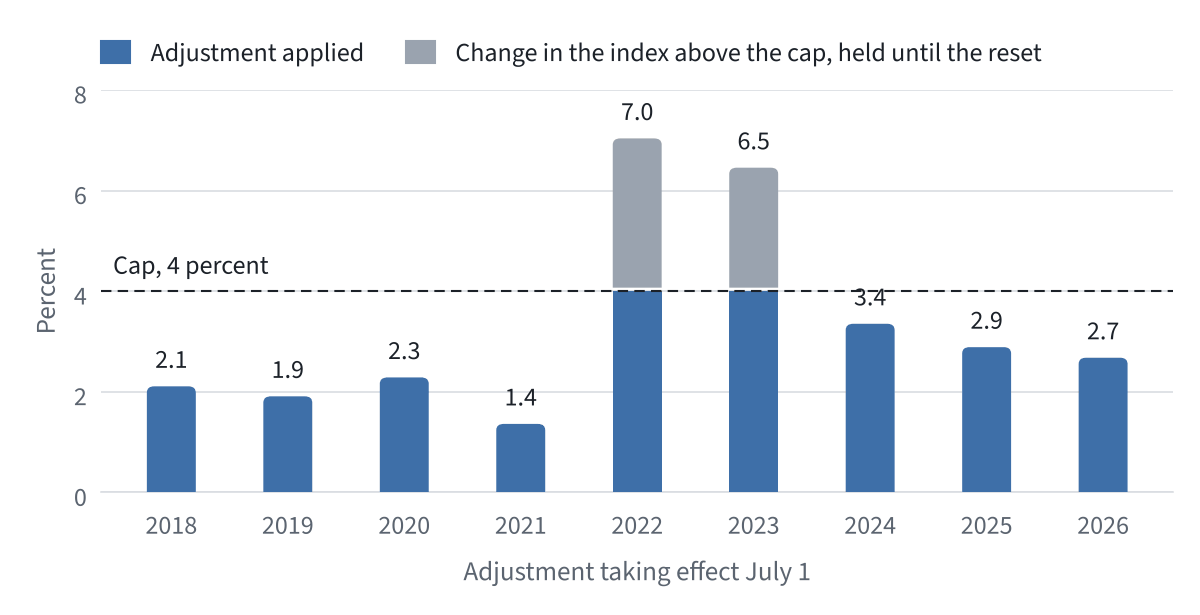
Over the nine adjustments the index rose 34.2 percent. Rent under the policy rose 27.4 percent. The cap held back 3.0 points in 2022 and 2.5 points in 2023, and by July 2026 rent stood 5.1 percent below where the index alone would have put it. The cap protects a tenant from a sharp increase in any one year. The reset in clause 10.2 is what returns the rent to market, so the two terms are designed to work together and neither is adopted without the other.
The Bureau published no index for October 2025 because of the lapse in appropriations that year. A policy that measured from October to October would have had no number to use. Clause 10.7 covers that case.
The second table shows the reset. Ground rent starts at the Schedule rate of $0.45 on July 1, 2026 and the index is assumed to rise 2.5 percent a year. In the first case the 2031 rent study concludes $0.56. In the second it concludes $0.60, which is more than 15 percent above the rent then paid, so clause 10.3 applies.
| Date | Study concludes $0.56 | Study concludes $0.60 | What happens |
|---|---|---|---|
| July 1, 2026 | $0.450 | $0.450 | Schedule rate at commencement |
| July 1, 2027 | $0.461 | $0.461 | Annual adjustment |
| July 1, 2028 | $0.473 | $0.473 | Annual adjustment |
| July 1, 2029 | $0.485 | $0.485 | Annual adjustment |
| July 1, 2030 | $0.497 | $0.497 | Annual adjustment |
| July 1, 2031 | $0.560 | $0.548 | Reset. The second case is 20.8 percent above the 2030 rent, so half takes effect |
| July 1, 2032 | $0.574 | $0.615 | Annual adjustment. In the second case, the balance of the reset with the adjustment |
| July 1, 2033 | $0.588 | $0.630 | Annual adjustment |
Exhibit 17. Ground rent per square foot under Section 10, with a reset in 2031. The index path and the two study conclusions are assumed for illustration. Illustrative figures for a sample airport.
The first reset is 12.7 percent and takes effect at once. The second is phased, and the lessee reaches the full Schedule rate one year later. Because clause 10.5 moves every agreement in a class on the same date, a lessee that signed in 2029 and one that signed in 2026 pay the same rent from July 1, 2031.
33. Evidence behind the Schedule rates
Each rate in the Schedule rests on the method Section 23 names for its category. The table sets the principal rates beside the same charge at the three airports that compete with Wexley Field for based aircraft.
| Rate | Wexley Field Schedule | Corbin Regional | Halverson Executive | Delmar Municipal |
|---|---|---|---|---|
| Aeronautical ground rent, improved land, per square foot per year | $0.45 | $0.42 | $0.62 | $0.28 |
| T-hangar unit, existing buildings, per month | $365 | $395 | $520 | $290 |
| Box hangar, existing buildings, per square foot per year | $9.60 | $10.20 | $14.40 | $7.20 |
| Tiedown, based aircraft, per month | $85 | $80 | $110 | $60 |
| Fuel flowage fee, per gallon | $0.12 | $0.10 | $0.15 | $0.08 |
Exhibit 18. Schedule rates and the same charges at three competing airports, from the rent study. Illustrative figures for a sample airport.
Ground rent was tested a second way, as Section 23 requires. Industrial land near the airport sells for about $7.00 per square foot. At the Authority's 6.50 percent rate that land would earn $0.455 per square foot per year, which supports the $0.45 the comparable leases indicate. Unimproved land, without a taxilane or utilities at the lot line, is set at $0.30.
The hangar rates for existing buildings sit inside the range of the three airports and below the two that are full. The Authority's T-hangars date from 1998 to 2006, and the study adjusted for age and condition. The rates for new buildings, $450 per month for a T-hangar and $12.00 per square foot for a box hangar, reflect what a new unit commands over one that is twenty years old. The Order names condition of facilities as a ground for a different rate, and Section 22 records it.
One piece of evidence points the other way and the Board should have it in front of it. The Authority holds 46 names for 84 T-hangar units and 31 names for six box hangars. A waiting list that persists is a sign that a rate is below the level at which demand and supply meet. Both lists exceed the one quarter threshold in clause 27.6, which is why that clause exists. The firm's paper on hangar waiting lists and FAA rate policy sets out the evidence.
The Order does not require market rent for aeronautical hangars. Paragraph 17.9 lets a sponsor charge for hangars and aviation offices at a level between cost and fair market value. Clause 21.1 is the Authority's choice within that range, and paragraph 17.11 makes fair market value the minimum for non-aeronautical use.
34. Where each federal review question is answered
When the FAA reviews a lease it works through the seven items in paragraph 12.3.b of the Order. The table lists them, with the other paragraphs this document relies on, and shows where each is answered.
| Order 5190.6C | Subject | Where this document answers it |
|---|---|---|
| 12.3.b(1) | Premises | Clause 6.2 requires a site plan. Clause 8.5 defines the area developed |
| 12.3.b(2) | Rights and obligations | Section 14, Section 15 and Section 16 |
| 12.3.b(3) | Term of aeronautical lease | Section 8. Term follows investment, options need Board consent and current rent, and no term exceeds 40 years |
| 12.3.b(4) | Payment of fees to the sponsor | Section 9 and Section 10. Every agreement of more than five years adjusts each year and resets every fifth year |
| 12.3.b(5) | Title | Clause 11.3 vests title in the Authority. Clause 11.7 requires facility rent after it vests |
| 12.3.b(6) | Subordination | Section 18 |
| 12.3.b(7) | Assignment and subleasing | Section 13 |
| 12.3.a(1) | Whether the lease extends an exclusive right | 18.2 and 6.9 |
| 8.8.b | Competitive offerings | 6.8 and 6.9 |
| 9.5.d | Grounds for differing rates | 22.2 and the register in 29.4 |
| 9.5.e | Index adjustment of ground leases | 10.1 |
| 9.7.b | Vacant land | 6.7 |
| 9.10 | Residency preference | 22.3 and 28.7 |
| 17.9 | Aeronautical rates | 21.1 and 21.2 |
| 17.11 | Non-aeronautical rates | 9.3 |
| 18.18(a) | Consistent methodology | 21.6 and Section 23 |
Exhibit 19. Paragraphs of FAA Order 5190.6C and the clauses of this document that answer them. Summaries, not legal advice.
The table is a finding aid. Whether an agreement complies is decided on its own terms and facts, and the sponsor's counsel reviews each one.
Adoption
This is a sample. It has not been adopted by any airport sponsor. A sponsor's counsel reviews a policy of this kind before the board acts on it.
The calendar below shows the steps this document sets for its own adoption and upkeep.
| Step | When | Clause |
|---|---|---|
| Proposed policy and Schedule published | By May 2, 2026, 60 days before the effective date | 27.3 |
| Public comment taken by the Board | Before the Board acts | 27.3 |
| Effective date | July 1, 2026 | |
| First annual adjustment | July 1, 2027, from the change in the index for 2026 | 10.1 |
| Waiting list counts published | Each quarter | Section 28 |
| Register of rate differences reviewed | Each year | 29.4 |
| Hangar use inspected | Each year | Section 14 |
| Rent study commissioned | In time for a new Schedule on July 1, 2031 | 27.2 |
| Interim review of a rate | When a waiting list or vacancy passes the threshold | 27.6 |
Exhibit 20. Adoption and upkeep calendar. Sample provisions.
WEXLEY FIELD AIRPORT AUTHORITY
Sample document. Resolution number and signatures omitted.
About This Sample
Valuation Takes Flight LLC prepares the economic provisions of airport leasing policies and rents and fees policies: term, rent basis, adjustment, reversion, the rate methods, the schedule, and the waiting list terms. The rates in a schedule come from a rent study or a rates and charges study at that airport.
Operating rules, safety requirements and development standards belong to the airport's planning and legal advisers. Dr. Clay W. Carter, DBA, CFA, FRM, CAIA, CIPM, leads each engagement. Nothing in this sample is legal advice.
Addendum A. Authorities and Sources
Paragraph references are to the edition and date shown. Summaries in this document are the firm's and are not legal advice.
- 49 U.S.C. 47107, Project grant application approval conditioned on assurances about airport operations, including subsection (a)(21) on hangar construction. uscode.house.gov
- Federal Aviation Administration. Airport Sponsor Assurances (April 2025): Assurances 5, 22, 23, 24, 25, 29 and 38. faa.gov
- Federal Aviation Administration. Order 5190.6C, Airport Compliance Manual, effective February 20, 2026: paragraphs 8.8.b, 9.5.d, 9.5.e, 9.7.b, 9.10, 12.3.a(1), 12.3.b, 17.9, 17.11 and 18.18(a), and Appendix G, Explanation of Terms. Appendix G at faa.gov. See also what Order 5190.6C changes.
- Ferraiouli-Laborde v. Puerto Rico Ports Authority, FAA Docket No. 16-24-05, Director's Determination (March 13, 2026).
- Federal Aviation Administration. Policy on the Non-Aeronautical Use of Airport Hangars, 81 Fed. Reg. 38906 (June 15, 2016), effective July 1, 2017. govinfo.gov. Summarized at the hangar use policy.
- Federal Aviation Administration. Advisory Circular 150/5190-8, Minimum Standards for Commercial Aeronautical Activities (December 7, 2023). faa.gov
- Federal Aviation Administration. Compliance Guidance Letter 2018-3, Appraisal Standards for the Sale and Disposal of Federally Obligated Airport Property (August 27, 2018, effective September 10, 2018). Summarized at CGL 2018-3.
- U.S. Bureau of Labor Statistics. Consumer Price Index for All Urban Consumers, U.S. city average, all items, not seasonally adjusted, December 2016 through December 2025. bls.gov
- Valuation Takes Flight LLC. Ground lease reversion risk, Hangar waiting lists and FAA rate policy, and The FAA regulations behind airport rents and hangar value.