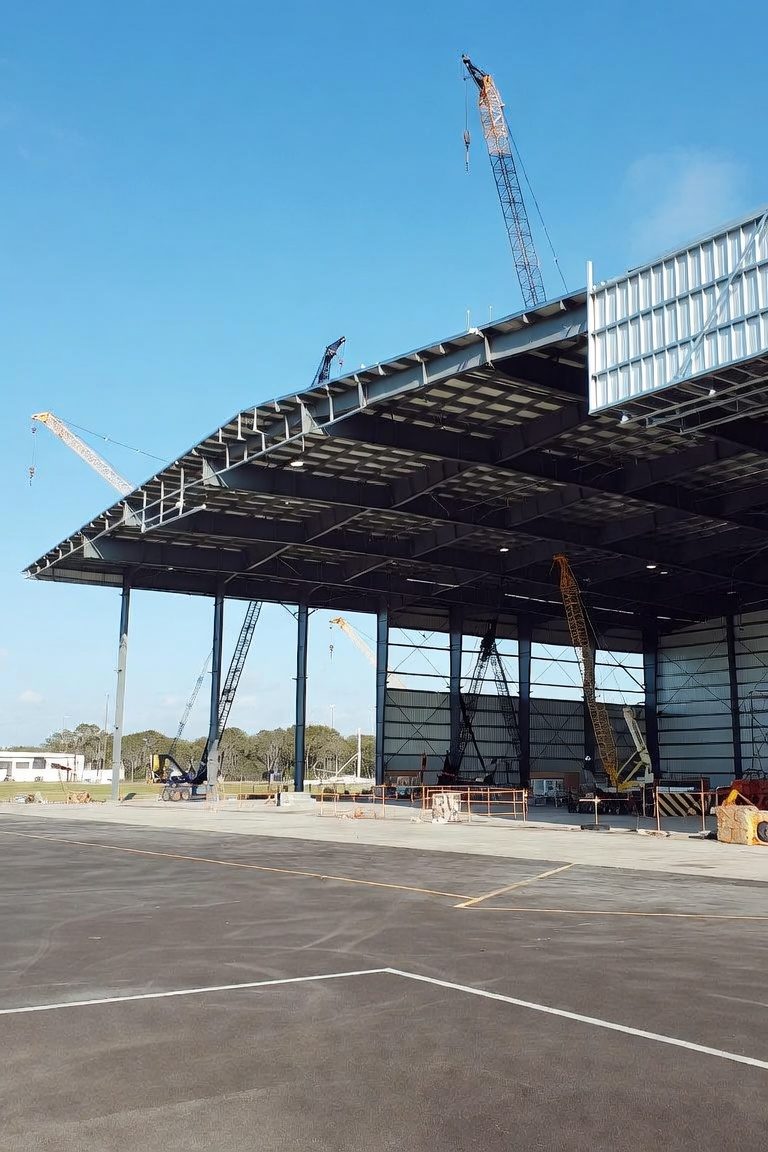
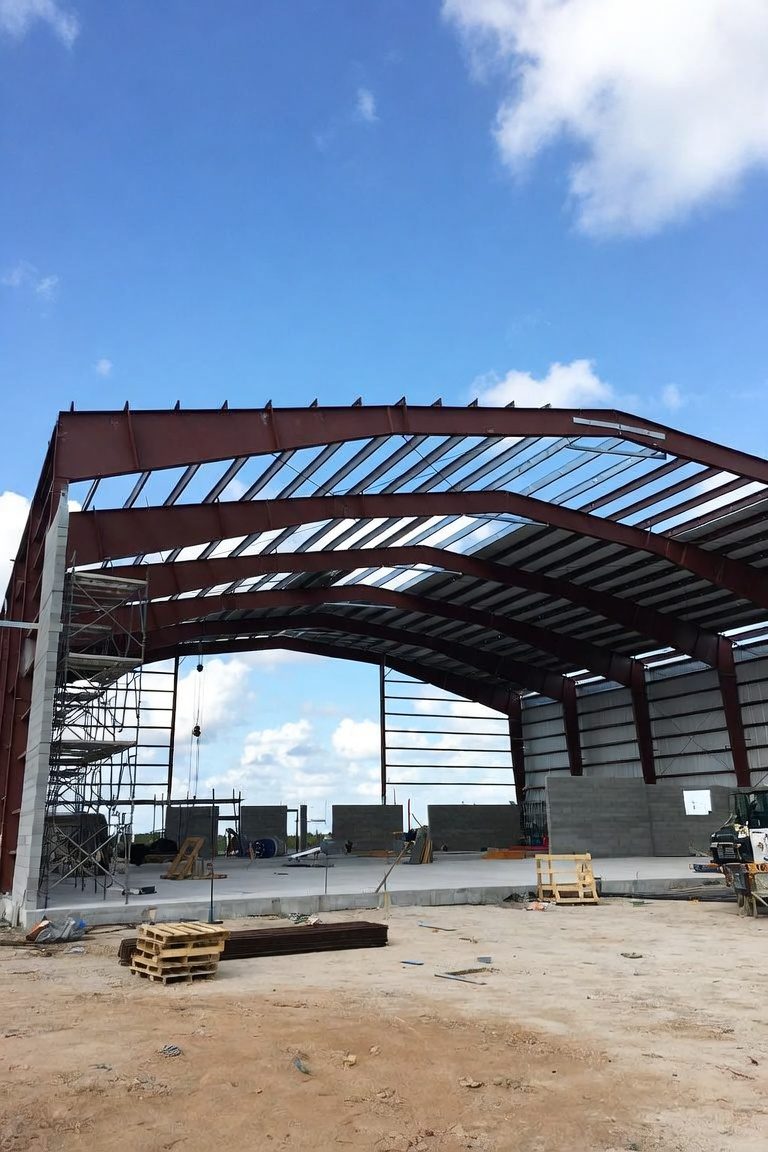
Hangar cost per square foot, by type
For preliminary planning in a typical North American market with standard wind and snow loads, these are the ranges owners see today. "Shell only" is the structure, envelope, and a basic slab; "turnkey" adds the door, systems, and interior needed to actually use the building.
| Hangar type | Typical size | Shell only | Turnkey |
|---|---|---|---|
| T-hangar (single GA) | 2,000-2,600 sq ft | $55-$85 / sq ft | $85-$130 / sq ft |
| Box hangar | 60×60 to 100×100 | $58-$100 / sq ft | $88-$150 / sq ft |
| Corporate / community | 15,000-25,000 sq ft | n/a | $100-$165 / sq ft |
| MRO / specialty | 30,000-60,000+ sq ft | n/a | $120-$220 / sq ft |
Ranges reflect current U.S. planning data compiled from steel-building and hangar-construction sources, cross-checked against vendor door pricing. Your project can fall outside these bands; use them as a starting point, not a quote.
The cost drivers that decide everything
Clear-span width and the door opening
Door width is the silent decision that sets your entire structural strategy. Jumping from a 60-foot to a 100-foot clear opening adds steel weight, stiffens frames, and forces a more expensive door package. Choose the smallest clear opening that still fits your fleet for the next decade; this one choice can move the budget by hundreds of thousands of dollars.
Slab, foundation, and soils
The slab can swing the budget by tens of dollars per square foot. General-aviation storage often uses a 6-to-8-inch slab; heavier tugs and MRO use push you to 8-to-10 inches with doweled joints and isolated door lines. A modest geotechnical study is cheap insurance against a foundation surprise.
Design loads and corrosion
High wind, seismic, and snow zones demand heavier frames. Coastal and corrosive environments justify galvanized members and upgraded coatings. These raise first cost but protect lifespan, inspection outcomes, and insurance.
Hangar door options and cost
After the steel, the door is the largest single line item. Small T-hangar doors run roughly $7,000 to $15,000; a mid-size bifold or hydraulic door (say 58×20) commonly lands between $42,000 and $70,000; and a wide corporate hydraulic door around a 70-foot clear opening can reach $160,000 or more. Bifold doors are reliable and side-clearance-friendly; hydraulic one-piece doors give a full clear opening and fast operation but swing outward and add cost; stacking and sliding panels suit very wide or specialty openings.
Regional multipliers, escalation, and soft costs
Labor and material multipliers swing from about 0.85 to 1.30 across regions, with remote and island sites at the high end. Carry an escalation allowance of roughly 3 to 7 percent per year for planning, and expect steel and door packages to run 10 to 24 weeks of lead time. Soft costs and contingency, design, engineering, permits, and reserve, typically add about 12 percent, and prudent owners carry 15 to 20 percent contingency until a guaranteed maximum price is set.
Worked example budgets
Single-bay T-hangar, 2,400 sq ft: shell, slab, bifold door, basic power and lighting, code fire protection, plus soft costs and contingency, a realistic planning total of roughly $330,000 to $360,000.
Box hangar, 60×120 (7,200 sq ft) with a small office: shell, slab, a ~70-foot hydraulic door, electrical, spot heat and modest office, wet sprinkler, sitework, and soft costs, a blended turnkey range of about $1.44 to $1.65 million (roughly $200 to $230 per square foot).
Corporate hangar, 100×200 (20,000 sq ft) with offices: owners planning for two to four business jets with attached administrative space often land around $4.4 to $5.1 million, or roughly $220 to $255 per square foot.
What it costs to build vs. what it is worth
This is where a valuation perspective changes the picture. Construction cost tells you what you will spend; it does not tell you what you will own. Most hangars are built on airport ground leases, and at expiration the improvements typically revert to the airport authority with no compensation. A hangar that costs $4 million to build can appraise for far less if the ground lease has, say, twelve years left, because value is the present worth of income over the remaining term, not the replacement cost. Before you build, model both. Our free Tools shows what the finished asset would be worth, and our research explains why the two numbers diverge.
Frequently asked
How much does it cost to build an aircraft hangar?
Roughly $55 to $100 per square foot for a shell and $88 to $220 per square foot turnkey, depending on type. A single-bay T-hangar often totals $150,000 to $360,000; a mid-size box hangar $1.4 to $1.7 million; and a 20,000 square foot corporate hangar $4.4 to $5.1 million.
What is the biggest cost in building a hangar?
After the steel structure, the door is usually the largest single line item, from about $10,000 for a small T-hangar door to $160,000 or more for a wide corporate door. Door width also drives the structural design, so it affects far more than its own price.
How much does a 60×60 hangar cost?
A 3,600 square foot box hangar typically runs about $58 to $100 per square foot as a shell and $88 to $150 per square foot turnkey, so roughly $210,000 to $540,000 depending on door, systems, and region.
Is building a hangar a good investment?
It depends far more on the ground lease than on the building. On leased land the improvements usually revert to the airport at lease end, so a hangar can be worth much less than it cost to build. Estimate the finished value with our Hangar Value Estimator before committing capital.