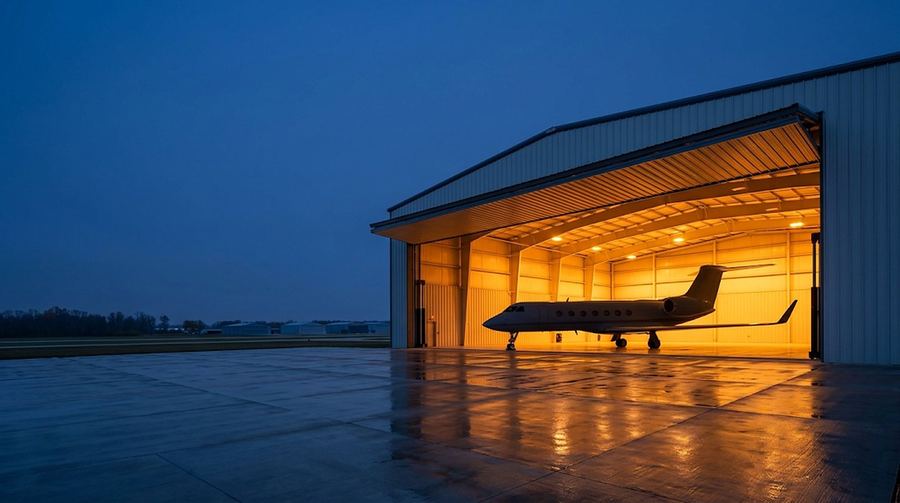
Letter of Transmittal
Re: Hangar 6, Wexley Field. Opinion of market value, leasehold estate.
Dear Mr. and Mrs. Ostrander,
At your request we have inspected the above property and developed an opinion of the market value of your leasehold interest in it. The purpose of the assignment is to support the internal valuation of the LLC in advance of a partner buyout, and you and your counsel are the intended users.
The subject is a 15,000 square foot corporate hangar built in 2013 on a 24,000 square foot ground leasehold at Wexley Field, a general aviation airport. The hangar has a 100 foot by 28 foot bi-fold hydraulic door, 28 feet of clear height, and 2,400 square feet of office and crew space. The ground lease runs to June 30, 2048, which leaves 22.0 years from the effective date, and it provides that the improvements revert to the airport sponsor at expiration. Two five year renewal options exist and require the sponsor to consent.
We developed all three approaches. The cost approach is built at the component level, with external obsolescence extracted from three comparable sales rather than estimated. The sales comparison approach rests on five verified leasehold hangar transactions. The income approach is a discounted cash flow over the remaining lease term, cross checked against direct capitalization. The three indications fall within 1 percent of one another. Based on that analysis, and subject to the assumptions and limiting conditions stated in this report, our opinion of the market value of the leasehold estate as of June 30, 2026 is:
The opinion covers the leasehold estate only. The sponsor holds a separate leased fee position, which we quantify in Section 15 so that both sides of the lease are on the record. Reasonable exposure time is 9 to 15 months. This report is a sample: the property, the parties, and the market data in it are illustrative, assembled to show the format and depth of analysis we deliver, and it is not an opinion of value for any real property.
Respectfully submitted,
VALUATION TAKES FLIGHT LLC
Dr. Carter, DBA, CFA, FRM, CAIA, CIPM
Signature omitted. This is a sample report.
1. Summary of Salient Facts and Conclusions
| Item | Detail |
|---|---|
| Property | Hangar 6, Wexley Field. Corporate box hangar, clear span, single bay |
| Gross building area | 15,000 square feet, 100 feet by 150 feet |
| Clear height | 28 feet to low steel |
| Hangar door | Bi-fold hydraulic, 100 feet wide by 28 feet high |
| Office and crew space | 2,400 square feet within the footprint, including mezzanine |
| Leasehold parcel | 24,000 square feet |
| Apron and taxilane | 12,000 square feet, direct connection to taxiway C |
| Year built | 2013. Chronological age 13 years |
| Interest appraised | Leasehold estate |
| Ground lease | 35 year term from July 1, 2013, expiring June 30, 2048 |
| Remaining term | 22.0 years at the effective date |
| Renewal | Two five year options, subject to sponsor consent |
| Reversion | Improvements revert to the sponsor at expiration |
| Contract ground rent | $9,120 per year, $0.38 per SF of land |
| Concluded market ground rent | $10,800 per year, $0.45 per SF of land |
| Concluded market rent, hangar | $19.50 per SF per year, triple net |
| Net operating income | $230,640 |
| Highest and best use | Continued use as a corporate storage and maintenance hangar |
| Effective date of value | June 30, 2026 |
| Cost approach | $2,219,423 ($147.96 per SF) |
| Sales comparison approach | $2,205,000 ($147.00 per SF) |
| Income approach | $2,199,290 ($146.62 per SF) |
| Opinion of market value, leasehold | $2,200,000 ($146.67 per SF) |
| Sponsor leased fee position | $284,517 |
| Insurable value, replacement cost | $3,450,700 |
| Exposure time | 9 to 15 months |
Illustrative figures for a sample property.
2. Scope of the Assignment
Purpose and intended use
The purpose of the assignment is to develop an opinion of the market value of the leasehold estate. The intended use is to support the internal valuation of the ownership entity in advance of a partner buyout. The intended users are the client and the client's counsel. No other party is an intended user.
Property rights appraised
We appraised the leasehold estate, which is the interest held by the tenant under the ground lease. It is not a fee simple interest. The tenant does not own the land, cannot convey the land, and will not own the improvements after June 30, 2048. This distinction is not a formality. It sets the terminal value in the income approach, it requires comparable sales that were themselves leasehold transfers, and it raises the rate at which the income is discounted.
Definitions
Market value. The most probable price a property should bring in a competitive and open market under all conditions requisite to a fair sale, the buyer and seller each acting prudently and knowledgeably, and assuming the price is not affected by undue stimulus. We apply the definition published at 12 C.F.R. Part 34, Subpart C.
Market rent. The most probable rent a property should bring in a competitive and open market under all conditions requisite to a fair lease. Rent in this report is stated on a triple net basis for a five year term.
Leasehold and leased fee. The leasehold is the tenant's interest for the lease term. The leased fee is the lessor's interest, being the right to contract rent and the right to the reversion.
Exposure time. The time the property would have been offered before a sale at the concluded value on the effective date. It is an opinion, and it conditions the value opinion.
What we did
We inspected the interior and exterior of the improvements and the leasehold parcel on June 24, 2026, measured the door opening and clear height, photographed the property, and walked the apron and taxilane connection. We read the ground lease in full, together with the sponsor's minimum standards, the rates and charges schedule, and the airport layout plan. We obtained based aircraft counts, operations, and the sponsor's hangar waiting list from airport management. We confirmed five hangar sales and five hangar rents with a party to the transaction or with the sponsor, and we verified the remaining ground lease term at each sale against the sponsor's lease record. We developed construction cost from a published cost service, a current door system quotation, and two recent hangar construction contracts in the region.
What we did not do
We did not perform an environmental site assessment, a structural or mechanical engineering study, a survey, or an accessibility compliance survey. We did not value personal property, aircraft, ground support equipment, or tenant trade fixtures, and we did not value the operating business of any occupant.
Standards
We prepare our reports to be transparent, reproducible, and reviewable. Every conclusion in this report is traceable to a schedule in it. Where an intended use requires a state certified general appraiser, which includes federally related transactions and many tax and litigation uses, we identify that at the proposal stage and scope the engagement accordingly.
3. Assumptions and Limiting Conditions
General
- Title is assumed marketable. No title search was performed.
- Information supplied by others was reviewed for reasonableness but not audited.
- No survey was performed. Areas are taken from the lease exhibit and the site plan.
- The property is assumed free of hazardous materials, including per and polyfluoroalkyl substances associated with legacy firefighting foam. No environmental assessment was provided.
- Structural, mechanical, and door systems are assumed to be in the condition observed.
- The improvements are assumed to conform to the airport layout plan and to the sponsor's minimum standards.
- Possession of this report conveys no right to publish it or to use it in any proceeding.
Extraordinary assumptions
E-1. The ground lease provided to us is assumed to be the complete and current agreement, with no side letters or amendments that modify the reversion clause, the assignment provisions, or the rent adjustment mechanism. The reversion clause sets the terminal value in the income approach. If a side agreement provides for compensation at reversion, our conclusion would change.
E-2. The hydraulic door system is assumed operable and to have received the manufacturer's recommended service. We observed the door in the open and closed positions. Cylinder and seal condition were not tested.
Hypothetical conditions
None. The property is analyzed as it exists at the effective date, subject to the actual lease terms.
The two extraordinary assumptions above are the ones that carry money. If either turns out to be wrong, the value changes, and we would rather flag that plainly at the front than bury it in an addendum.
4. How We Value Hangars
Hangars are not warehouses with airplanes in them. Our method reflects four things we have found decide the number on nearly every hangar assignment we take.
The lease is the asset
On leased airport land the tenant owns a wasting interest. Most airport ground leases return the improvements to the sponsor at expiration, so the tenant's ownership has an end date and no residual. We read the lease before we look at a comparable, we abstract it clause by clause, and we carry the reversion into the terminal value rather than mentioning it and then capitalizing income as if it ran forever. A hangar with 22 years left and a hangar with 40 years left are different assets even when the steel is identical.
The door decides who rents the building
Floor area is a weak proxy for hangar value. What a tenant is buying is a door width, a door height, and a clear span, because those three dimensions decide which aircraft fits. Two buildings of the same square footage at the same airport can differ in rent by several dollars a foot because one accepts a large cabin aircraft and the other does not. We measure the opening on every inspection and we price it separately.
Depreciation belongs at the component level
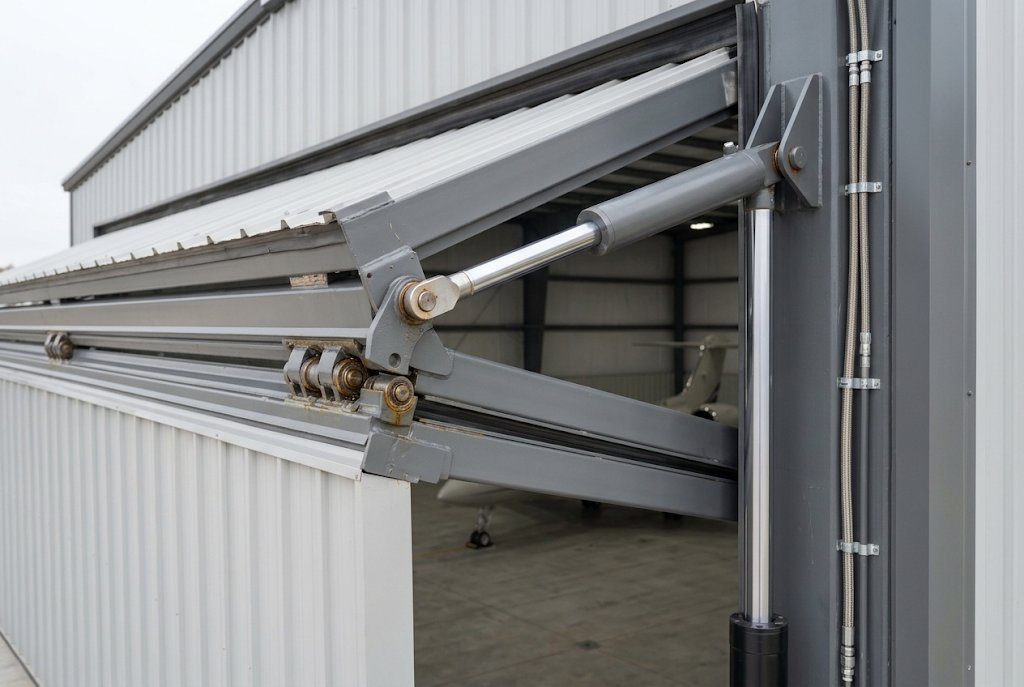
A bi-fold hydraulic door is a mechanical assembly of cylinders, pumps, valves, hinges, and seals with an economic life roughly half that of the shell it hangs on, and on this subject it is 12.3 percent of direct construction cost. Applying one age to life ratio to the whole building understates depreciation on the door and mechanical systems while overstating it on the shell and the slab. We break the improvement into its major systems and depreciate each on its own life.
The airport is the market
The relevant market for a hangar is the set of fields a based aircraft owner would actually consider, which is usually three to six airports within a reasonable drive. Runway length, instrument approach, fuel, fleet mix, and the length of the hangar waiting list explain more about hangar value than metropolitan industrial vacancy ever will. We collect that evidence from the sponsor rather than from a regional market report.
A hangar on a federally obligated airport also sits inside a regulatory frame. The sponsor must keep a fee and rental structure that makes the airport as self sustaining as possible, aeronautical charges must be reasonable, and federal policy limits what may lawfully occupy a hangar. That last point matters to value: the alternative uses that support a conventional industrial building are not available here, and the rate we apply reflects it.
5. Wexley Field and the Hangar Market
Wexley Field is a general aviation airport with one 6,000 foot primary runway, a full parallel taxiway, a precision instrument approach, one fixed base operator, and both jet A and 100LL. It has no air carrier service. It is a federally obligated airport.
The competitive set below is the group of fields a based turbine operator in this market would actually consider. It is the evidence behind the vacancy assumption in the income approach and behind the airport tier adjustments in the sales grid.
| Airport | Role | Longest runway | Based aircraft | Turbine based | Hangar waiting list | Ground rent per SF |
|---|---|---|---|---|---|---|
| Wexley Field (subject) | General aviation reliever | 6,000 ft | 186 | 39 | 31 names, box hangars | $0.45 |
| Corbin Regional | General aviation | 5,400 ft | 152 | 24 | 14 names | $0.41 |
| Halverson Executive | Corporate emphasis | 7,100 ft | 171 | 58 | 44 names | $0.58 |
| Delmar Municipal | Basic general aviation | 4,300 ft | 88 | 6 | None | $0.26 |
Exhibit 1. Competitive airport set. Illustrative figures for a sample property.
Demand exceeds supply at three of the four fields. Halverson, with longer pavement and a heavier turbine population, commands higher ground rent and higher hangar rent, which is why comparable sale 3 required a downward tier adjustment. Delmar is not a substitute for a turbine operator, which is why comparable sale 4 required the largest upward adjustment in the grid.
Supply pipeline
Two box hangars totaling 30,000 square feet are under construction at Halverson with delivery expected inside 18 months. Nothing is under construction or permitted at Wexley Field. The subject's 28 foot opening is current generation and is matched by the new Halverson product, so no functional deduction for door height is warranted here.
6. The Ground Lease
We abstract the lease before we value anything, because the lease determines what the client actually owns and for how long.
| Provision | Terms | Effect on value |
|---|---|---|
| Parties | Wexley Field Airport Authority as lessor. Ostrander Aviation Holdings LLC as lessee. | Sponsor is a federally obligated public agency, so the compliance frame applies. |
| Premises | 24,000 square feet described by the lease exhibit, with non exclusive taxilane access. | Airside access is by easement and is not perpetual. Value depends on it. |
| Term | 35 years from July 1, 2013, expiring June 30, 2048. | 22.0 years remain. This sets the cash flow horizon. |
| Renewal | Two five year options, exercisable 24 months before expiration, subject to lessor consent not to be unreasonably withheld, at rent then prevailing. | Consent conditioned, and the rent is unfixed. Credited at zero in the cash flow and tested separately. |
| Rent | $0.38 per SF of land per year, $9,120 annually, adjusted every third year by CPI, capped at 3.0 percent per adjustment. | Below the concluded market rate of $0.45. Worth $16,020 over the remaining term, captured once. |
| Use | Aircraft storage, maintenance, and directly related activity. Non aeronautical use prohibited without written consent. | Alternative use is foreclosed. Part of the reason the leasehold carries a rate premium. |
| Assignment | No assignment or sublease of the whole without lessor's prior written consent. Leasehold mortgage permitted with notice and lender cure rights. | Consent narrows the buyer pool and lengthens exposure. Cure rights are what make leasehold financing possible. |
| Maintenance and insurance | Lessee maintains the premises and improvements and carries liability and property coverage naming lessor as additional insured. | Supports the triple net rent structure used in the income approach. |
| Reversion | All improvements become the property of lessor at expiration without payment or allowance. | Terminal value of the leasehold is zero. The single largest input in the valuation. |
Exhibit 2. Ground lease abstract. Illustrative figures for a sample property.
Pricing the reversion
We set the terminal value in the income approach to zero because that is what the lease requires. The effect is visible in the arithmetic. Of the $2,535,608 this income stream would be worth over a 40 year horizon, the 22 year leasehold captures $2,199,290, or 86.7 percent. The balance belongs to the sponsor, and the sponsor pays nothing for it. Section 12 shows how that share moves as the term runs down.
7. Site and Improvements
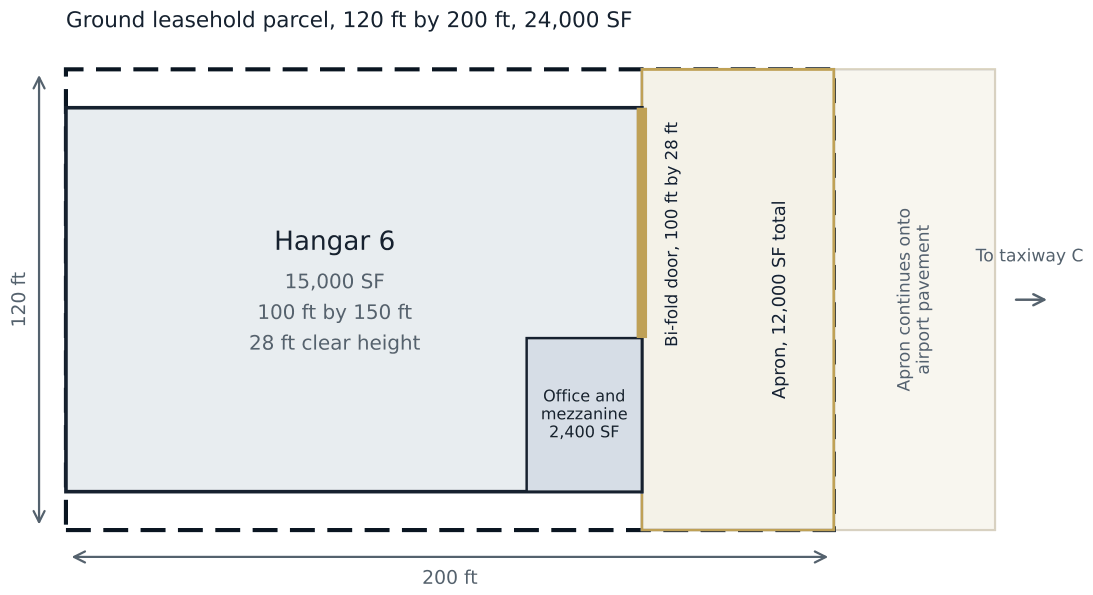
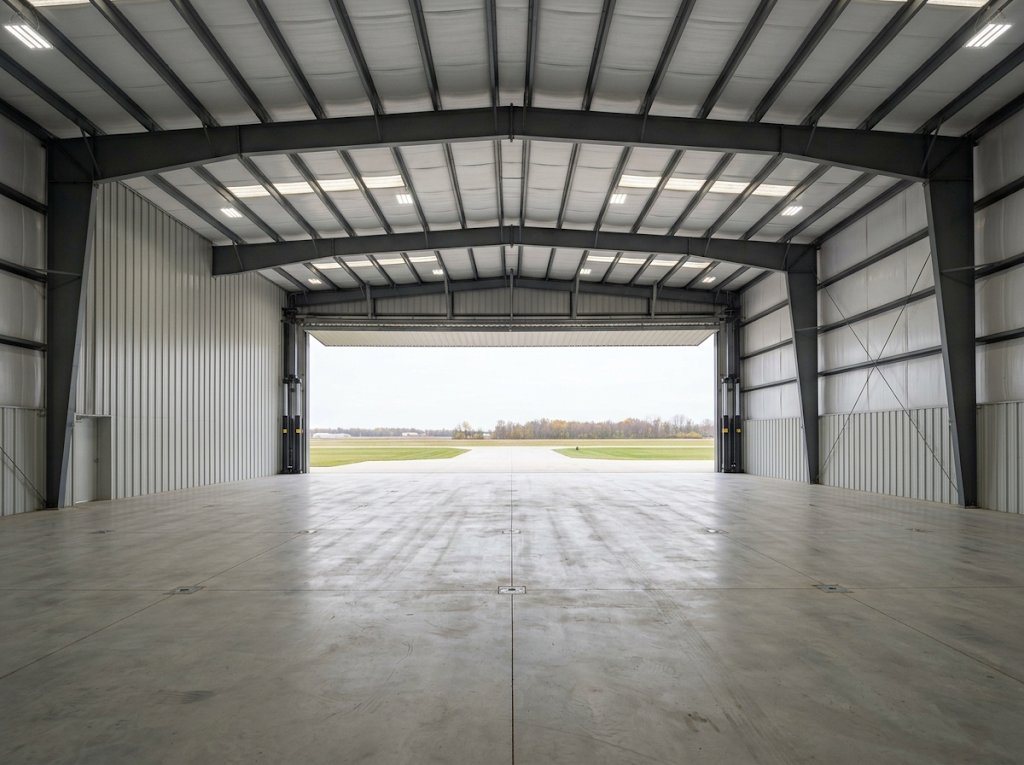
The leasehold parcel contains 24,000 square feet, is rectangular at 120 feet of frontage by 200 feet of depth, fronts taxiway C with direct airside access, and is level and at grade with the apron. Landside access is by a shared service road under a non exclusive easement described in the lease exhibit. Utilities are supplied by the sponsor.
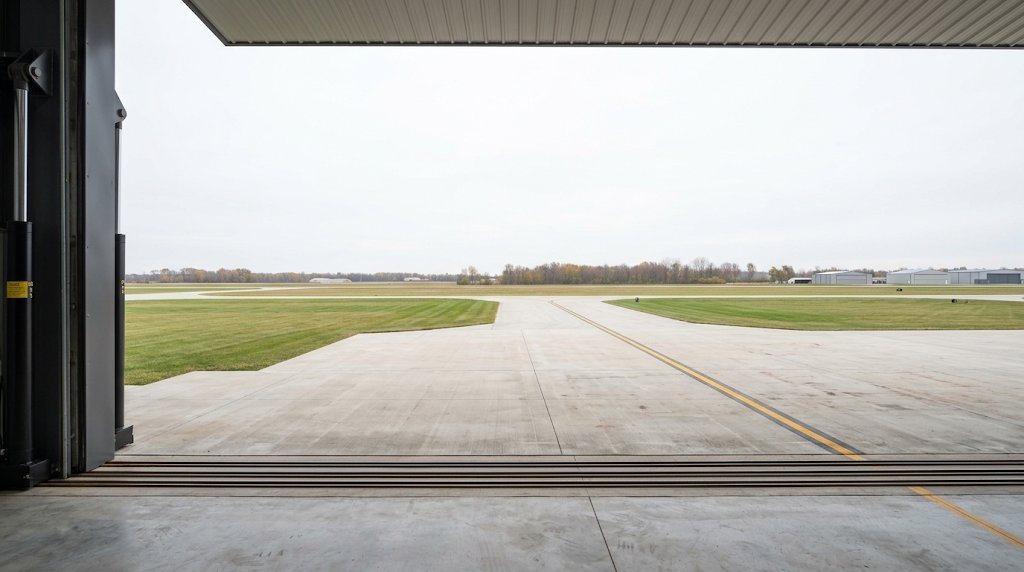
The apron serving the hangar contains 12,000 square feet. Roughly half of it lies inside the leasehold boundary and the balance is airport pavement the lease grants the tenant the right to use. The tenant built and maintains the whole of it, so the cost approach carries the full 12,000 square feet as an improvement.
| Component | Detail |
|---|---|
| Structure | Pre-engineered rigid steel frame, clear span, single bay |
| Gross building area | 15,000 square feet, 100 feet wide by 150 feet deep |
| Clear height | 28 feet to low steel, 28 feet at the door opening |
| Door system | Bi-fold hydraulic, 100 feet wide by 28 feet high, four lift cylinders, on a 12 month service interval |
| Floor | 12 inch reinforced concrete slab, sealed, rated for the design aircraft |
| Office and crew space | 2,400 square feet. Two offices, crew lounge, restrooms, and mezzanine storage |
| Heating and air | Gas fired radiant tube in the bay, packaged units serving the office, compressed air distribution |
| Fire protection | Addressable detection and high expansion suppression, installed 2013, serviced 2025 |
| Electrical | 600 amp three phase, LED high bay, aircraft ground power outlet |
| Apron | 12,000 square feet of concrete with a direct taxiway C connection |
| Condition | Good. Effective age is assessed system by system in Section 9. |
Exhibit 5. Improvement summary.
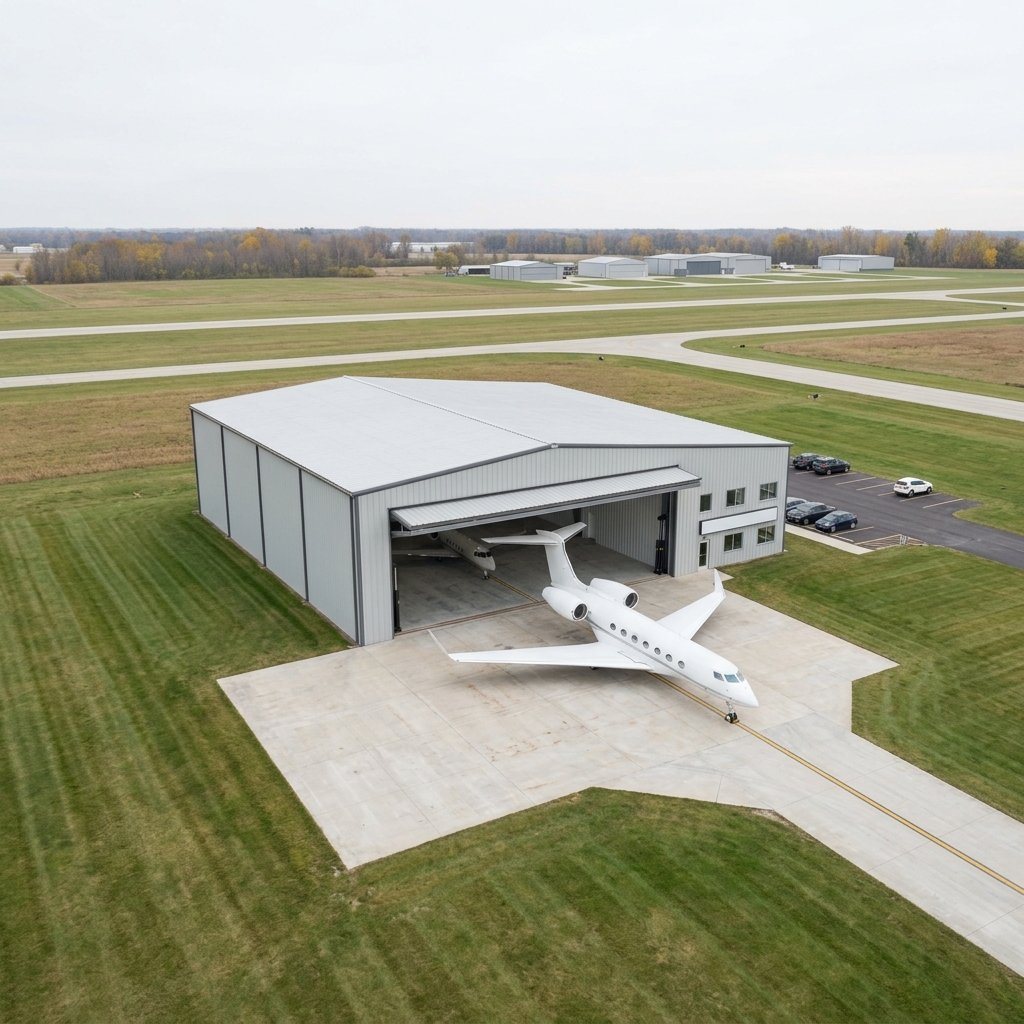
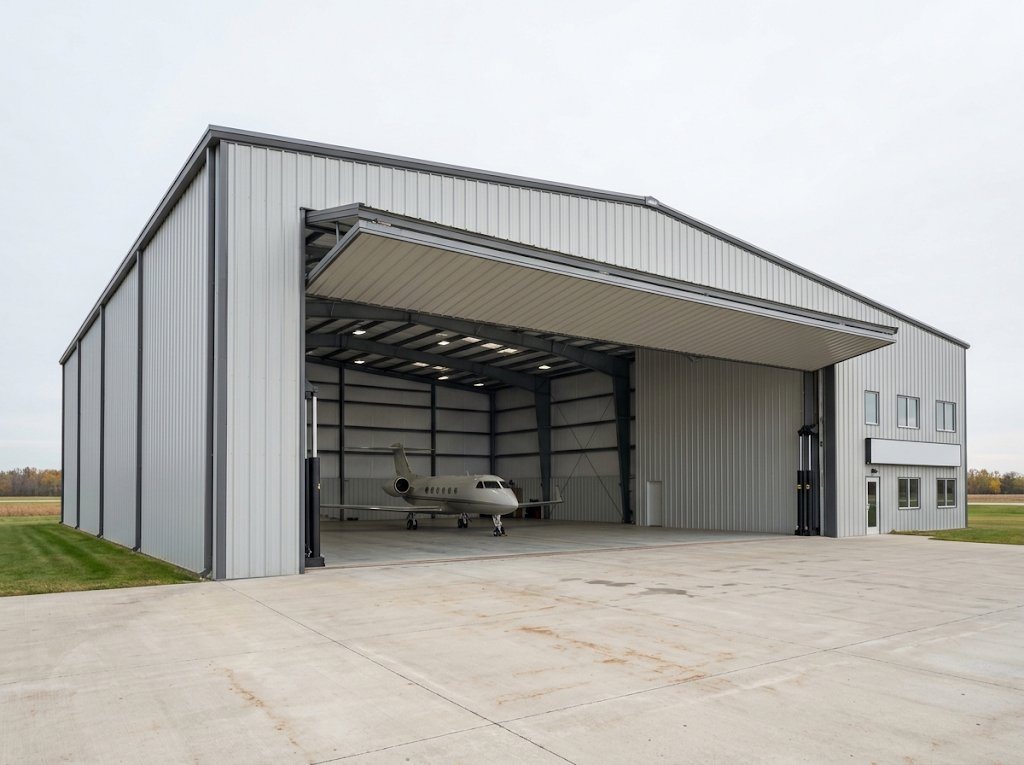
At 100 feet of clear opening and 28 feet of height the subject accepts the large cabin business jets that drive rent at this field. That is the single most important physical fact about the building, and it is why we do not lead with a dollar per square foot figure.
Subject photographs
Photographs are the record of the condition assumed in the depreciation analysis. We photograph the exterior elevations, the door in both positions, the interior bay, the slab, the door mechanism, the mechanical and fire equipment, the office, and the apron connection on every inspection. They are what a reviewer uses two years later to test whether the effective ages we applied were reasonable. The four below were taken on the morning of the inspection.
8. Highest and Best Use
As vacant
Legally permissible. The lease restricts the premises to aircraft storage, maintenance, and directly related activity. The sponsor's minimum standards and the airport layout plan permit a conventional hangar on this parcel. Federal policy limits non aeronautical occupancy of hangars. The permissible set is aviation use.
Physically possible. The parcel is level, at grade with the apron, has taxilane frontage, and is served by utilities. At 24,000 square feet it supports a footprint of roughly 15,000 to 16,000 square feet once setbacks and the apron inside the boundary are allowed for.
Financially feasible. Waiting lists at three of four fields in the competitive set and market rent of $19.50 per square foot triple net support new construction where the ground lease term is long enough to amortize it. At 22.0 years remaining the parcel would not support a new building today. On a fresh 35 year lease it would.
Maximally productive. A conventional box hangar with an opening tall and wide enough for the current turbine fleet, on a term long enough to finance.
Conclusion as vacant. Development with a corporate box hangar under a new long term ground lease.
As improved
The improvements are legally conforming, in good condition, and generate income that exceeds the return available from the site in any permitted alternative. Demolition is not indicated. Conversion is foreclosed by the lease and by federal policy.
Conclusion as improved. Continued use as a corporate aircraft storage and maintenance hangar through the remaining lease term.
9. Cost Approach
Replacement cost new
Costs are developed by component from a published cost service, a current quotation for the door system, and two recent hangar construction contracts in the region. We use the component structure rather than a single square foot rate because the door and the mechanical systems behave differently from the shell over time, and because it lets a reader test any line.
| Component | Quantity | Unit | Unit cost | Replacement cost new |
|---|---|---|---|---|
| Pre-engineered rigid steel frame, roof, and wall panel | 15,000 | SF | $132.00 | $1,980,000 |
| Foundation, footings, and 12 inch reinforced slab | 15,000 | SF | $26.00 | $390,000 |
| Bi-fold hydraulic door, 100 ft by 28 ft | 1 | LS | $465,000.00 | $465,000 |
| Office, crew quarters, restrooms, and mezzanine | 2,400 | SF | $110.00 | $264,000 |
| Radiant heat, ventilation, and compressed air | 1 | LS | $118,000.00 | $118,000 |
| Fire detection and high expansion suppression | 1 | LS | $186,000.00 | $186,000 |
| Electrical service, distribution, and LED high bay | 1 | LS | $124,000.00 | $124,000 |
| Apron, taxilane connection, and tiedowns | 12,000 | SF | $16.00 | $192,000 |
| Site utilities, grading, drainage, and fencing | 1 | LS | $74,000.00 | $74,000 |
| Direct cost subtotal | $3,793,000 | |||
| Indirect cost at 10 percent, design, permits, and construction financing | $379,300 | |||
| Entrepreneurial incentive, none applied | $0 | |||
| Total replacement cost new | $4,172,300 |
Exhibit 6. Replacement cost new, $278.15 per square foot. Illustrative figures for a sample property.
We apply no entrepreneurial incentive. Incentive is the reward that motivates a developer to build, and highest and best use as vacant established that no developer would build this building on a 22 year remaining term. Carrying an incentive line here would import a profit the market will not pay.
Physical depreciation, by component
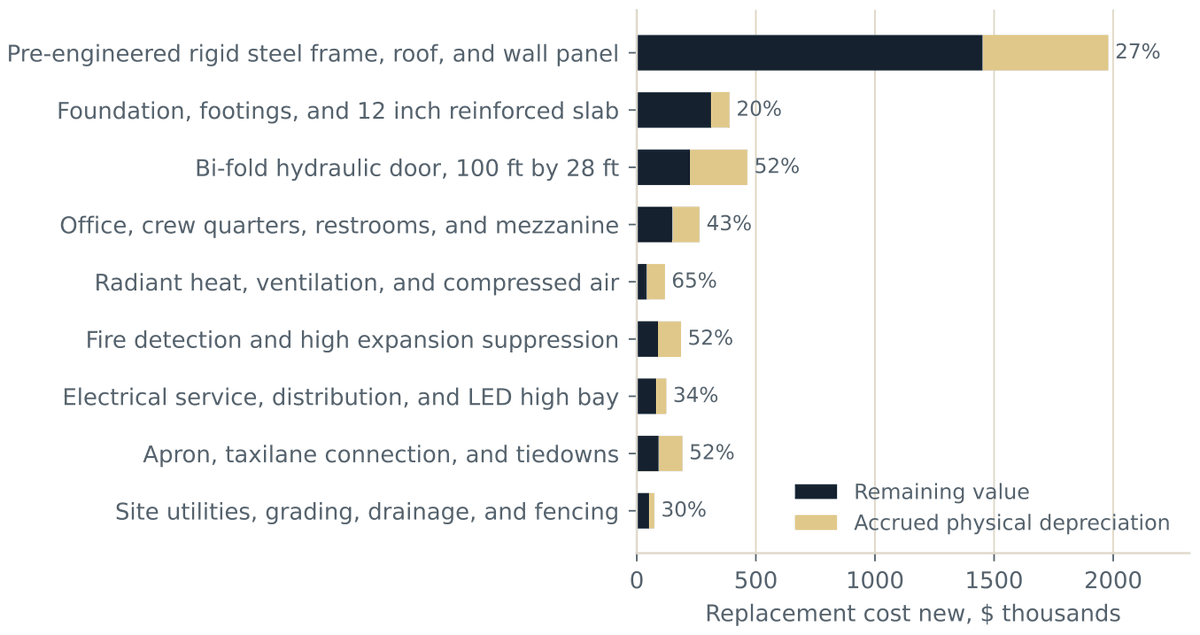
Each system carries its own effective age and economic life. Effective age reflects condition and maintenance rather than the calendar, which is why the shell and the slab on this 13 year old building carry an effective age of 12 while the door and mechanical systems carry 13.
| Component | Cost new | Effective age | Economic life | Depreciation | Accrued | Remaining value |
|---|---|---|---|---|---|---|
| Pre-engineered rigid steel frame, roof, and wall panel | $1,980,000 | 12 | 45 | 26.7 pct | $528,000 | $1,452,000 |
| Foundation, footings, and 12 inch reinforced slab | $390,000 | 12 | 60 | 20.0 pct | $78,000 | $312,000 |
| Bi-fold hydraulic door, 100 ft by 28 ft | $465,000 | 13 | 25 | 52.0 pct | $241,800 | $223,200 |
| Office, crew quarters, restrooms, and mezzanine | $264,000 | 13 | 30 | 43.3 pct | $114,400 | $149,600 |
| Radiant heat, ventilation, and compressed air | $118,000 | 13 | 20 | 65.0 pct | $76,700 | $41,300 |
| Fire detection and high expansion suppression | $186,000 | 13 | 25 | 52.0 pct | $96,720 | $89,280 |
| Electrical service, distribution, and LED high bay | $124,000 | 12 | 35 | 34.3 pct | $42,514 | $81,486 |
| Apron, taxilane connection, and tiedowns | $192,000 | 13 | 25 | 52.0 pct | $99,840 | $92,160 |
| Site utilities, grading, drainage, and fencing | $74,000 | 12 | 40 | 30.0 pct | $22,200 | $51,800 |
| Direct cost subtotal | $3,793,000 | 34.3 pct | $1,300,174 | $2,492,826 | ||
| Indirect cost, at the weighted rate | $379,300 | 34.3 pct | $130,017 | $249,283 | ||
| Total | $4,172,300 | $1,430,192 | $2,742,108 |
Exhibit 7. Component depreciation schedule. Illustrative figures for a sample property.
External obsolescence, extracted from the market
Depreciated cost overstates what a leasehold hangar sells for, and the difference is external to the building. It comes from the finite term, the sponsor's consent right on transfer, the prohibition on alternative use, and the narrower pool of lenders who will advance against a leasehold. Rather than estimate that difference, we extract it from sales. For three of our five comparables we developed a cost estimate on the same basis we used for the subject and compared it to the price actually paid.
| Sale | Cost new per SF | Effective age | Physical depreciation | Depreciated cost per SF | Remaining term | Term factor | Indicated before external | Adjusted price per SF | Indicated external obsolescence |
|---|---|---|---|---|---|---|---|---|---|
| 1 | $252.00 | 10 yrs | 25.0 pct | $189.00 | 26 yrs | 0.9905 | $187.20 | $154.54 | 17.4 pct |
| 3 | $268.00 | 7 yrs | 17.5 pct | $221.10 | 30 yrs | 1.0124 | $223.84 | $185.30 | 17.2 pct |
| 5 | $258.00 | 12 yrs | 30.0 pct | $180.60 | 21 yrs | 0.9456 | $170.77 | $146.00 | 14.5 pct |
Exhibit 9. External obsolescence extracted from comparable sales. Illustrative figures for a sample property.
The three sales indicate 14.5 percent to 17.4 percent. We conclude 16 percent, which is near the middle of the extracted range and closest to sale 1, the transaction most similar to the subject in term and configuration.
Leasehold term adjustment
Depreciated cost measures the improvements over their remaining economic life, which is 27.5 years on a cost weighted basis. Our client has the use of them for 22.0 years. The adjustment is the ratio of the present value annuity factor for 22.0 years to the factor for 27.5 years, both at 11.50 percent, or 7.9027 divided by 8.2612, which is 0.9566.
| Line | Amount |
|---|---|
| Total replacement cost new | $4,172,300 |
| Less accrued physical depreciation | ($1,430,192) |
| Depreciated replacement cost | $2,742,108 |
| Less external obsolescence at 16 percent | ($438,737) |
| Depreciated cost of the improvements | $2,303,371 |
| Leasehold term adjustment, factor 0.9566 | x 0.9566 |
| Improvement contribution to the leasehold | $2,203,404 |
| Plus present value of the below market ground rent | $16,020 |
| Cost approach indication | $2,219,423 |
| Indicated value per square foot | $147.96 |
Exhibit 10. Cost approach summary. Illustrative figures for a sample property.
10. Sales Comparison Approach
We analyzed five hangar transactions. All five were transfers of a leasehold interest on an airport ground lease, which is the first requirement. A fee simple industrial sale is not a comparable for this property no matter how close it sits, because the rights conveyed are different and that difference cannot be adjusted away credibly. Each sale was confirmed with a party to the transaction or with the sponsor, and the remaining term at the date of sale was verified against the sponsor's lease record.
| Sale | Airport | Building area | Sale date | Price | Price per SF | Term at sale | Door height | Effective age |
|---|---|---|---|---|---|---|---|---|
| 1 | Wexley Field | 13,800 SF | 9 months prior | $2,095,000 | $151.81 | 26 yrs | 28 ft | 10 yrs |
| 2 | Corbin Regional | 17,600 SF | 6 months prior | $2,262,000 | $128.52 | 18 yrs | 26 ft | 15 yrs |
| 3 | Halverson Executive | 15,400 SF | 4 months prior | $2,831,000 | $183.83 | 30 yrs | 30 ft | 7 yrs |
| 4 | Delmar Municipal | 11,900 SF | 20 months prior | $1,406,000 | $118.15 | 15 yrs | 26 ft | 17 yrs |
| 5 | Corbin Regional | 14,600 SF | 8 months prior | $2,098,000 | $143.70 | 21 yrs | 28 ft | 12 yrs |
| Subj | Wexley Field | 15,000 SF | Effective date | 22.0 yrs | 28 ft | 12 yrs |
Exhibit 11. Comparable leasehold hangar sales. Illustrative figures for a sample property.
Adjustment rates
We publish the rates rather than the percentages alone, so that a reader can test them. On a live engagement each rate is supported by paired sales and by market participant interviews, and that support sits in the workfile.
| Element | Rate applied | Direction |
|---|---|---|
| Market conditions | 2.4 percent per year | Upward for older sales |
| Remaining ground lease term | 0.9 percent per year of difference | Downward when the sale has a longer term |
| Door height | 2.8 percent per foot of difference | Downward when the sale has a taller door |
| Building size | 0.5 percent per 1,000 SF of difference | Upward when the sale is larger |
| Effective age | 0.5 percent per year of difference | Upward when the sale is older |
| Airport tier and condition | Stated per sale | Both directions |
Exhibit 12. Adjustment rates. Illustrative figures for a sample property.
Adjustment grid
| Element | Sale 1 | Sale 2 | Sale 3 | Sale 4 | Sale 5 |
|---|---|---|---|---|---|
| Price per square foot | $151.81 | $128.52 | $183.83 | $118.15 | $143.70 |
| Market conditions | +1.8 pct | +1.2 pct | +0.8 pct | +4.0 pct | +1.6 pct |
| Time adjusted price per SF | $154.54 | $130.06 | $185.30 | $122.88 | $146.00 |
| Remaining ground lease term | -3.6 pct | +3.6 pct | -7.2 pct | +6.3 pct | +0.9 pct |
| Door height | 0 | +5.6 pct | -5.6 pct | +5.6 pct | 0 |
| Building size | -0.6 pct | +1.3 pct | +0.2 pct | -1.6 pct | -0.2 pct |
| Effective age | -1.0 pct | +1.5 pct | -2.5 pct | +2.5 pct | 0 |
| Airport tier | 0 | 0 | -2.5 pct | +2.0 pct | 0 |
| Condition | -1.0 pct | +1.0 pct | -2.0 pct | +1.5 pct | 0 |
| Net adjustment | -6.2 pct | +13.0 pct | -19.6 pct | +16.4 pct | +0.7 pct |
| Gross adjustment | 6.2 pct | 13.0 pct | 20.0 pct | 19.4 pct | 1.1 pct |
| Adjusted price per square foot | $144.96 | $146.97 | $148.98 | $142.97 | $147.02 |
Exhibit 13. Adjustment grid. Illustrative figures for a sample property.
Conclusion
The adjusted indications run from $142.97 to $148.98 per square foot with a mean of $146.18. Sale 5 carries the smallest gross adjustment at 1.1 percent, sits at a competing field in the same submarket, and matches the subject on door height and closely on remaining term. It receives the greatest weight. Sale 1 is at the subject airport and corroborates it. Sales 3 and 4 bracket the range from above and below and required the largest gross adjustments, at 20.0 percent and 19.4 percent, which is itself a comment on how comparable they are.
Sales comparison indication: $2,205,000, or $147.00 per square foot.
11. Income Approach
Market rent
We survey hangar rent the way a standalone rent study surveys it, stating the rate together with its structure, term, escalation, and expense responsibility. A rate quoted without its structure is not comparable to anything, and gross and net quotes for the same building can differ by several dollars a foot.
| Comparable | Airport | Area | Door height | Rate per SF per year | Structure | Comment |
|---|---|---|---|---|---|---|
| R-1 | Wexley Field | 13,800 SF | 28 ft | $16.80 | 5 yr NNN | Subject airport, newer office build out |
| R-2 | Wexley Field | 16,200 SF | 26 ft | $15.60 | 5 yr NNN | Subject airport, shorter door |
| R-3 | Halverson Executive | 15,000 SF | 30 ft | $18.40 | 7 yr NNN | Superior field and door height |
| R-4 | Corbin Regional | 14,600 SF | 28 ft | $16.35 | 5 yr NNN | Direct configuration match |
| R-5 | Delmar Municipal | 12,400 SF | 24 ft | $13.90 | 3 yr NNN | Inferior field, limits fleet |
| Subj | Wexley Field | 15,000 SF | 28 ft | $19.50 | 5 yr NNN | Concluded market rent |
Exhibit 14. Hangar rent comparables. Illustrative figures for a sample property.
The five rents run from $13.90 to $18.40 per square foot triple net. Two are at the subject airport. R-1 at $16.80 has newer office finishes than the subject and sets the upper bound. R-2 at $15.60 has a 26 foot opening that excludes part of the fleet the subject accepts and sets the lower bound. R-4 at Corbin is the closest configuration match. We conclude $19.50 per square foot per year, triple net, on a five year term.
Stabilized operating statement
| Line | Basis | Amount |
|---|---|---|
| Potential gross income | 15,000 SF at $19.50 per SF, triple net | $292,500 |
| Less vacancy and collection loss | 5 percent of potential gross income | ($14,625) |
| Effective gross income | $277,875 | |
| Ground rent | Contract rate under the lease | ($9,120) |
| Property and liability insurance | $0.85 per SF of building area | ($12,750) |
| Management | 4 percent of effective gross income | ($11,115.00) |
| Reserves for replacement | $0.40 per SF, weighted toward the door system | ($6,000) |
| Repairs and maintenance | $0.55 per SF of building area | ($8,250) |
| Total operating expenses | 17.0 percent of effective gross income | ($47,235.00) |
| Net operating income | $230,640.00 |
Exhibit 15. Stabilized operating statement. Illustrative figures for a sample property.
The reserve is set above a warehouse rate because the door is the reserve. At $465,000 of replacement cost on a 25 year life it is the dominant replacement item in the building. Ground rent is deducted at the contract rate, which is how the below market lease enters this approach.
Rate support
We build the rate rather than quote one. The band of investment below reflects terms currently available for hangar leasehold collateral in this market.
| Component | Input | Weighted |
|---|---|---|
| Loan to value | 60 percent | |
| Mortgage interest rate | 6.85 percent | |
| Amortization | 25 years, monthly payments | |
| Mortgage constant | 0.08367 | 0.05020 |
| Equity dividend rate | 8.75 percent | 0.03500 |
| Overall rate, fee simple analogue | 8.52 percent | |
| Leasehold premium, 22 year remaining term | +200 basis points | |
| Indicated leasehold overall rate | 10.52 percent |
Exhibit 16. Rate support. Illustrative figures for a sample property.
The premium sits at the bottom of the 200 to 400 basis point range we normally see on hangar leaseholds, because 22 years is a comparatively long remaining term and the lease grants lender cure rights. Shorter terms sit higher in that range and, inside roughly ten years, above it.
Discounted cash flow
Net operating income grows at 2.75 percent a year, consistent with the CPI mechanism in the lease and with observed rent movement in the submarket. The discount rate is 11.50 percent. The terminal value is zero, because the improvements revert to the sponsor without payment at the end of year 22.
| Year | Net operating income | Discount factor | Present value |
|---|---|---|---|
| 1 | $230,640.00 | 0.89686 | $206,852.02 |
| 2 | $236,982.60 | 0.80436 | $190,619.24 |
| 3 | $243,499.62 | 0.72140 | $175,660.33 |
| 4 | $250,195.86 | 0.64699 | $161,875.32 |
| 5 | $257,076.25 | 0.58026 | $149,172.10 |
| 6 | $264,145.84 | 0.52042 | $137,465.77 |
| 7 | $271,409.85 | 0.46674 | $126,678.10 |
| 8 | $278,873.63 | 0.41860 | $116,736.99 |
| 9 | $286,542.65 | 0.37543 | $107,576.02 |
| 10 | $294,422.57 | 0.33671 | $99,133.95 |
| 11 | $302,519.19 | 0.30198 | $91,354.38 |
| 12 | $310,838.47 | 0.27083 | $84,185.32 |
| 13 | $319,386.53 | 0.24290 | $77,578.85 |
| 14 | $328,169.66 | 0.21785 | $71,490.82 |
| 15 | $337,194.33 | 0.19538 | $65,880.55 |
| 16 | $346,467.17 | 0.17523 | $60,710.56 |
| 17 | $355,995.02 | 0.15715 | $55,946.27 |
| 18 | $365,784.88 | 0.14095 | $51,555.87 |
| 19 | $375,843.96 | 0.12641 | $47,510.01 |
| 20 | $386,179.67 | 0.11337 | $43,781.64 |
| 21 | $396,799.61 | 0.10168 | $40,345.86 |
| 22 | $407,711.60 | 0.09119 | $37,179.71 |
| Reversion | Improvements revert without payment | 0.00000 | $0 |
| Present value of the leasehold estate | $2,199,289.68 |
Exhibit 17. Discounted cash flow. Illustrative figures for a sample property.
Direct capitalization cross check
Capitalizing first year net operating income at the leasehold overall rate of 10.52 percent indicates $2,192,395, against $2,199,290 from the discounted cash flow. The two agree within 0.31 percent. That agreement is not automatic and it is worth stating why it holds here. The overall rate we built carries a premium for the finite term, and the cash flow carries the same fact directly by ending at year 22 with nothing after it. When the two methods are set up consistently they should converge. When a report capitalizes a wasting leasehold at a fee simple rate they will not, and the error runs in the direction of overstating value.
Income approach indication: $2,199,290, or $146.62 per square foot. The implied overall rate is 10.49 percent.
12. Remaining Term and Reversion
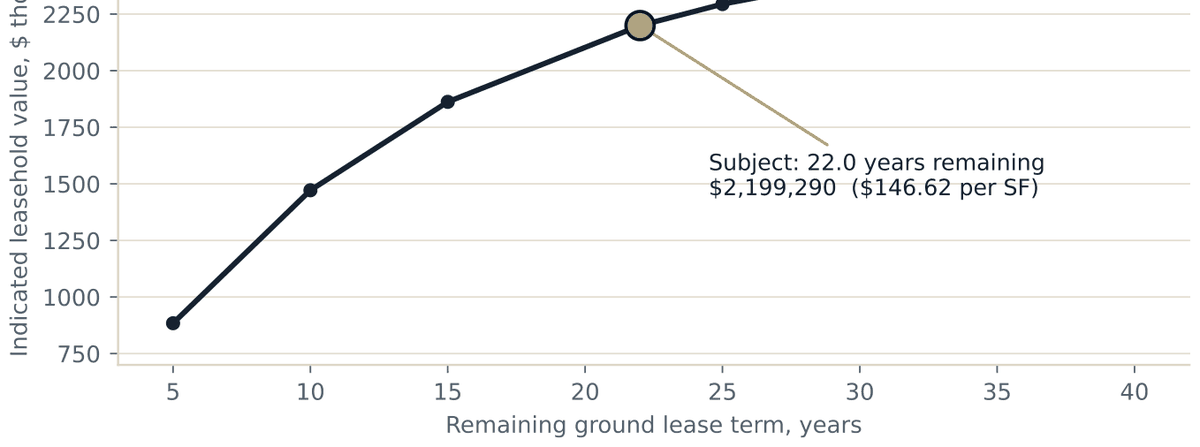
This exhibit holds the building constant and varies only the remaining ground lease term. It is the analysis we are asked for most often, because it answers the question behind a buyout, a loan, or an estate plan: what is this worth later, not just today.
| Remaining term | Indicated value | Per square foot | Share of the 40 year value |
|---|---|---|---|
| 5 years | $884,179 | $58.95 | 34.9 percent |
| 10 years | $1,471,770 | $98.12 | 58.0 percent |
| 15 years | $1,862,260 | $124.15 | 73.4 percent |
| 22 years (subject) | $2,199,290 | $146.62 | 86.7 percent |
| 25 years | $2,294,221 | $152.95 | 90.5 percent |
| 30 years | $2,408,828 | $160.59 | 95.0 percent |
| 35 years | $2,484,992 | $165.67 | 98.0 percent |
| 40 years | $2,535,608 | $169.04 | 100.0 percent |
Exhibit 19. Remaining term sensitivity. Illustrative figures for a sample property.
The decay is not a straight line. Value falls slowly while the horizon is long, because distant cash flows are discounted heavily in any case, and then falls sharply once the term approaches the point where conventional leasehold financing dries up. At 22 years the subject supports 86.7 percent of the 40 year value. At 10 years the same building supports 58.0 percent.
The renewal options
The lease carries two five year options. They require the sponsor to consent and they do not fix the rent, so we credit them at zero in the cash flow. We publish the sensitivity anyway. Crediting the first option in full would raise the indication to $2,443,067, or 11.1 percent above our conclusion. Anyone taking a different view of renewal risk can see the size of it without re-running the model.
13. Simulating the Renewal Options
Section 12 credits the two renewal options at zero, because the sponsor must consent and the rent on renewal is not fixed. That is the right basis for a value conclusion. It is not the whole answer to the question an owner actually asks, which is what the options might be worth if they run. This section answers that separately, and it does not change the conclusion in Section 16.
Why simulate rather than pick a number
A single renewal assumption buries three different uncertainties inside one figure: whether the sponsor consents, how rent behaves over the next thirty years, and what a buyer will pay for a wasting interest. Those uncertainties do not move together and they are not equally important. Running them as distributions rather than as point estimates shows which one drives the answer and how wide the honest range is.
Method
We ran 20,000 trials. Each trial draws a rent growth path, a discount rate, and the outcome of each consent decision, then values the leasehold over whatever term that trial produces, with the terminal value still set to zero at the end of it. Each trial is valued twice, once on the contract term alone and once with the options it was granted, so the difference isolates the option value from the noise in the other inputs.
| Variable | Distribution | Basis |
|---|---|---|
| Consent to the first option | Granted with probability 75 percent | Grant Assurance 22 restrains unjustly discriminatory treatment and the lease says consent shall not be unreasonably withheld, so refusal is possible but is not the expected case |
| Consent to the second option | Granted with probability 65 percent, conditional on the first | A sponsor that has renewed once is more likely to renew again, but the horizon is longer and the airport layout plan is less certain that far out |
| Net operating income growth | Normal, mean 2.75 percent, standard deviation 1.50 percent, drawn each year | Mean matches the discounted cash flow in Section 11. The spread reflects observed movement in hangar rents in this submarket |
| Discount rate | Normal, mean 11.50 percent, standard deviation 1.00 percent, floored at 8.50 percent | Mean matches Section 11. The spread reflects the range of leasehold pricing we see across buyers |
| Ground rent on renewal | Resets to market escalating 2.50 percent a year, times a negotiation factor drawn Normal, mean 1.00, standard deviation 0.08 | The lease says rent then prevailing. The factor carries the risk that consent is priced |
| Terminal value | Zero in every trial | Section 14.1 of the lease. Reversion without payment applies at the end of the contract term and at the end of any option term |
Exhibit 20. Simulation inputs. Illustrative figures for a sample property.
| Measure | Value of the leasehold | Per square foot |
|---|---|---|
| Fifth percentile | $2,012,222 | $134.15 |
| Lower quartile | $2,198,119 | $146.54 |
| Median | $2,350,025 | $156.67 |
| Upper quartile | $2,517,454 | $167.83 |
| Ninety fifth percentile | $2,803,945 | $186.93 |
| Mean | $2,370,223 | $158.01 |
| Standard deviation | $241,132 | |
| Concluded value, Section 16, options credited at zero | $2,200,000 | $146.67 |
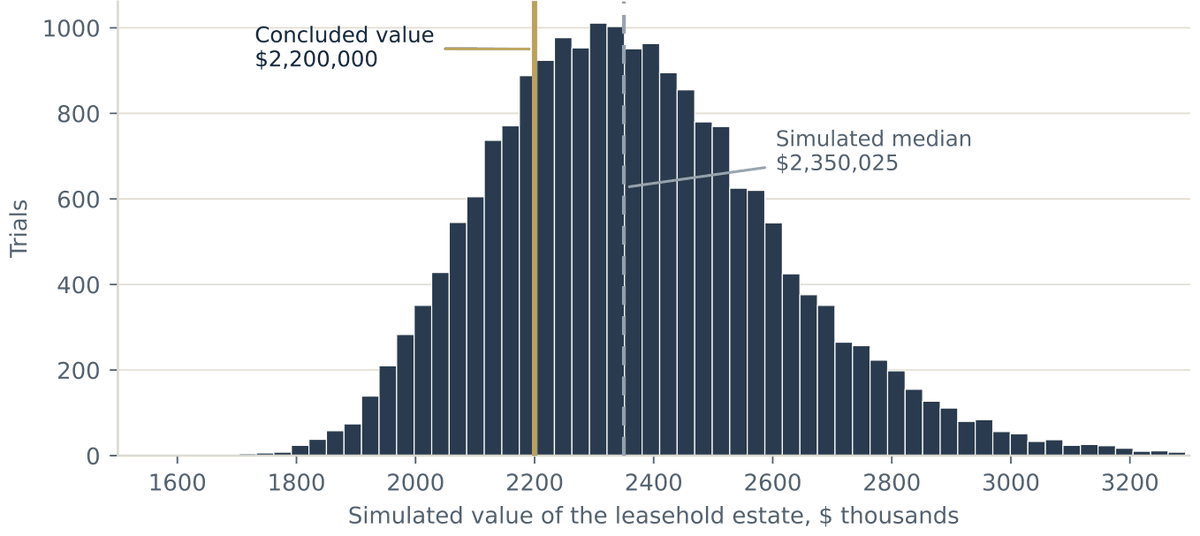
Exhibit 22. Simulated distribution against the concluded value. Illustrative figures for a sample property.
What the simulation says
The options are worth about $161,337 on a probability weighted basis, or $10.76 per square foot. That is 7.3 percent of the concluded value. The median trial carries $173,608 of option value, above the mean, because the distribution has a floor at zero for the 24.4 percent of trials in which consent is refused and no ceiling on the trials in which both options run in a strong rent environment.
Consent is the variable that matters. Across the trials, 24.4 percent end at the contract term, 26.8 percent gain five years, and 48.8 percent gain ten. Rent growth and the discount rate widen the distribution around each of those outcomes, but neither moves its centre nearly as far as the consent decision does. An owner protecting this value protects the relationship with the sponsor and the record of compliance with the lease, not the rent roll.
74.8 percent of trials value the leasehold above the concluded $2,200,000, which is the expected result of concluding on the contract term alone. The fifth percentile at $2,012,222 is the downside case: consent refused, weak rent growth, and a buyer pricing the wasting term hard.
This simulation does not change the value conclusion and it is not an alternative opinion of value. Market value rests on what the lease grants, and the lease grants a term ending in 2048 with two options the sponsor may decline. What the simulation gives an owner is a defensible estimate of what is at stake in the renewal negotiation, and of what a buyer might rationally pay above the contract term value to acquire that upside.
14. Insurable Value
Insurable value and market value answer different questions, and on a leasehold they diverge sharply. An owner who insures to market value is underinsured. An owner who assumes the building is worth its insured replacement cost is overestimating what a sale would produce. We state both so the conversation with the carrier and the conversation with a buyer stay separate.
| Component | Replacement cost new | Covered by a standard policy |
|---|---|---|
| Pre-engineered rigid steel frame, roof, and wall panel | $1,980,000 | Yes |
| Foundation, footings, and 12 inch reinforced slab | $390,000 | No, below grade or site work |
| Bi-fold hydraulic door, 100 ft by 28 ft | $465,000 | Yes |
| Office, crew quarters, restrooms, and mezzanine | $264,000 | Yes |
| Radiant heat, ventilation, and compressed air | $118,000 | Yes |
| Fire detection and high expansion suppression | $186,000 | Yes |
| Electrical service, distribution, and LED high bay | $124,000 | Yes |
| Apron, taxilane connection, and tiedowns | $192,000 | No, below grade or site work |
| Site utilities, grading, drainage, and fencing | $74,000 | No, below grade or site work |
| Insurable direct cost subtotal | $3,137,000 | |
| Indirect cost at 10 percent | $313,700 | |
| Indicated insurable value, replacement cost basis | $3,450,700 | |
| Market value of the leasehold estate | $2,200,000 | |
| Difference | $1,250,700 | Depreciation, the finite term, and market factors |
Exhibit 23. Insurable value compared with market value. Illustrative figures for a sample property.
Insurable value here is stated on a replacement cost basis. A policy written on actual cash value would indemnify the depreciated figure instead, which is a materially different number. The policy language controls and we express no opinion on any policy.
15. The Sponsor's Leased Fee Position
Our opinion covers the leasehold. The sponsor holds the other half of the lease, and in a buyout, a lease renegotiation, or an assessment appeal somebody will eventually ask what that half is worth. The sponsor's position is the right to receive contract ground rent for 22 years and the right to receive the improvements at the end of it. We discount the rent stream at 7.00 percent, below the leasehold rate, because ground rent secured by a building the tenant has already paid for is a low risk stream.
| Interest and component | Amount |
|---|---|
| Leased fee, present value of contract ground rent over 22.0 years | $118,752 |
| Leased fee, depreciated value of the improvements at the reversion date | $734,407 |
| Leased fee, present value of that reversion | $165,765 |
| Indicated value of the leased fee position | $284,517 |
| Indicated value of the leasehold estate | $2,200,000 |
| Sum of the two interests | $2,484,517 |
Exhibit 24. Leasehold and leased fee. Illustrative figures for a sample property.
The two interests do not sum to the value of an unencumbered fee, and they are not supposed to. Neither party can act alone. The tenant cannot extend or convert the use without consent and captures nothing at the end. The sponsor cannot reach the improvements before 2048 and cannot re-tenant the parcel in the meantime. Adding a leasehold value to a leased fee value and calling the total the value of the property is an error we see regularly in estate work, partnership disputes, and assessment appeals.
16. Reconciliation and Value Conclusion
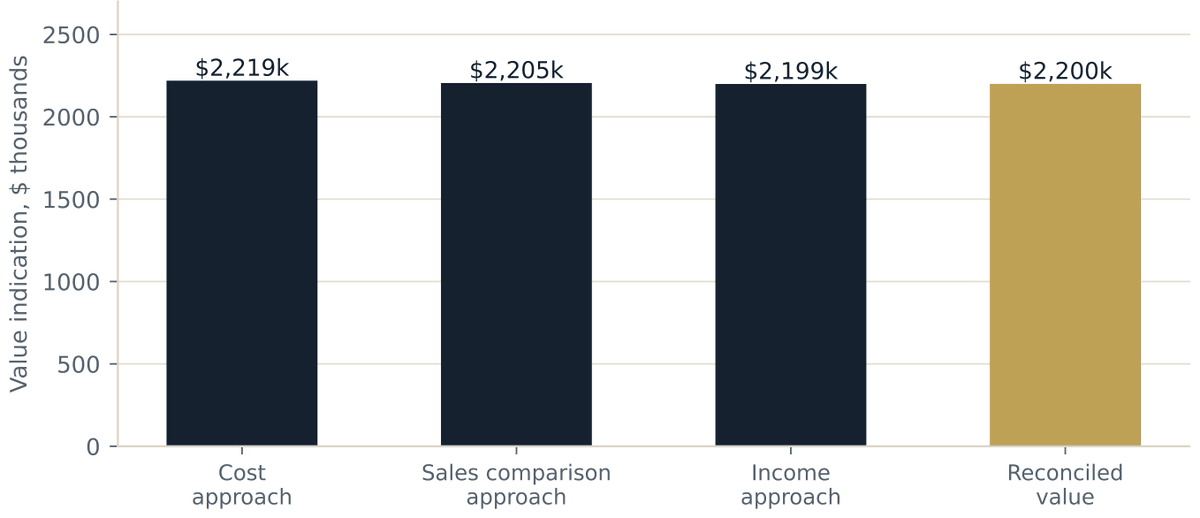
Reconciliation is a judgment about the quality of evidence, not an average. We state the weight and the reason so that a reader who disagrees with a weight can compute the effect.
| Approach | Indication | Per square foot | Weight | Weighted amount |
|---|---|---|---|---|
| Cost approach | $2,219,423 | $147.96 | 15 percent | $332,913.52 |
| Sales comparison approach | $2,205,000 | $147.00 | 45 percent | $992,250.00 |
| Income approach | $2,199,289.68 | $146.62 | 40 percent | $879,715.87 |
| Weighted indication | $2,204,879.39 | |||
| Rounded value conclusion | $146.67 | $2,200,000 |
Exhibit 26. Reconciliation. Illustrative figures for a sample property.
Sales comparison, 45 percent
Five verified leasehold transactions, four of them inside twelve months, with remaining terms that bracket the subject on both sides and one sale at the subject airport. This is the strongest evidence in the file.
Income approach, 40 percent
The intended use is a buyout of an income producing asset, so the approach that models the cash flow the owners actually receive is directly relevant. Rent support is good, with two comparables at the subject airport, and the direct capitalization cross check confirms it.
Cost approach, 15 percent
The cost approach carries real information here because the external obsolescence was extracted from sales rather than assumed, and because the component schedule is independently useful for insurance and for capital planning. It receives the least weight because it requires the most estimation, not because it is uninformative.
The three indications fall within 0.9 percent of one another. Weighted as shown they produce $2,204,879.39, which we round to $2,200,000.
17. Exposure Time and Marketing Time
Exposure time is 9 to 15 months. It is retrospective and answers how long the property would have had to be exposed before a sale at the concluded value on the effective date.
Marketing time is 9 to 15 months. It is prospective and begins at the effective date.
The comparable sales carried marketing periods of 6 to 18 months, shortest at Halverson where the ground lease terms run longest and longest at Delmar where they run shortest. The subject sits between them. Three conditions extend exposure for a leasehold relative to conventional commercial property: the sponsor's consent right adds a step and a timeline to any transfer, the buyer pool is limited to parties who can use aviation space at this specific field, and leasehold financing is available from a narrower set of lenders on shorter amortization.
18. Certification
We certify that, to the best of our knowledge and belief:
- The statements of fact in this report are true and correct.
- The reported analyses, opinions, and conclusions are limited only by the reported assumptions and limiting conditions and are our impartial and unbiased professional analyses, opinions, and conclusions.
- We have no present or prospective interest in the property and no personal interest with respect to the parties involved.
- We have performed no services regarding the subject property within the three year period immediately preceding acceptance of this assignment.
- We have no bias with respect to the property or to the parties involved.
- Our engagement was not contingent upon developing or reporting predetermined results.
- Our compensation is not contingent upon the development or reporting of a predetermined value, the amount of the value opinion, the attainment of a stipulated result, or the occurrence of a subsequent event directly related to the intended use of this assignment.
- We made a personal inspection of the property.
- No one provided significant real property appraisal assistance to the persons signing this certification.
Signature omitted. This is a sample report and is not certified.
Dr. Carter, DBA, CFA, FRM, CAIA, CIPM · Valuation Takes Flight LLC
19. About Valuation Takes Flight
Valuation Takes Flight LLC is an aeronautical valuation advisory firm. We value aircraft hangars, fixed base operations, and airport ground leases, and we do it nationwide. The practice is remote first, with site work performed wherever the engagement calls for it.
What we do
Market value and market rent opinions on hangars and FBO facilities. Ground lease and reversion analysis. Hangar rent studies for owners and airport sponsors. Property tax appeal support. Partner and shareholder buyout valuations. Estate and gift valuations of hangar holding entities. Litigation support and expert testimony. Portfolio level review for lenders and institutional owners.
Who leads the work
Dr. Carter, DBA, CFA, FRM, CAIA, CIPM, is the founder and principal. He is the author of Valuing Aircraft Hangars: A Textbook for Real Estate Appraisers and serves as Assistant Professor at an aeronautical university in Daytona Beach, Florida. His research covers hangar valuation method, ground lease economics, and capitalization rate determination for aviation leaseholds. Before founding the firm he worked in institutional investment analysis, performance measurement under the Global Investment Performance Standards, and risk modeling for private assets.
How we scope an engagement
Every proposal states the scope, the intended use and users, the deliverable, and the delivery date before work begins. Where an intended use requires a state certified general appraiser, we say so at the proposal stage and structure the engagement accordingly. We would rather turn down work than deliver a report that will not do the job the client needs it to do.
If you are holding this because you are choosing an appraiser, the useful comparison between proposals is scope to scope rather than price to price. A quote that is materially cheaper is usually scoped differently, and sometimes for good reason. Ask what is in it.
20. Addendum: Terms Used in This Report
| Term | As used here |
|---|---|
| Based aircraft | Aircraft operationally based at an airport, reported by the sponsor. Our primary demand measure for hangar space. |
| Bi-fold door | A hangar door folding in two horizontal leaves, usually hydraulically actuated. The dominant configuration for corporate hangars and the largest single mechanical component in the building. |
| Clear span | The unobstructed interior width between structural supports. Determines the wingspan the building accepts. |
| Effective age | The age indicated by condition and utility, which can differ from chronological age in either direction. |
| External obsolescence | A loss in value caused by conditions outside the property. Here it is extracted from comparable sales rather than estimated. |
| Leased fee | The lessor's interest, being contract rent plus the reversion. |
| Leasehold | The lessee's interest, being the right to use and occupy for the lease term under the lease conditions. |
| Obligated airport | An airport whose sponsor has accepted federal grants or federally conveyed property and is subject to grant assurances. |
| Possessory interest | A taxable interest in publicly owned property held by a private party. The usual basis on which a hangar leasehold is assessed. |
| Reversion | The passing of improvements to the lessor at lease expiration. Where the lease provides no compensation, the terminal value of the leasehold is zero. |
| Self sustaining | The federal requirement that a sponsor maintain a fee and rental structure making the airport as self sustaining as possible in its circumstances. |
| Term factor | The ratio of the present value annuity factor for the remaining lease term to the factor for the remaining economic life of the improvements. |
This report is a sample prepared by Valuation Takes Flight LLC to show the format, method, and level of support our clients receive. Wexley Field, Hangar 6, the named parties, and all market data in it are illustrative. It is not an opinion of value for any real property and should not be relied upon for any transaction, filing, or proceeding.