
Letter of Transmittal
Re: Opinion of the fair market value of one hundred percent of the common stock of Cardington Aviation Services, Inc., and of the adequacy of the consideration proposed.
Dear Ms. Okonjo,
You have engaged us to advise you, as trustee, on whether the price proposed for the shares of Cardington Aviation Services, Inc. represents adequate consideration under section 3(18)(B) of the Employee Retirement Income Security Act. It does not.
Cardington is a Part 145 repair station at two airports, holding airframe, radio, instrument, accessory, and specialized service ratings. It employs 112 people including 64 billable technicians and produced $23,025,044 of revenue and $3,049,074 of normalized EBITDA in the year ended June 30, 2026. Its principal facility sits on a ground lease with seven years to run, at the end of which the improvements revert to the sponsor without compensation.
The two selling shareholders propose to sell the whole of the company to a newly formed employee stock ownership plan for $19,500,000. We valued it under the income and market approaches, decomposed the enterprise into the components that behave differently, applied an explicit haircut to the component that does not transfer on a change of ownership, and tested whether the company can carry the debt the transaction creates. Our opinion of the fair market value of one hundred percent of the common stock as of June 30, 2026 is:
Section 27 reconciles the two figures step by step, and every step is a re run of the same model. A second question should decide the matter, and it is this. The structure leaves the company carrying acquisition debt, mandatory facility capital, and a growing obligation to repurchase shares out of one stream of cyclical cash. At the proposed price it breaches its senior covenant in 98.7 percent of simulated paths. Section 30 sets out what we recommend. This report is a sample and is not an opinion on which any fiduciary may rely.
Respectfully submitted,
VALUATION TAKES FLIGHT LLC
Dr. Carter, DBA, CFA, FRM, CAIA, CIPM
Signature omitted. This is a sample report.
1. Summary of Salient Facts and Conclusions
Exhibit 1. Salient facts
| Item | Detail |
|---|---|
| Subject company | Cardington Aviation Services, Inc., a Part 145 repair station |
| Founded | 1994 |
| Locations | Two. Brenner Municipal Airport, the principal facility, and Tolliver Regional Airport |
| Certificate | Federal Aviation Administration Part 145 repair station certificate, with an equivalent European Union Aviation Safety Agency approval |
| Ratings | Airframe Class 2 and Class 4, Radio Class 1, 2, and 3, Instrument Class 1 and 2, Accessory Class 1 and 2, and Specialized Service for non destructive inspection |
| Employees | 112, of whom 64 are billable technicians |
| Facilities | 48,000 square feet at Brenner Municipal Airport on a ground lease, 22,000 square feet at Tolliver Regional Airport under a building lease from an entity owned by the sellers |
| Ground lease | Commenced July 1, 2008, 25 year term, expires June 30, 2033. 7.0 years remain |
| Reversion | Improvements revert to the sponsor at expiration without compensation |
| Revenue | $23,025,044 for the twelve months ended June 30, 2026 |
| Normalized EBITDA | $3,049,074, being 13.2 percent of revenue |
| Customer concentration | Largest customer 18.4 percent of revenue, five largest 47.2 percent |
| Interest valued | One hundred percent of the common stock, on a controlling basis |
| Standard of value | Fair market value, as required by ERISA section 3(18)(B) |
| Premise of value | Going concern |
| Effective date | June 30, 2026 |
| Report date | July 17, 2026 |
| Intended use | To assist the trustee in determining whether the consideration proposed for the shares is adequate consideration |
| Intended user | The trustee of the plan and its counsel. No other party |
Exhibit 2. The proposal, and the conclusion
| Price for one hundred percent of the stock | Enterprise value | Multiple of normalized EBITDA | |
|---|---|---|---|
| Proposed in the term sheet | $19,500,000 | $19,920,000 | 6.53x |
| Opinion of fair market value | $12,200,000 | $12,620,000 | 4.14x |
| Maximum the company can support | $12,700,000 | $13,120,000 | 4.30x |
| Excess of the proposal over fair market value | $7,300,000 | 59.8 percent |
Two tests govern. The first is the price: the plan may not pay more than fair market value. The second is the structure: the plan should not pay a price the company cannot carry. The proposal fails both, and it fails the first by $7,300,000 and the second by $6,800,000.
2. Scope of the Assignment
Purpose, intended use, and intended user
The purpose of this assignment is to develop an opinion of the fair market value of one hundred percent of the common stock of Cardington Aviation Services, Inc. and to advise the trustee whether the consideration proposed for those shares is adequate consideration within the meaning of section 3(18)(B) of the Employee Retirement Income Security Act. The intended user is the trustee and its counsel. The sellers, the company, its lenders, and its employees are not intended users, and none of them may rely on this report.
Standard of value
The standard of value is fair market value: the price at which the stock would change hands between a willing buyer and a willing seller, neither under compulsion and both having reasonable knowledge of the relevant facts. That is the standard ERISA imposes and it is the standard the Internal Revenue Service applies to closely held stock under Revenue Ruling 59-60. It is not investment value, and it is not the value of the company to these particular buyers. Section 19 explains why one consequence of that, the treatment of the S corporation election, cuts against the price the sellers propose.
What we were asked to do, and what we were not
| Procedure | Performed |
|---|---|
| Opinion of fair market value of the stock | Yes |
| Opinion on the adequacy of the consideration proposed | Yes |
| Opinion on whether the transaction is fair to the plan from a financial point of view | Yes. Section 29 |
| Analysis of the company's ability to service the transaction debt | Yes. Section 23 |
| Analysis of the repurchase obligation | Yes. Section 22 |
| Review of the financing terms proposed | Yes. Sections 28 and 29 |
| Site visits to both facilities | Yes, on May 12 and May 13, 2026 |
| Management interviews | Yes. Both selling shareholders, the general manager, the director of maintenance, the chief inspector, the quality manager, and the controller |
| Review of audited financial statements | Yes, for the five fiscal years ended June 30, 2026 |
| Review of the certificate, ratings, and repair station manual | Yes |
| Review of the ground lease, the building lease, and the sponsor's minimum standards | Yes |
| Review of the term sheet and the draft financing documents | Yes |
| Independent legal opinion on certificate transferability | No. See Section 8 |
| Environmental site assessment | No. See Section 3 |
| Audit of the financial statements | No. We relied on the statements as audited by others |
| Machinery and equipment appraisal | No. Tangible personal property is stated at fair value in continued use from management's schedule, our inspection, and published used equipment data |
| Advice on plan design, tax structuring, or the terms of the plan document | No |
Independence
Valuation Takes Flight LLC has no present or prospective interest in the company or its stock, no relationship with either selling shareholder, no relationship with the investment bank that prepared the sellers' analysis, and no interest in whether the transaction closes. Our fee is fixed, agreed before the work began, and is not contingent on the value reported, on the transaction closing, or on any other outcome. We have performed no services for this company or these shareholders in the three years preceding this engagement.
That paragraph is not a formality. The published process standard requires the trustee to obtain written confirmation that the valuation advisor has no relationship with the sponsor, any counterparty, or any party structuring the transaction, and the case law treats interlocking relationships among the trustee, the banker, and the appraiser as evidence that the process failed. Section 31 records how that requirement was satisfied.
Reporting standard
This is a sample. It is written in the form of a detailed valuation report and follows the structure we use in engagements of this type. It should not be treated as a report prepared under any professional standard, and no party should rely on it.
3. Assumptions and Limiting Conditions
General assumptions
- We assume the certificate, the ratings, the operations specifications, the leases, and the term sheet furnished to us are complete and accurate. We read them. We are not attorneys and we offer no legal interpretation of them.
- We assume the company holds good title to its personal property, free of liens other than those disclosed.
- We assume the financial statements audited by the company's accountants for the five years ended June 30, 2026 are fairly stated. We did not audit them. The normalization adjustments in Section 12 are ours.
- We assume no change in the applicable law, regulation, or Federal Aviation Administration policy between the effective date and the date of any transaction.
- We assume the plan will be qualified under section 401(a) of the Internal Revenue Code and will hold the stock as an employee stock ownership plan within the meaning of section 4975(e)(7).
- Projections in this report are not forecasts and are not guaranteed. They are the cash flows a buyer would model at the effective date on the information then available.
Extraordinary assumption regarding certificate continuity
We assume the repair station certificate remains in force through and after the transaction. This is an extraordinary assumption and its use might have affected the conclusion. The privileges of a repair station are not transferable. Section 8 sets out why a purchase of stock is on better ground than a purchase of assets, and also why the trustee should obtain a written opinion of aviation counsel rather than rely on ours.
Extraordinary assumption regarding environmental condition
We assume the premises at both airports are free of hazardous material and that no remediation obligation attaches to the company. We performed no environmental assessment. This is an extraordinary assumption. A repair station that has run a plating line, a paint booth, and a parts washer for three decades carries an ordinary risk of release, and aqueous film forming foam in a hangar suppression system is a recognized source of per and polyfluoroalkyl substances. A Phase I assessment with a foam specific scope should precede closing, and the trustee should not treat this report as a substitute for one.
Hypothetical conditions
None were used.
Limiting conditions
- This report is a sample. The company, the airports, the parties, and every figure in it are illustrative. Nothing in it is an opinion of value for any real company, and no fiduciary should rely on it for any purpose.
- Neither this report nor any part of it may be distributed, quoted, or referred to without our written consent.
- The opinion applies only as of the effective date and only for the intended use.
- Nothing in this report is legal, tax, or investment advice.
4. Adequate Consideration: the Two Part Standard
Section 3(18)(B) of the Employee Retirement Income Security Act defines adequate consideration for an asset with no generally recognized market as the fair market value of the asset as determined in good faith by the trustee or named fiduciary. That sentence carries two requirements, and a transaction has to satisfy both.
Exhibit 3. The two parts, and who bears each
| Part | What it requires | Who bears it | How this report addresses it |
|---|---|---|---|
| Content | The price must be fair market value. A price above fair market value is a prohibited transaction no matter how careful the process that produced it | The trustee, advised by the valuation professional | Sections 11 through 25 develop the opinion, and Section 27 reconciles it to the price proposed |
| Process | The value must be determined in good faith, which the case law reads as a prudent and documented investigation | The trustee alone. It cannot be delegated to the appraiser | Section 31 records the process against the published standard, and Section 30 sets out what remains for the trustee to do |
Why the second part cannot be bought
The most quoted sentence in the ESOP valuation case law says that reliance on an expert is not a magic wand a fiduciary may wave over a transaction to ensure its responsibilities are fulfilled. It comes from the Fourth Circuit's decision affirming a judgment against a trustee that engaged a well known appraiser, received a report, and accepted it. The court found the trustee had not investigated the appraiser's qualifications, had not given the appraiser complete information, had not questioned the assumptions, and had not satisfied itself that reliance was justified.
An appraisal firm that tells a trustee its report discharges the trustee's duty is describing a service it cannot deliver. What a report can do is make the trustee's questioning possible: state every assumption, show every calculation, disclose every input that could not be obtained, and say plainly where the analysis is weak. That is the standard this report is written to.
What the cases have actually cost
Exhibit 4. Two decided cases, and what the errors were worth
| Case | What happened | Damages |
|---|---|---|
| Brundle v. Wilmington Trust, N.A., Fourth Circuit, March 21, 2019 | The plan paid $4,235 per share. A second appraisal in the trustee's possession, using substantially the same methodology, indicated $1,838.11. The court itemized the overpayment: management growth projections $4,325,000; a beta of 0.7 rather than 1.0 $2,936,000; a control premium the plan did not obtain $8,186,000; the omission of a lack of control discount $9,715,250; stock appreciation rights $1,611,000; and consistent upward rounding $3,000,000 | $29,773,250 |
| Walsh v. Vinoskey, Fourth Circuit, December 6, 2021 | The plan paid $406 per share against prior appraisals from 2004 to 2009 ranging from $220 to $285, with no change in performance to explain the step up. The court found fair market value was $278.50. The trustee's diligence was described as rushed and cursory. The selling shareholder was held liable as a knowing participant because he knew the price exceeded fair market value | $6,502,500, reduced on appeal to $1,863,033 after offsetting debt the seller forgave |
Three of the six itemized errors in the first case appear in the sellers' analysis of this transaction: growth projections taken from management without testing, a control premium the plan does not obtain, and a discount rate below what the risk supports. Section 27 prices each of them, and the second is worth $1,091,466 on its own. The point of citing the cases is not to alarm. It is that the errors are known, they are specific, and they are checkable.
5. The Regulatory Record and Where It Stands
A trustee reading this in 2026 is entitled to ask what the Department of Labor currently requires. The honest answer is that fifty two years after ERISA there is still no final regulation defining how good faith fair market value is to be determined, and that the enforcement posture has changed twice in eighteen months.
Exhibit 5. The record
| Date | What happened | What it means now |
|---|---|---|
| 1974 | ERISA is enacted. Section 3(18)(B) requires adequate consideration for an asset with no generally recognized market | The statutory standard. Unchanged |
| 1988 | The Department proposes a regulation at 29 CFR 2510.3-18(b) defining adequate consideration | Never finalized. Cited by practitioners and by courts as persuasive, but it is not law |
| 2014 | The Department settles with a trustee and publishes the process agreement that accompanies the settlement | Not binding on anyone else, and the Department has said so. It is nonetheless the most detailed statement of what a prudent process looks like, and Section 31 documents this engagement against it |
| 2022 | Section 346 of the SECURE 2.0 Act directs the Secretary of Labor to issue formal guidance on acceptable standards and procedures for establishing good faith fair market value | A statutory instruction that has not been carried out |
| January 16, 2025 | The Department releases a proposed rule defining adequate consideration, scheduled for publication in the Federal Register on January 22 | It would have defined fair market value, prescribed a good faith process, and offered a safe harbor exemption |
| January 20, 2025 | The proposal is withdrawn under a government wide regulatory freeze before publication | It was never published. It has no force or effect. Its contents are still worth reading as a statement of what the Department was thinking |
| January 15, 2026 | The Department ends the ESOP National Enforcement Project | Valuation cases are no longer a national enforcement priority |
| April 14, 2026 | Field Assistance Bulletin 2026-01 sets four enforcement priorities: prioritize the most egregious conduct or significant harm, avoid regulating through enforcement, require senior approval for significant enforcement activity, and close routine investigations within eighteen months and complex ones within thirty | The Bulletin directs that the agency avoid cases that unfairly second guess process based fiduciary judgments, and that pending valuation investigations be reviewed against that principle |
What the withdrawn proposal would have required
It is worth setting out, because it tells a trustee what the agency thinks even though it cannot enforce it. The proposal defined fair market value in conventional terms and required a good faith process resting on an independent fiduciary and a qualified independent appraiser with no other business relationship with the sponsor or the seller and no interest contingent on the transaction closing. Its optional safe harbor would have required a single class of stock, internal loan terms matching the senior debt, a second monitoring fiduciary, no warrants to the sellers, sellers relinquishing control rights, seller notes priced at senior rather than subordinated rates, and trustee fiduciary liability insurance covering at least twenty percent of the purchase price.
Three of those conditions bear directly on the transaction in front of you. The term sheet grants the sellers warrants, which Section 28 quantifies. The seller note is priced at 9.50 percent against senior debt at 8.15 percent, a spread of 135 basis points. And the sellers continue to own the building at Tolliver Regional Airport and to lease it to the company. None of that is unlawful. All of it is the pattern the agency proposed to exclude from a safe harbor, and a trustee should be able to say why it accepted each one.
What the change in enforcement posture does not change
It does not change the standard of value. Section 3(18)(B) still requires fair market value, and a price above fair market value is still a prohibited transaction under section 406. It does not change the case law, which is the work of courts rather than the Department. And it does not reach private litigation, which is where the majority of ESOP valuation claims now originate: participants sue, and a participant class does not consult a Field
Assistance Bulletin before filing.
A softer enforcement posture reduces the chance of an investigation. It does not reduce the chance that a price above fair market value is later found to have been above fair market value. Those are different risks, they run to different counterparties, and only one of them has moved.
6. How We Value Aviation Companies for ESOP Purposes
An aviation service business is not a generic services company with hangars. Four things about it change the analysis, and a valuation that treats them as narrative colour rather than as inputs will produce a number that is wrong in a predictable direction.
1. Separate the enterprise into components that behave differently
Real property held under a ground lease, tangible personal property and tooling, working capital, and the certificate and relationship intangible do not carry the same risk, do not depreciate on the same clock, and do not transfer on the same terms. Section 18 decomposes the enterprise before it adjusts anything.
2. Value the leasehold as a wasting interest, not as real estate
The Brenner improvements revert to the sponsor in 7 years without compensation. The company will still need premises. Section 16 carries the cost of re providing them into the terminal value rather than assuming the enterprise continues on today's rent forever.
3. Apply the transferability haircut as a visible step
A guideline multiple drawn from transactions in generically comparable service firms embeds an assumption that the target's intangible earnings are durable and transferable. A repair station certificate is neither. Section 18 reduces the intangible component explicitly and shows the calculation, rather than burying the judgment in an unexplained multiple.
4. Test the projection against capacity, not only against history
The published process standard asks whether a projection is reasonable against the company's own five year history on seven metrics. That test is necessary and it is not sufficient. A projection can sit comfortably inside the historical range and still be unachievable, because a shop cannot bill hours it cannot staff. Section 13 runs the historical test and Section 14 runs the capacity test.
5. Model the three claims on cash together
A leveraged ESOP has to service acquisition debt, fund the mandatory facility capital that aviation operations require, and satisfy a growing obligation to repurchase shares. The three compete for the same cyclical cash flow and a downcycle brings them into direct conflict. Section 23 models them together and Section 24
stresses them.
6. Do not charge the same risk twice
The finite ground lease appears in the terminal value. It is therefore not also loaded into the discount rate. The company specific premium in Section 15 carries a small allowance for the leasehold, and Section 15 says exactly what that allowance is for.
7. Say what could not be obtained
The good faith standard rewards disclosure of the gaps. Section 30 lists the four items this engagement could not resolve and what each would change.
Every one of these rules costs the sellers money in this transaction, which is a reason to state them before the numbers rather than after. They are the same rules we apply when the analysis favours the seller. Section 19 contains one that does: the company's cash is added to equity value in full, on the view that none of it is needed as an operating balance.
7. The Company
Cardington was founded in 1994 by two engineers who had run the maintenance department of a regional operator. It began as a single airframe shop at Brenner Municipal Airport and added avionics in 2003, an accessory and component shop in 2009, and the Tolliver Regional Airport line station in 2016. Both founders remain shareholders. One is the president and one is the director of maintenance named on the certificate.
Exhibit 6. Operating metrics
| Metric | Value | Comment |
|---|---|---|
| Billable technicians | 64 | Against 66 authorized positions. The two open airframe positions have been open eleven months |
| Total employees | 112 | Including quality, records, purchasing, tool crib, sales, and administration |
| Available hours per technician | 1,850 | Net of holiday, vacation, and training |
| Utilization | 71.5 percent | Three year average of billable to available hours |
| Billed hours | 84,656 | Derived, and reconciled to the work order system |
| Blended billed rate | $172.00 | Weighted across airframe, avionics, accessory, and line, net of discounts and warranty rework |
| Labor revenue | $14,560,832 | Derived from the four figures above |
| Parts and materials to labor | 48.7 percent | Three year average |
| Outside services to labor | 9.43 percent | Paint, interiors, and specialized non destructive inspection subcontracted out |
Exhibit 7. Revenue, direct cost, and gross margin by line Twelve months ended June 30, 2026. Individual lines are rounded and may not sum exactly to the totals shown.
| Line | Location | Revenue | Direct cost | Gross margin | Margin |
|---|---|---|---|---|---|
| Airframe labor, Brenner | Brenner | $6,465,009 | $3,943,656 | $2,521,354 | 39.0% |
| Avionics labor, Brenner | Brenner | $3,232,505 | $1,874,853 | $1,357,652 | 42.0% |
| Accessory and component shop, Brenner | Brenner | $1,528,887 | $917,332 | $611,555 | 40.0% |
| Line maintenance labor, Tolliver | Tolliver | $2,504,463 | $1,602,856 | $901,607 | 36.0% |
| AOG and field service | Shared | $829,967 | $506,280 | $323,687 | 39.0% |
| Parts and materials | Shared | $7,091,125 | $5,566,533 | $1,524,592 | 21.5% |
| Outside services and subcontract | Shared | $1,373,086 | $1,208,316 | $164,770 | 12.0% |
| Total | $23,025,044 | $15,619,827 | $7,405,217 | 32.2% |
Exhibit 8. Customer concentration
| Customer | Share of revenue | Basis of the relationship |
|---|---|---|
| Largest customer, a fractional operator | 18.4% | Purchase orders issued inspection by inspection. No master agreement |
| Second largest, a corporate flight department | 11.2% | A three year maintenance agreement expiring in 2028 |
| Third largest, a charter certificate holder | 7.9% | Purchase orders, with a preferred provider letter that either party may end on notice |
| Fourth largest, an aircraft management company | 5.2% | A two year agreement expiring in 2027, assignable with consent |
| Fifth largest, a corporate flight department | 4.5% | Purchase orders. The relationship runs to the chief pilot rather than to the company |
| Five largest customers | 47.2% |
Concentration of this order is a risk factor, and Section 15 prices it. What matters as much as the percentage is the basis of the relationship. Three of the five largest customers, together 30.8 percent of revenue, are served on purchase orders rather than under a contract that survives a change of ownership. Section 18 treats that as one reason the intangible component does not transfer at full value.
8. The Certificates, and What Transfers
A repair station's earnings come from a certificate. The certificate does not transfer with the stock in the way a customer list or a building does, and the extent to which it carries through a change of ownership is the single most important legal question in this valuation.
Exhibit 9. Certificate and ratings held
| Rating | Scope |
|---|---|
| Airframe Class 2 | Large aircraft of composite construction |
| Airframe Class 4 | Large aircraft of all metal construction |
| Radio Class 1 | Communication equipment |
| Radio Class 2 | Navigational equipment |
| Radio Class 3 | Radar equipment |
| Instrument Class 1 | Mechanical instruments |
| Instrument Class 2 | Electrical instruments |
| Accessory Class 1 | Mechanical accessories |
| Accessory Class 2 | Electrical accessories |
| Specialized Service | Non destructive inspection, eddy current and fluorescent penetrant |
What the regulation says
The privileges of a repair station are not transferable. 14 CFR 145.57(b) provides that if the holder of a repair station certificate sells or transfers its assets and the new owner chooses to operate as a repair station, the new owner must apply for an amended or new certificate. 14 CFR 145.57(a) requires a request in a form acceptable to the Administrator for a change in name, location, or rating.
The transaction in front of the trustee is a purchase of stock rather than a purchase of assets. The corporate holder of the certificate does not change; its shareholders do. That distinction matters and it favours the plan. Federal Aviation Administration guidance to inspectors nonetheless directs them to consult counsel where a question arises whether a change in stockholder ownership amounts to a transfer of repair station assets, which means the outcome is a matter of administrative judgment rather than a matter of right.
Exhibit 10. What a change of ownership puts at risk
| Item | Exposure | What the trustee should obtain |
|---|---|---|
| The certificate itself | A stock purchase should not require a new certificate. The company continues to hold it. The risk is that a regional office takes a different view | A written opinion of aviation counsel, and a pre transaction conversation with the principal maintenance inspector |
| Named management | The accountable manager, the chief inspector, and the director of maintenance are accepted by the Administrator by name. One of them is a selling shareholder and none is under an employment agreement extending beyond closing | Employment and non competition agreements for all three, signed at closing, and a documented succession plan for the director of maintenance |
| Operations specifications | Continue with the certificate, but a change in management personnel requires notification and acceptance | Confirmation that the notification has been filed and accepted |
| EASA approval | Derived from the Federal Aviation Administration certificate through the bilateral agreement and the maintenance annex. It follows the status of the underlying certificate | Confirmation from the agency that the approval continues, obtained before closing |
| OEM service authorizations | Two of the four terminate on a change of control unless the manufacturer consents. Together they support 18.5 percent of revenue | Written consents, or a price adjustment if consent is not obtained |
| Liability for prior work | A buyer that keeps the certificate number may be held responsible for work performed under previous management | Representations and warranties with survival, and an escrow sized to the exposure |
The valuation consequence is Section 18. Earnings that depend on a certificate the company holds at the Administrator's acceptance, on three individuals named to that certificate, and on two manufacturer authorizations that end on a change of control are not worth what earnings of the same size are worth in a business whose intangible assets simply convey. That difference is measured rather than asserted.
9. The Facilities and the Ground Lease
Exhibit 11. The two facilities
| Brenner Municipal Airport, principal facility | Tolliver Regional Airport, line station | |
|---|---|---|
| Building area | 48,000 square feet | 22,000 square feet |
| Interest held | Ground leasehold. The company owns the improvements until reversion | Building lease from an entity owned by the selling shareholders |
| Commenced | July 1, 2008 | Current term commenced 2019 |
| Expires | June 30, 2033 | December 31, 2029 |
| Remaining term | 7.0 years | 3.5 years, with two five year options at the tenant's election |
| Rent | $0.46 per square foot on 165,528 square feet of land, $76,143 per year | $9.75 per square foot, $214,500 per year, against a market rate of $7.40 |
| Renewal | One ten year option at the sponsor's discretion, rent reset to market | At the tenant's election |
| Reversion | Improvements revert to the sponsor at expiration without compensation | Not applicable. The company owns no improvements there |
| Consent to a change of control | Required from the airport sponsor | Required from the landlord, who is the seller |
The ground lease is the problem
Seven years remain. At expiration the hangar, the shop, the paint booth, the compressed air and vacuum systems, and every other improvement the company has paid for become the sponsor's property, and the company has no right to compensation and no right to renew. There is a ten year option and it is exercisable at the sponsor's discretion at a rent reset to market.
A valuation that carries today's rent into a terminal value forever is assuming the company keeps premises it will not own on terms it does not have. Section 16 does not do that. It carries an explicit annual cost from the reversion date, being the difference between the contract rent of $0.46 per square foot and a concluded market ground rent of $1.34, and it discounts that cost back through the terminal value. Section 23 separately carries $1,450,000 of facility capital in the year following the reversion, because whatever happens the company will be paying to re provide something.
The related party lease is a separate issue
The Tolliver Regional Airport building is owned by an entity the selling shareholders will continue to own after closing. The company pays $9.75 per square foot against a market rate of $7.40. Section 12 restates the rent to market for valuation purposes, which increases normalized earnings by $51,700 a year. It does not solve the problem. After closing the plan will own a company that pays above market rent to the people who sold it the company, under a lease with 3.5 years remaining and options only at the tenant's election. Section 30 recommends what to do about it.
10. The Market for Business Aviation Maintenance
The market is strong and the constraint is labor. Both statements matter to this valuation, and they pull in opposite directions.
Exhibit 12. Market evidence considered
| Source | What it reports | Effect on this valuation |
|---|---|---|
| Oliver Wyman maintenance, repair, and overhaul survey published May 27, 2026, drawing on more than 150 industry professionals | A global market of $136 billion in 2025 rising toward $140 billion in 2026, driven by an extended maintenance cycle from an aging fleet and durability problems on next generation engines | Supports demand. It does not by itself support revenue growth at a shop that cannot add hours |
| The same survey | A shortfall of 17,800 certificated mechanics in the United States in 2025, projected to reach 22,000 by 2027 | The binding constraint. Section 14 builds growth from technicians rather than from demand |
| The same survey | Direct labor cost growth of 5.5 to 6.0 percent a year against a pre pandemic norm near 3 percent, and 6.4 percent for engine labor in North America. More than 40 percent of respondents reported increased direct labor attrition | The reason margin compresses rather than expands. Section 13 tests management's expansion assumption against it |
| Aviation Technician Education Council pipeline report, November 2025 | A maintenance workforce above 431,000. Roughly 9,000 new mechanic certificates issued in the year, 4 percent below the 2023 record of 9,401. A 10 percent shortage of certificated mechanics in 2025, narrowing to 7 percent by 2035 but still 10,000 short | The shortage is structural rather than cyclical. It does not resolve inside the projection period |
| The same report | School graduates down 5 percent from the 2023 record above 10,000, enrollment up 9 percent, and about one third of available seats unfilled | Supports the assumption that the company adds four technicians over five years rather than the twelve its order backlog would justify |
The company's own experience matches the published evidence. Two authorized airframe positions have been open for eleven months. Wage rates for licensed airframe and powerplant technicians in the local market rose 6.1 percent in the last twelve months. Utilization is 71.5 percent, which is close to the practical ceiling for a shop that also runs an aircraft on ground desk, and the order backlog stands at 14 weeks against a five year average of 9.
A backlog is not the same thing as growth. A shop with a fourteen week backlog and two unfillable positions is capacity constrained, and the correct response in a projection is to raise the rate rather than the volume. That is what Section 14 does, and it is the difference between the two projections in Section 13.
11. Historical Financial Performance
Exhibit 13. Five year history, normalized Illustrative figures for a sample engagement.
| Fiscal year ended June 30 | Revenue | Growth | Normalized EBITDA | Margin |
|---|---|---|---|---|
| 2022 | $18,420,000 | $2,548,000 | 13.8% | |
| 2023 | $19,510,000 | 5.9% | $2,701,000 | 13.8% |
| 2024 | $20,640,000 | 5.8% | $2,844,000 | 13.8% |
| 2025 | $21,760,000 | 5.4% | $2,952,000 | 13.6% |
| 2026 | $23,025,044 | 5.8% | $3,049,074 | 13.2% |
| Compound annual | 5.7% | 13.7% average |
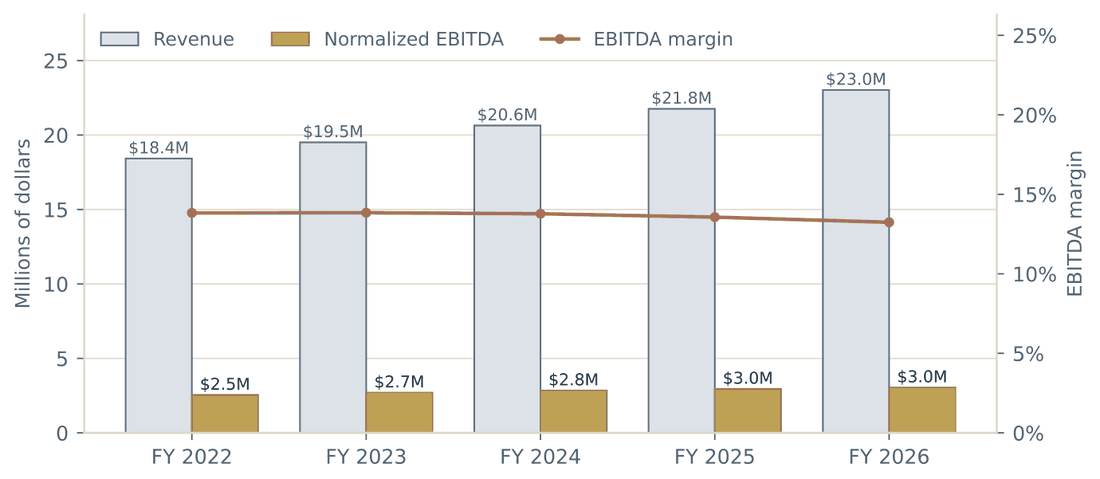
Revenue compounded at 5.7 percent over the five years. Normalized earnings compounded at 4.6 percent. The gap between those two figures is the whole story of this business at this moment: revenue is growing and margin is not, because the rate increases the shop has pushed through have been consumed by the wage increases it has had to pay to keep the technicians who bill those hours. Margin fell from 13.8 percent in fiscal 2022 to 13.2 percent in fiscal 2026.
This matters in Section 13, where management projects margin expanding to 13.8 percent. Nothing in the five year record points that way, and the published labor cost evidence in Section 10 points the other way.
12. Normalizing Earnings
Reported earnings of a company owned by the two people who run it reflect their compensation choices and their tax planning. Normalization restates them as the earnings the plan would inherit. Every adjustment below is supported by a document.
Exhibit 15. Overhead as reported
| Overhead item | Amount | Percent of revenue |
|---|---|---|
| Salaries and wages, management, quality, records, purchasing, and administration | $2,180,000 | 9.47% |
| Payroll taxes and employee benefits on overhead payroll | $523,200 | 2.27% |
| Ground rent, Brenner | $76,143 | 0.33% |
| Facility rent, Tolliver, payable to an entity owned by the sellers | $214,500 | 0.93% |
| Utilities | $198,400 | 0.86% |
| Insurance, products liability, hangarkeepers, and general | $412,000 | 1.79% |
| Repairs and maintenance | $164,800 | 0.72% |
| Tooling, calibration, and shop supplies not charged to work orders | $286,500 | 1.24% |
| Training and certification | $178,400 | 0.77% |
| Technical data subscriptions, software, and enterprise systems | $246,900 | 1.07% |
| Professional fees, legal, and audit | $164,000 | 0.71% |
| Property and personal property taxes | $142,600 | 0.62% |
| Marketing and travel | $138,200 | 0.60% |
| Other administrative | $118,700 | 0.52% |
| Total overhead | $5,044,343 | 21.91% |
Exhibit 16. Normalization of earnings
| Amount | |
|---|---|
| Gross margin, all lines | $7,405,217 |
| Less total overhead | ($5,044,343) |
| EBITDA as reported | $2,360,874 |
| Shareholder compensation in excess of market for the roles performed | $620,000 |
| Aircraft, vehicles, travel, and club dues not required by the operation | $182,000 |
| Nonrecurring write off of the abandoned enterprise system implementation | $164,000 |
| Tolliver rent restated from the related party rate to market | $51,700 |
| Technical data subscriptions restated to the renewal quotation | ($47,000) |
| Workers compensation experience modifier restated to the current factor | ($62,000) |
| Nonrecurring gain on the disposal of surplus tooling | ($34,500) |
| Recurring cost of employee stock ownership plan administration | ($186,000) |
| Total normalization adjustments | $688,200 |
| Normalized EBITDA | $3,049,074 |
Exhibit 17. Support for each adjustment
| Adjustment | Support |
|---|---|
| Shareholder compensation in excess of market | The two shareholders draw $1,140,000 between them. Compensation survey data for a president and a director of maintenance at a shop of this size, and two offers made to outside candidates in the last two years, support $520,000 for the roles as performed |
| Aircraft, vehicles, travel, and club dues | Identified from the general ledger detail and confirmed by the controller. A single engine aircraft titled in the company, two vehicles, and four club memberships. None is required by the operation and none is included in the assets valued |
| Abandoned enterprise system implementation | A 2025 write off of capitalized implementation cost on a system the company did not adopt. Nonrecurring |
| Tolliver rent restated to market | The company pays a related party $9.75 per square foot. Three arm's length leases at comparable airports and the sponsor's own published rate support $7.40 |
| Technical data subscriptions restated | Two manufacturer data subscriptions renew in the coming year at rates already quoted, $47,000 above the trailing expense. A buyer inherits the higher number |
| Workers compensation experience modifier | The company's experience modifier rose following two 2025 claims. The premium at the current factor is $62,000 above the trailing expense |
| Gain on disposal of surplus tooling | A 2026 gain on the sale of tooling for a type the shop no longer supports. Nonrecurring and removed |
| Cost of employee stock ownership plan administration | Trustee fees, the annual independent valuation, third party administration, the plan audit, and repurchase administration. These are recurring costs the company does not have today and will have every year after closing. Quoted at $186,000 and deducted |
Four of the eight adjustments reduce earnings. The last of them is the one most often omitted, and omitting it flatters the enterprise value by roughly $769,847 at the multiple this report concludes. An ESOP company carries costs a private company does not, every year, and a buyer that ignores them is valuing a company that will not exist after closing.
13. Management's Projection and the Seven Metric Test
The sellers' financial advisor built its conclusion on a projection management prepared in support of the transaction. The published process standard requires that projection to be assessed for reasonableness against the company's own five year history and against comparable company data on seven metrics, and requires that where the projection meets or exceeds historical performance the material assumptions supporting it be documented and explained. We ran that test.
Exhibit 18. Management's projection against the five year history
| Metric | Five year history | Management projection | This report | Basis |
|---|---|---|---|---|
| Revenue growth | 5.7% | 5.8% | 4.6% | Compound annual, five years |
| EBITDA margin | 13.7% | 13.8% | 13.2% | Normalized, five year average |
| EBIT margin | 11.6% | 11.7% | 11.1% | Normalized less depreciation |
| Return on assets | 14.2% | 23.8% | 14.6% | Earnings before interest and tax over total assets |
| Return on equity | 23.1% | 41.2% | 23.8% | Net income over book equity |
| Capital expenditure to revenue | 2.2% | 1.8% | 2.4% | Five year average against the projection |
| Free cash flow to revenue | 5.1% | 10.9% | 5.3% | After tax, after capital and working capital |
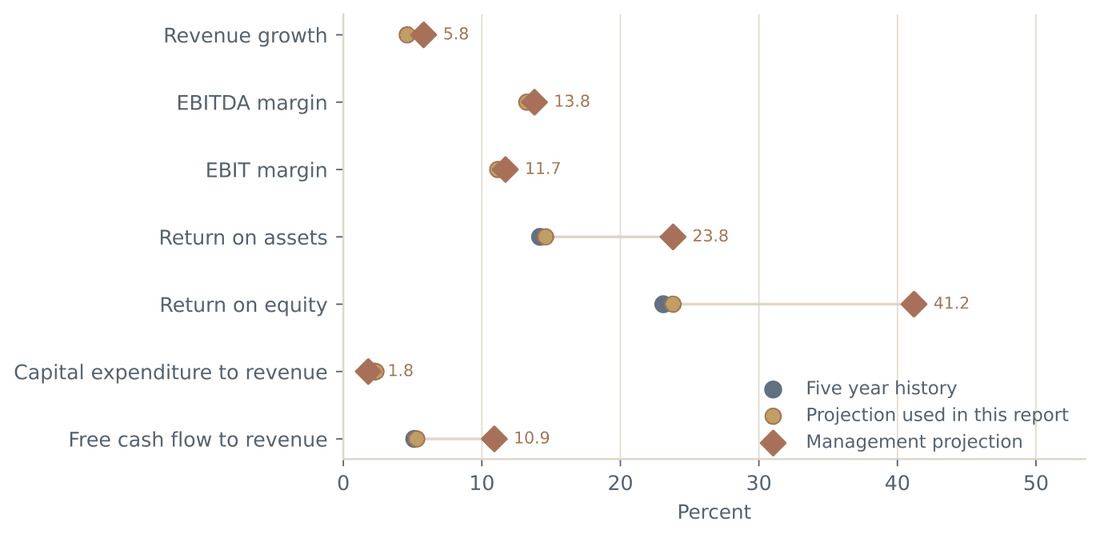
What the test shows, and what it misses
Three of the seven metrics fail the test outright. Management projects return on assets of 23.8 percent against a five year history of 14.2 percent, return on equity of 41.2 percent against 23.1 percent, and free cash flow of 10.9 percent of revenue against 5.1 percent. Those are not refinements of the historical record. They are a different business.
A fourth fails in the direction that flatters value while looking conservative. Management projects capital expenditure at 1.80 percent of revenue against a five year average of 2.21 percent. Lower capital spending raises free cash flow and therefore raises value. In a business that depends on calibrated test equipment, tooling, and a paint booth, a forecast below the historical average needs an explanation, and none was offered.
Now the part the seven metric test does not catch. Management projects revenue growth of 5.8 percent. The five year history is 5.7 percent. On the test as written, the projection passes: it is below the historical rate. It is nonetheless unachievable, because the historical rate was produced by rate increases and by one heavy inspection program that ran through fiscal 2024 and 2025 and has ended, and because the shop is at 71.5 percent utilization with two positions it has been unable to fill for eleven months. Revenue growth cannot be assessed without asking where the hours come from.
A projection can satisfy every element of the published standard and still be wrong. The standard asks whether the projection is reasonable against history. It does not ask whether the company has the people to deliver it. For a business whose revenue is technicians multiplied by hours multiplied by a rate, that second question is the one that decides the answer.
14. The Projection We Developed
Revenue at a repair station is billable technicians, multiplied by available hours, multiplied by utilization, multiplied by a rate. We projected each of the four rather than projecting the product.
Exhibit 20. Capacity model underlying the growth rate
| Driver | At the effective date | In projection year five | Basis |
|---|---|---|---|
| Billable technicians | 64 | 68 | Four net additions over five years. Against a national shortfall of 17,800 certificated mechanics rising to 22,000 by 2027, and a local pipeline producing fewer graduates than in 2023, four is what the company can realistically hire and keep |
| Available hours per technician | 1,850 | 1,850 | Held constant. Net of holiday, vacation, and recurrent training |
| Utilization | 71.5 percent | 71.5 percent | Held constant at the three year average. The shop is near the practical ceiling for an operation that also staffs an aircraft on ground desk |
| Blended billed rate | $172.00 | $202.81 | Growing 3.35 percent a year. Below the 5.5 to 6.0 percent labor cost growth reported for the sector, which is why margin compresses rather than holds |
| Implied revenue growth | 4.61 percent | The product of technician growth of 1.22 percent and rate growth of 3.35 percent |
Exhibit 21. Projection assumptions
| Assumption | Value | Basis |
|---|---|---|
| Explicit projection period | 5 years | Standard for a going concern of this kind. Long enough for the capacity model to work through, short enough to be tested |
| Revenue growth | 4.61 percent | Exhibit 20 |
| EBITDA margin | 13.2 percent | Held at the normalized level, which is below the five year average of 13.7 percent. Not expanded |
| Depreciation and amortization | 2.10 percent of revenue | Five year average |
| Capital expenditure | 2.35 percent of revenue | Above the five year average of 2.21 percent, because two avionics test benches and the paint booth filtration reach the end of their useful lives inside the projection period |
| Working capital | 17.4 percent of revenue, charged on the change | Trailing twelve month average. Work in process on open repair orders is the largest element |
| Effective tax rate | 25.5 percent | Blended federal and state on a C corporation basis. Section 19 explains why the S corporation election the buyer will make is not reflected in fair market value |
| Long term growth | 2.75 percent | Below the projected rate growth, reflecting a market in which the constraint is labor rather than demand |
| Terminal value | Constant growth, with the cost of re providing the premises carried in | Section 16 |
| Discounting convention | Mid year on the explicit period, end of year on the terminal value | The explicit cash flows arrive through the year. The terminal value is a value at the end of year five and is discounted as one. Discounting it at mid year would raise the indication by roughly $610,118 |
Our projection is lower than management's on every metric except capital expenditure, where it is higher. That is not conservatism for its own sake. It is what happens when a projection is built from the four things that actually produce revenue at a repair station instead of from a growth rate applied to last year.
15. Discount Rate
Exhibit 22. Cost of equity, modified capital asset pricing model
| Component | Rate | Basis |
|---|---|---|
| Risk free rate | 4.55 percent | Twenty year United States Treasury at the effective date |
| Equity risk premium | 5.00 percent | Long horizon supply side estimate |
| Size premium | 4.85 percent | Smallest capitalization decile |
| Industry risk adjustment | 0.55 percent | Aviation support services |
| Company specific risk premium | 3.85 percent | Itemized in Exhibit 23 |
| Cost of equity | 18.80 percent |
Exhibit 23. Company specific risk premium, itemized
| Factor | Basis points |
|---|---|
| Customer concentration, largest customer 18.4 percent of revenue and top five 47.2 percent | 110 |
| Certificate dependence and the accountable manager requirement | 75 |
| Technician scarcity and direct labor attrition | 90 |
| Key person concentration in the director of maintenance and chief inspector | 80 |
| Single primary facility on a ground lease with seven years to run | 30 |
| Total company specific risk premium | 385 |
The allowance for the ground lease is 30 basis points and no more, because the reversion is already in the cash flow model. Section 16 carries the cost of re providing the premises through the terminal value. What the 30 points cover is the residual: the sponsor's consent right on a change of control, the possibility that the ten year option is refused, and the disruption a relocation would cause. Loading the reversion itself into the discount rate as well would price the same risk in two places.
Exhibit 24. Weighted average cost of capital
| Component | Weight | Rate | Weighted |
|---|---|---|---|
| Debt, after tax at 25.5 percent | 30% | 6.07% | 1.822% |
| Equity | 70% | 18.80% | 13.160% |
| Weighted average cost of capital | 100% | 14.982% | |
| Rounded, and used in Section 16 | 15.00% |
The 30 percent debt weight is the structure an industry participant would carry, not the structure this transaction creates. Fair market value is the price between a hypothetical willing buyer and a hypothetical willing seller, and the leverage a particular buyer chooses to use is a financing decision rather than an attribute of the company. Section 23 uses the actual proposed structure, because that section is asking a different question.
The sellers' advisor used 14.50 percent. The difference of 50 basis points is the one on which reasonable professionals most often disagree, and it is worth $688,372. It ranks sixth of the 11 methodological differences Section 27 identifies. Three of them are larger, and none of the three is about a rate.
16. Income Approach
Exhibit 25. Discounted cash flow Illustrative figures for a sample engagement.
| Year | Revenue | Margin | EBITDA | D and A, memo | Taxes | Capital | Working capital | Cash flow | Factor | Present value |
|---|---|---|---|---|---|---|---|---|---|---|
| 1 | $24,086,668 | 13.2% | $3,189,659 | $505,820 | ($684,379) | ($566,037) | ($184,723) | $1,754,521 | 0.9325 | $1,636,099 |
| 2 | $25,197,242 | 13.2% | $3,336,726 | $529,142 | ($715,934) | ($592,135) | ($193,240) | $1,835,417 | 0.8109 | $1,488,291 |
| 3 | $26,359,021 | 13.2% | $3,490,573 | $553,539 | ($748,944) | ($619,437) | ($202,150) | $1,920,043 | 0.7051 | $1,353,837 |
| 4 | $27,574,366 | 13.2% | $3,651,515 | $579,062 | ($783,475) | ($647,998) | ($211,470) | $2,008,571 | 0.6131 | $1,231,530 |
| 5 | $28,845,748 | 13.2% | $3,819,876 | $605,761 | ($819,599) | ($677,875) | ($221,220) | $2,101,181 | 0.5332 | $1,120,271 |
Exhibit 26. Terminal value and conclusion
| Amount | Method | |
|---|---|---|
| Present value of the explicit period | $6,830,028 | Five years at 15.00 percent, mid year convention |
| Terminal cash flow, year six | $2,158,964 | Year five grown at 2.75 percent |
| Capitalized at 15.00 percent less 2.75 percent | $17,624,195 | Constant growth |
| Less the present value of re providing the premises | ($669,852) | The step from $0.46 to $1.34 per square foot from June 30, 2033, after tax, capitalized and lagged to the terminal date |
| Terminal value | $16,954,343 | |
| Present value of the terminal value | $8,429,305 | Discounted five years at 15.00 percent |
| Indicated enterprise value | $15,259,333 | 5.00 times normalized EBITDA |
The terminal value is 55 percent of the indicated enterprise value. That share is high, and it is high in every five year discounted cash flow of a stable business. It does not follow that the discount rate is what decides the answer. Section 27 shows the opposite: the three explicit period assumptions move the value by $2,547,795
between them against $688,372 for the rate, because the explicit period assumptions also drive the terminal cash flow they are capitalizing. The high terminal share is why the treatment of the ground lease belongs in the terminal value rather than in a footnote: $669,852 of the terminal value is removed by the cost of re providing premises the company will not own after June 30, 2033.
17. Market Approach
Transactions in privately held maintenance businesses are not public, and the published multiple literature for aviation service companies is thin. What exists supports a range rather than a point, and the range is wide enough that the market approach is a check on the income approach rather than a substitute for it.
Exhibit 27. Guideline evidence considered
| Segment | Enterprise value to EBITDA | Relevance to the subject |
|---|---|---|
| Business aviation airframe and avionics MRO, single location | 4.10 to 5.30 | The closest single comparison. The subject is larger and holds more ratings |
| Business aviation MRO, multiple locations with OEM authorizations | 5.20 to 6.80 | Relevant to the extent the subject's two locations and four manufacturer authorizations resemble the set. Two of the four terminate on a change of control |
| Component and accessory overhaul specialist | 5.60 to 7.40 | Relevant to the accessory and component shop, which is 8.3 percent of gross margin |
| Line maintenance and field service operator | 3.40 to 4.60 | Relevant to the Tolliver line station |
Exhibit 28. Concluded multiple
| Multiple | Enterprise value | |
|---|---|---|
| Range concluded for a business of this description | 4.60 to 6.60 | |
| Base multiple concluded | 5.40x | $16,465,000 |
| Customer concentration adjustment, less 8 percent | 4.968x | $15,147,800 |
| Ground lease term adjustment, less 6 percent | 4.670x | $14,238,932 |
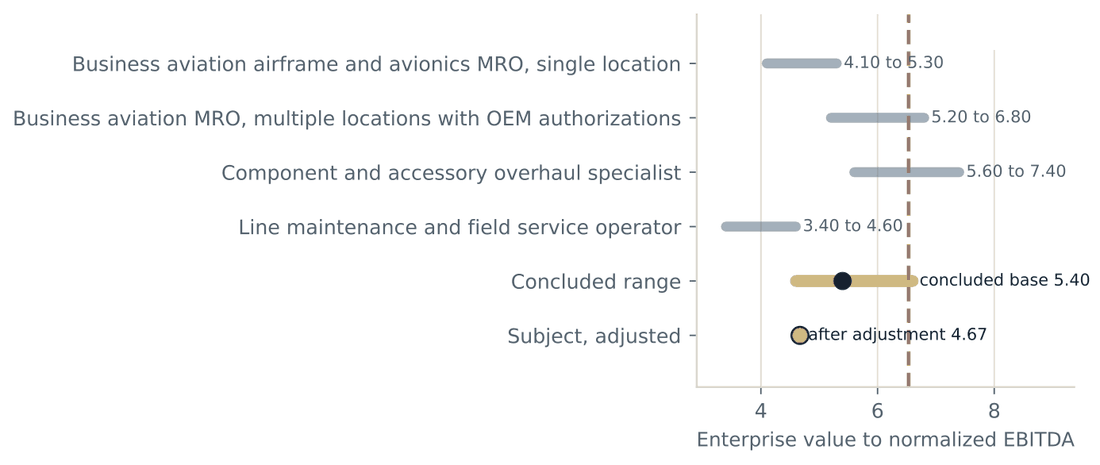
The two adjustments are modest and they are specific. Concentration reduces the multiple because a buyer of a business whose largest customer is 18.4 percent of revenue on purchase orders prices that fact. The ground lease reduces it because seven years of remaining term at the principal facility is short against the set, which is drawn from operators on longer tenure or on owned real estate.
The result is 4.670 times normalized EBITDA, or $14,238,932 of enterprise value, against $15,259,333 from the income approach. The two indications differ by 7.2 percent. Section 18 weights them 60 percent to the income approach and 40 percent to the market approach, because the income approach models the capacity constraint and the reversion directly while the market approach can only carry them as adjustments to a multiple.
The price proposed in the term sheet implies 6.53 times normalized EBITDA on an enterprise basis. That sits inside one of the four ranges in Exhibit 27, the one for multiple location operators holding manufacturer authorizations, and above the top of the other three. It is worth saying plainly that this is the segment the subject most resembles. The reason the subject does not earn that segment's multiple is that two of its four authorizations terminate on a change of control and had not been consented to when this report was written, which is Section 8 and is why Recommendation 6 asks for the consents.
18. Component Decomposition and the Transferability Haircut
A single enterprise value hides the fact that the enterprise is made of four things that behave differently. One reverts to a landlord in seven years. One can be loaded onto a truck. One turns over every ninety days. And one exists at the acceptance of a federal administrator and in the memory of a handful of customers.
Exhibit 30. Weighted enterprise value before adjustment
| Approach | Indication | Weight | Weighted |
|---|---|---|---|
| Income approach, Section 16 | $15,259,333 | 60% | $9,155,600 |
| Market approach, Section 17 | $14,238,932 | 40% | $5,695,573 |
| Enterprise value before the haircut | 100% | $14,851,173 |
Exhibit 31. The four components
| Component | Value | How it was measured | How it behaves |
|---|---|---|---|
| Real property, the leasehold improvements over the remaining term | $1,906,708 | Depreciated leasehold improvements of $3,050,000, multiplied by the ratio of the present value annuity factor over the 7.0 years remaining to the factor over the 18 year weighted remaining economic life, both at 11.75 percent | Reverts to the sponsor. Terminal value to the company is zero |
| Tangible personal property and tooling | $3,350,000 | Fair value in continued use from management's schedule, our inspection, and published used equipment data. Exhibit 32 | Moves. It is the only component that survives a reversion or a relocation intact |
| Working capital | $3,616,000 | Receivables, parts inventory, work in process, and prepaid expenses, net of payables and customer deposits | Turns over. It is realizable and it is the least uncertain component |
| Certificate and relationship intangible | $5,978,465 | The residual. Enterprise value less the three components above | Does not transfer on its own terms. Section 8 sets out why |
Exhibit 32. Tangible personal property at fair value in continued use
| Asset | Fair value |
|---|---|
| Airframe and structures tooling, jigs, and fixtures | $1,180,000 |
| Avionics test equipment and benches | $964,000 |
| Accessory shop equipment | $388,000 |
| Non destructive inspection equipment | $246,000 |
| Ground support equipment and tugs | $214,000 |
| Vehicles and mobile service units | $186,000 |
| Enterprise systems, technical data terminals, and office equipment | $172,000 |
| Leasehold improvements at Brenner, depreciated | $2,640,000 |
| Leasehold improvements at Tolliver, depreciated | $410,000 |
| Total | $6,400,000 |
| Less leasehold improvements, carried in the real property component | ($3,050,000) |
| Tangible personal property component | $3,350,000 |
Exhibit 33. The transferability haircut
| Factor | Haircut |
|---|---|
| The repair station certificate is not transferable, and 14 CFR 145.57(b) requires a new or amended certificate where assets are transferred | 6.0% |
| Accountable manager, chief inspector, and director of maintenance are named to the certificate and are not under contract beyond closing | 4.8% |
| Two OEM service authorizations terminate on a change of control unless renewed | 3.9% |
| Customer relationships run to individuals rather than to the company, and the largest account is served on purchase orders rather than a contract | 3.0% |
| EASA approval is derived from the FAA certificate through the bilateral agreement and follows its status | 1.8% |
| Concluded transferability haircut | 19.5% |
Exhibit 34. Effect of the haircut on enterprise value
| Amount | |
|---|---|
| Certificate and relationship intangible, before | $5,978,465 |
| Haircut at 19.5 percent | ($1,165,801) |
| Certificate and relationship intangible, after | $4,812,664 |
| Real property, tangible personal property, and working capital, unchanged | $8,872,708 |
| Enterprise value after the haircut | $13,685,372 |
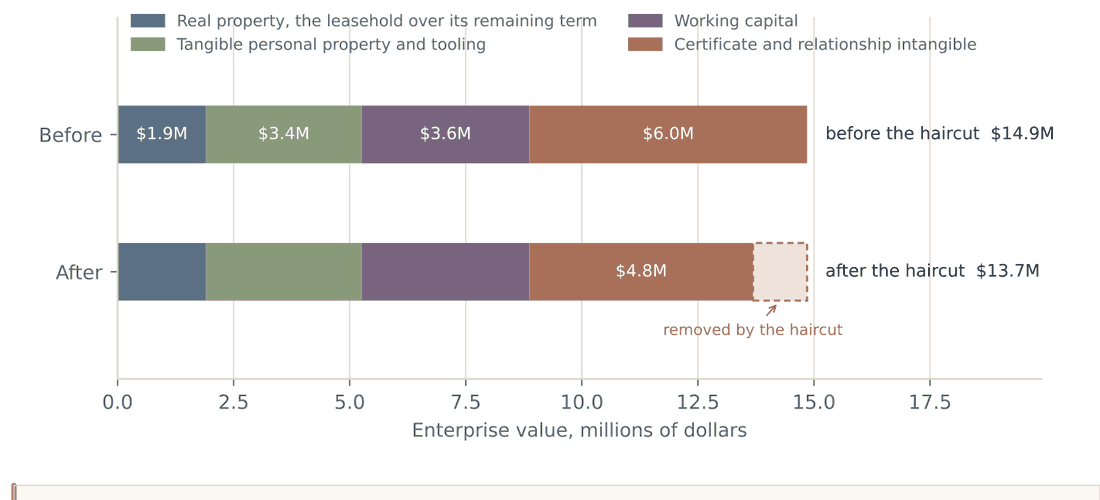
The haircut applies to one component and not to the enterprise. Reducing the whole enterprise by 19.5 percent would take $2,895,979 off a business whose tooling, receivables, and inventory transfer without difficulty. Reducing only the component that does not transfer takes $1,165,801. The difference is not a rounding convention. It is the difference between an adjustment that can be defended line by line and a discount applied to a number because it felt too high.
19. From Enterprise Value to Equity Value
Exhibit 36. Equity bridge
| Amount | Note | |
|---|---|---|
| Enterprise value after the haircut, Section 18 | $13,685,372 | |
| Less interest bearing debt | ($2,260,000) | Equipment notes and the drawn revolver at the effective date |
| Add cash and equivalents | $1,840,000 | None of it is required as an operating balance. Working capital is carried separately |
| Equity value, controlling and marketable | $13,265,372 |
Exhibit 37. Balance sheet items at the effective date
| Item | Amount |
|---|---|
| Cash and equivalents | $1,840,000 |
| Accounts receivable, net | $3,140,000 |
| Parts and materials inventory | $2,480,000 |
| Work in process on open repair orders | $860,000 |
| Prepaid expenses and deposits | $186,000 |
| Accounts payable and accrued liabilities | ($2,410,000) |
| Customer deposits on scheduled inspections | ($640,000) |
| Net working capital, excluding cash | $3,616,000 |
The S corporation election, and why it is not in this number
On closing the company will elect S corporation status. Because a plan is a tax exempt shareholder, a company owned entirely by an employee stock ownership plan pays no federal income tax. That is a real and substantial benefit. It is the reason ESOP transactions can carry leverage that would be imprudent in a taxable company, and Section 23 relies on it when it tests whether this company can service the debt.
It is not in fair market value, and stating that plainly is worth doing because it is one of the places this report runs against the sellers. Fair market value is the price between a hypothetical willing buyer and a hypothetical willing seller. The exemption from federal income tax is not available to the universe of hypothetical buyers. It is available to this buyer because of what this buyer is. Adding it to fair market value would let the plan pay the seller for a benefit the plan itself creates, and the correct treatment is to value the company on a taxed basis and to let the plan keep the benefit of its own status.
Had we taken the other view, the indicated value would have been materially higher and the plan would have paid the sellers for a benefit the plan itself creates. We note it because the sellers' analysis takes the other view, and because a trustee reading two reports with different answers is entitled to know where they diverge.
20. Control: What the Plan Obtains and What It Does Not
The plan is buying one hundred percent of the stock, so the question of whether to add a control premium looks settled. It is not. What a control premium pays for is the ability to change things, and this plan will acquire a company whose two most important assets sit outside its control.
Exhibit 38. Attributes of control, tested one at a time
| Attribute | What the plan obtains | Assessment |
|---|---|---|
| Board | The ESOP appoints the full board through the trustee | Obtained |
| Voting on major corporate transactions | Passed through to participants by statute | Obtained |
| Compensation and capital allocation | Board level, therefore trustee controlled | Obtained |
| Premises | The Brenner ground lease requires sponsor consent to a change of control and the sponsor's minimum standards bind the company | Shared |
| Certificate | The repair station certificate is held subject to FAA oversight and named personnel; the company cannot transfer it or operate without it | Not obtained |
| Tolliver premises | Leased from an entity the sellers will continue to own | Not obtained |
We applied no control premium and we took no discount for lack of control. The reasoning is the same in both directions. The plan will appoint the board through the trustee, and the earnings in Section 12 are stated on a control basis because shareholder compensation has already been normalized to market. A premium on top of control level earnings would charge the plan twice for the same thing, which is the error the Fourth Circuit itemized at $8,186,000 in the case discussed in Section 4.
Against that, the company cannot transfer its own premises without the sponsor's consent, cannot operate without a certificate held at the Administrator's acceptance, cannot change the individuals named to that certificate without notification and acceptance, and leases one of its two facilities from the people selling it the company. A buyer of one hundred percent of this company does not obtain the freedom of action a control premium assumes. The sellers' analysis applies a premium of 7 percent. Section 27 removes it, worth $1,091,466.
21. Marketability and the Put Option
A minority interest in a private company is illiquid, and the discounts observed in the restricted stock studies cluster in the twenty five to forty percent range, with the pre offering studies higher still. An ESOP participant is in a different position, because the Internal Revenue Code gives them a right to make the company buy their shares back at fair market value.
Exhibit 39. What the put option does, and what it does not
| Consideration | Direction |
|---|---|
| Statutory put option under IRC 409(h) gives participants a right to sell at fair market value, which removes most of the illiquidity a private minority interest carries | Reduces |
| The put is only as good as the company's ability to fund it, and Section 23 shows the repurchase obligation competing with acquisition debt and mandatory facility capital | Increases |
| Distribution may be made in five annual installments, which spreads the call on cash but lengthens the participant's wait | Increases |
| Earnings are cyclical, and the obligation to repurchase does not pause in a downcycle | Increases |
| Concluded discount for lack of marketability | 8.0% |
Discounts in the range of five to ten percent are customary for ESOP shares, against the range just described for private minority interests without a put. We concluded 8.0 percent, toward the upper end of the customary range. The reason is Section 23. The put is a promise by the company, and its value depends on the company having the cash to honour it. A company carrying acquisition debt, mandatory facility capital, and a growing repurchase obligation against cyclical earnings is a company whose put is worth less than the put of a company with no debt. An appraiser cannot remove the marketability discount on the theory that repurchases are fully funded and at the same time ignore the cost of funding them.
The five year installment distribution policy pulls the same way. It spreads the call on the company's cash, which is prudent, and it lengthens the wait for the participant, which is a real cost to the person holding the share.
Exhibit 40. Effect on value
| Amount | |
|---|---|
| Equity value, controlling and marketable, Section 19 | $13,265,372 |
| Discount for lack of marketability at 8.0 percent | ($1,061,230) |
| Indicated fair market value | $12,204,142 |
| Rounded | $12,200,000 |
22. The Repurchase Obligation
Every share the plan allocates is a share the company will one day have to buy back at fair market value. The obligation is contractual, it is cumulative, and it does not appear on the balance sheet on the day of the transaction. It is the single largest item a formation valuation can leave out and still look complete.
Exhibit 41. Plan and participant assumptions
| Assumption | Value | Basis |
|---|---|---|
| Participants at closing | 104 | Employees with a year of service. Eight of the 112 employees are not yet eligible |
| Eligible payroll | $7,420,000 | The contribution base |
| Average participant age | 41.6 years | From the census |
| Participants within seven years of retirement | 14 | The wave that drives the obligation in projection years three through eight |
| Annual turnover | 11.5 percent | Five year average, excluding retirements |
| Vesting | 6 year straight line | As drafted. Faster than the statutory graded minimum, which vests nothing before year two |
| Share release | 10 years | Straight line with the internal loan amortization |
| Distribution policy | 5 annual installments beginning the year after separation | As drafted. It spreads the call on cash and lengthens the participant's wait |
Exhibit 42. Projected repurchase obligation at fair market value Cash required is net of the installment schedule. Balances put back in years seven through ten are still being paid out after year ten, which is why the two totals differ.
| Plan year | Shares released | Vested share | Separation rate | Balances put back | Cash required, net of installments |
|---|---|---|---|---|---|
| 1 | 10% | 17% | 11.5% | $24,085 | $0 |
| 2 | 20% | 33% | 11.5% | $99,230 | $4,817 |
| 3 | 30% | 50% | 13.7% | $274,829 | $24,663 |
| 4 | 40% | 67% | 13.7% | $503,243 | $79,629 |
| 5 | 50% | 83% | 13.7% | $809,907 | $180,277 |
| 6 | 60% | 100% | 13.7% | $1,201,253 | $342,259 |
| 7 | 70% | 100% | 13.7% | $1,443,506 | $577,692 |
| 8 | 80% | 100% | 13.7% | $1,699,213 | $846,548 |
| 9 | 90% | 100% | 11.5% | $1,647,537 | $1,131,424 |
| 10 | 100% | 100% | 11.5% | $1,885,515 | $1,360,283 |
| Ten year total | $9,588,317 | $4,547,592 |
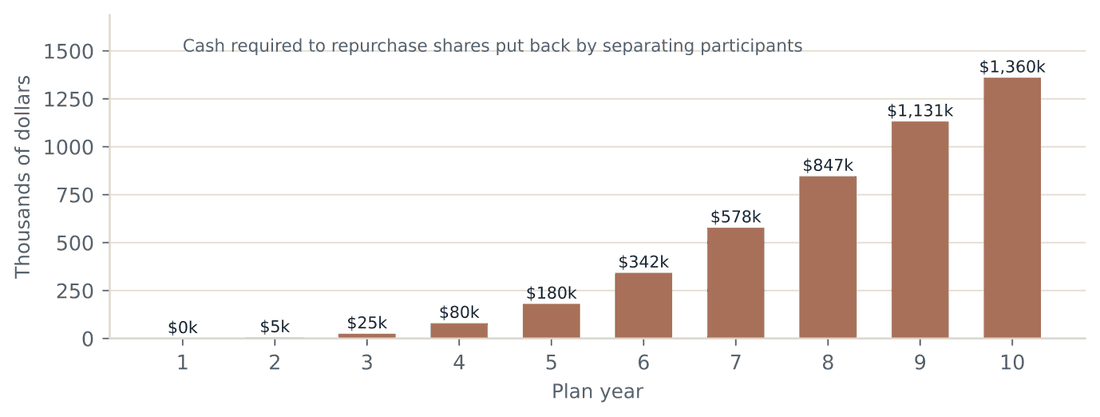
The obligation starts at nothing, because no participant has separated and no share has vested. It reaches $180,277 by plan year five and $1,360,283 by plan year ten, and it keeps rising after that as the release schedule
completes and the retirement wave arrives. The company will be paying it out of the same cash flow that services the acquisition debt.
A repurchase obligation calculated at the transaction price rather than at fair market value is larger, because every share is worth more. Overpaying at formation does not only cost the participants the excess. It raises every repurchase the company will make for the next twenty years, which is a second and continuing cost that a single overpayment figure does not capture.
23. The Three Way Liquidity Claim
This is the section that should decide the transaction. An aviation service business inside a leveraged employee stock ownership plan has to do three things with one stream of cyclical cash: service the acquisition debt, fund the facility capital its operations require, and buy back the shares of everyone who leaves. The three compete, and a downcycle brings them into direct conflict.
Exhibit 44. The structure proposed, and the structure at fair market value
| At the proposed price | At fair market value | |
|---|---|---|
| Purchase price | $19,500,000 | $12,200,000 |
| Senior term loan | $7,800,000 | $4,880,000 |
| Seller notes | $10,500,000 | $6,120,000 |
| Company cash contributed | $1,200,000 | $1,200,000 |
| Senior terms | 7 years at 8.15 percent | 7 years at 8.15 percent |
| Seller note terms | 15 years at 9.50 percent, 3 years interest only | 15 years at 9.50 percent, 3 years interest only |
| Senior covenant | Fixed charge coverage of 1.20 times | Fixed charge coverage of 1.20 times |
| Years of ten breaching the covenant | 7 | 0 |
Two conventions are worth stating before the schedule. First, after closing the company will be a one hundred percent employee owned S corporation and will pay no federal income tax, so the cash available is measured before federal tax and after a state provision of 2.5 percent. Second, projection year 8 carries $1,450,000 of facility capital, because that is the year after the ground lease expires and the company will be paying to re provide premises whatever form that takes.
Exhibit 45. The three claims at the proposed price of $19,500,000 Illustrative figures for a sample engagement.
| Yr | EBITDA | Capital | Working cap. | State tax | Debt service | Repurch. | Available | Cover, debt | Cover, all three |
|---|---|---|---|---|---|---|---|---|---|
| 1 | $3,189,659 | ($566,037) | ($184,723) | ($26,266) | ($2,503,359) | ($0) | $2,412,633 | 0.96 | 0.96 |
| 2 | $3,336,726 | ($592,135) | ($193,240) | ($31,133) | ($2,503,359) | ($7,699) | $2,520,218 | 1.01 | 1.00 |
| 3 | $3,490,573 | ($619,437) | ($202,150) | ($36,286) | ($2,503,359) | ($39,420) | $2,632,701 | 1.05 | 1.04 |
| 4 | $3,651,515 | ($647,998) | ($211,470) | ($41,745) | ($3,009,330) | ($127,275) | $2,750,301 | 0.91 | 0.88 |
| 5 | $3,819,876 | ($677,875) | ($221,220) | ($48,731) | ($3,009,330) | ($288,148) | $2,872,049 | 0.95 | 0.87 |
| 6 | $3,996,001 | ($709,130) | ($231,420) | ($56,178) | ($3,009,330) | ($547,053) | $2,999,273 | 1.00 | 0.84 |
| 7 | $4,180,246 | ($741,826) | ($242,091) | ($64,117) | ($3,009,330) | ($923,361) | $3,132,212 | 1.04 | 0.80 |
| 8 | $4,372,986 | ($2,226,030) | ($253,253) | ($72,586) | ($1,503,471) | ($1,353,088) | $1,821,117 | 1.21 | 0.64 |
| 9 | $4,574,613 | ($811,811) | ($264,930) | ($78,555) | ($1,503,471) | ($1,808,424) | $3,419,318 | 2.27 | 1.03 |
| 10 | $4,785,537 | ($849,241) | ($277,145) | ($84,884) | ($1,503,471) | ($2,174,223) | $3,574,267 | 2.38 | 0.97 |
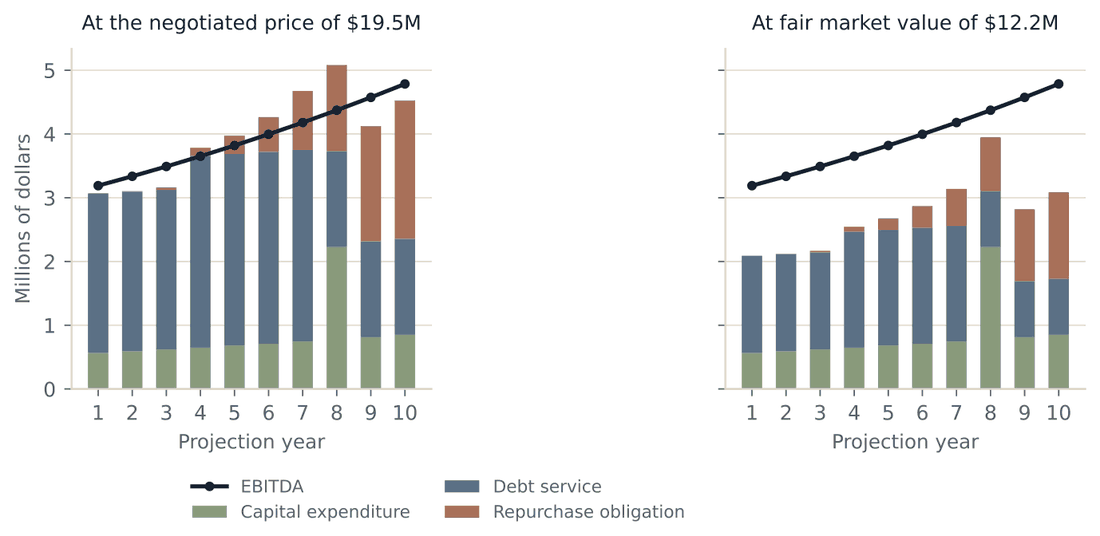
At the proposed price the company clears its covenant in 3 of ten years and falls below it in 7. In projection year one, before a single share has been repurchased, coverage is 0.96 against a covenant of 1.20. The structure is not tight. It does not work.
At fair market value the same structure clears the covenant in all ten years. The thinnest coverage is 1.50 in projection year 4, and it is worth knowing why that year rather than year 8 when the facility capital lands. Year 4 is the year the seller note's three year interest only period ends and debt service steps up by $294,909. The facility capital year is carried more easily because by then the senior loan is most of the way amortized.
Section 24 asks what happens when the projection does not hold.
24. Simulating the Downcycle
Business aviation maintenance is cyclical. Deferred inspections, parked aircraft, and customers stretching payables all arrive together, and they arrive without notice. A projection that holds for ten years is not a forecast, it is an assumption, and the trustee is entitled to know what happens when the assumption fails.
Exhibit 47. Simulation specification
| Variable | Distribution | Basis |
|---|---|---|
| Revenue growth | Normal, mean 4.61 percent, standard deviation 2.60 percent | The capacity model in Section 14, with the dispersion observed over the five year history |
| EBITDA margin | Normal, mean 13.2 percent, standard deviation 1.50 percent, bounded at 5.5 and 21.0 percent | The normalized margin, with dispersion reflecting labor cost pass through |
| A downcycle occurs | Bernoulli, probability 55 percent | Two general aviation downturns in the last twenty five years, plus the sector specific risk of an engine or airframe programme ending |
| Timing | Uniform across projection years two to eight | No basis for expecting it early or late |
| Depth and shape | First year revenue decline normal, mean 16.0 percent, standard deviation 5.5 percent, bounded at zero and 38 percent. Second year at 60 percent of the first, then full recovery | The shape of the 2008 and 2020 declines in business aviation maintenance demand |
| Trials | 20,000 | Sufficient for the percentile estimates reported |
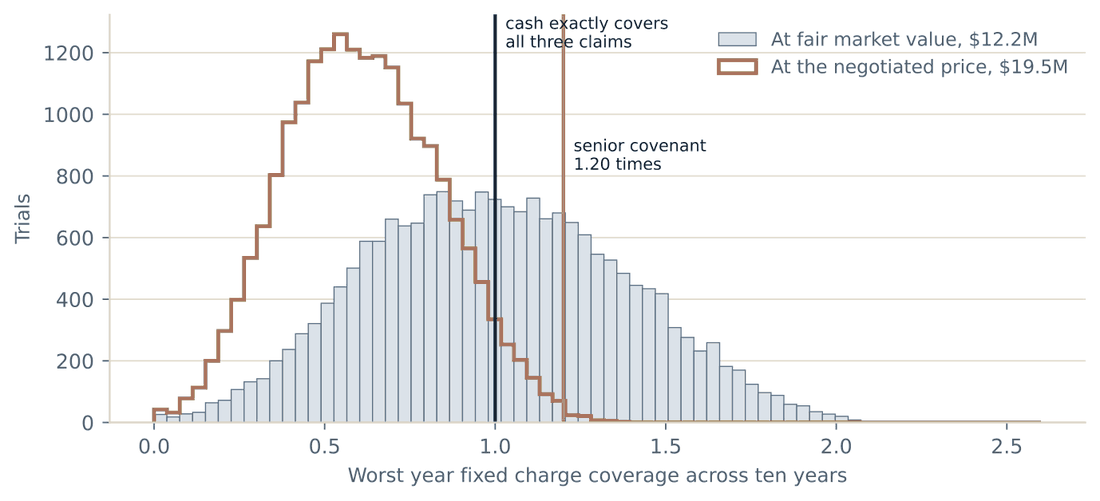
Exhibit 49. Simulation results
| Proposed price | Fair market value | Maximum supportable | Fair market value, restructured | |
|---|---|---|---|---|
| Price | $19,500,000 | $12,200,000 | $12,700,000 | $12,200,000 |
| Probability of breaching the senior covenant | 98.7 percent | 23.9 percent | 29.0 percent | 19.1 percent |
| Probability cash does not cover all three claims | 95.2 percent | 50.7 percent | 55.1 percent | 53.4 percent |
| Median worst year coverage on all three claims | 0.60 | 0.99 | 0.95 | 0.97 |
| Fifth percentile | 0.25 | 0.41 | 0.40 | 0.40 |
| Median worst year coverage on debt service alone | 0.86 | 1.40 | 1.35 | 1.56 |
At the proposed price the company breaches its senior covenant in 98.7 percent of paths. There is no reading of that number under which the price is prudent.
At fair market value the covenant holds in 76.1 percent of paths, which is a normal risk profile for a leveraged transaction. The second line is the one to read carefully. In 50.7 percent of paths the company's cash does not cover debt service, facility capital, and the repurchase obligation together. It will not default in those paths, because the repurchase obligation can be deferred within the plan's distribution rules in a way a loan payment cannot. What happens instead is that participants wait, which is the cost falling on the people the plan exists to benefit.
Exhibit 50. A structure the same price can carry
| Change | Proposed | Recommended | Effect |
|---|---|---|---|
| Senior tranche | 40 percent of price, capped at 2.75 times EBITDA | 30 percent of price, capped at 2.20 times EBITDA | Less amortizing debt in the early years |
| Seller note term | 15 years | 20 years | Lower annual amortization |
| Interest only period | 3 years | 5 years | Cash preserved through the facility capital year |
| Probability of breaching the senior covenant | 23.9 percent | 19.1 percent | At the same price |
Price and structure are two levers and the trustee has both. Correcting the price to fair market value is not optional, because paying more than fair market value is a prohibited transaction. Correcting the structure is discretionary and it is a trade rather than a free gain. It moves the risk of a covenant breach from 23.9 percent to 19.1 percent, and it raises the probability that cash does not cover all three claims from 50.7 percent to 53.4 percent, because a twenty year note keeps debt service competing with repurchases for five more years. The trustee is choosing between a risk that defaults the company and a risk that makes participants wait.
25. Opinion of Fair Market Value
Based on the analysis in Sections 11 through 21, and subject to the assumptions and limiting conditions in Section 3, our opinion of the fair market value of one hundred percent of the common stock of Cardington Aviation Services, Inc. as of June 30, 2026 is:
Exhibit 51. The conclusion tested against every metric in this report
| Metric | Value | Comment |
|---|---|---|
| Enterprise value to normalized EBITDA | 4.14x | Below the adjusted market multiple of 4.67 in Exhibit 28 and below the bottom of the guideline range, because the guideline range is stated before the transferability haircut in Section 18 and before the marketability discount in Section 21. Those two steps are worth 0.53 of multiple between them |
| Equity value to revenue | 0.53x | Well below the one times revenue rule of thumb sometimes quoted for maintenance businesses, which is a rule about revenue rather than about earnings |
| Income approach against market approach | 7.2 percent apart | Two methods built from different evidence, the market approach the lower of the two |
| Against the maximum the company can support | $12,700,000 | Fair market value is below the feasibility ceiling, so the price constraint binds rather than the structure constraint |
| Against tangible assets | $8,872,708 | The three transferable components. The intangible component after the haircut is $4,812,664, or 35 percent of enterprise value |
| Against the price proposed | $19,500,000 | 59.8 percent above. Section 27 reconciles the two |
26. The Maximum Price the Company Can Support
Fair market value answers what the stock is worth. It does not answer whether the company can carry the debt required to buy it. Those are different questions and a prudent trustee asks both.
We solved for the highest price at which the company clears its senior covenant in every projected year and still funds the repurchase obligation out of the same cash. The answer is $12,783,691, or $12,700,000 rounded.
Exhibit 52. The two constraints
| Constraint | Ceiling | Source | Binding |
|---|---|---|---|
| The plan may not pay more than fair market value | $12,200,000 | Section 25 | Yes |
| The company must be able to carry the price | $12,700,000 | Section 23 | No |
| Governing ceiling | $12,200,000 |
On this transaction the price constraint binds. That will not always be so. Where the structure is more leveraged, the seller note shorter, or the company more cyclical, the feasibility ceiling falls below fair market value and the trustee may not pay fair market value either. It is worth doing the arithmetic in both directions every time, because the order in which the two constraints bind is not predictable from the size of the company.
Two cautions about the figure. It is computed on the projection in Section 14, and Section 24 shows that the projection fails in a meaningful share of simulated paths. And it is computed on the structure proposed. Exhibit 50 shows a structure at the same price that carries materially less risk, which means the feasibility ceiling is a function of the financing terms as much as of the company.
27. Reconciling the Proposed Price to the Opinion
The sellers' financial advisor concluded to a value that supports the price in the term sheet. We conclude to $12,200,000. The difference is $7,300,000, and this section accounts for all of it.
Each line below is a re run of the same model with one assumption replaced. The order is disclosed because a sequential attribution of this kind is order dependent: the amount attributed to any single change depends on which changes have already been made. We ran the four operating assumptions through 6 orderings. The largest movement of any single item across those orderings was $90,107, so the ranking below is stable even though the individual figures are not exact.
Exhibit 53. From the sellers' conclusion to the opinion Illustrative figures for a sample engagement.
| Step | Value | Change |
|---|---|---|
| As concluded by the sellers' financial advisor | $19,949,848 | |
| Negotiated and rounded to the term sheet price | $19,920,000 | ($29,848) |
| Revenue growth restated from 5.8 percent to the tested 4.6 percent | $19,491,038 | ($428,962) |
| Margin expansion removed, margin held at the normalized 13.2 percent | $18,683,910 | ($807,128) |
| Capital expenditure restated from 1.80 percent of revenue to 2.35 percent | $17,372,205 | ($1,311,704) |
| Discount rate restated from 14.50 percent to 15.00 percent | $16,683,834 | ($688,372) |
| Control premium of 7 percent removed | $15,592,368 | ($1,091,466) |
| Cost of re providing the premises in 2033 carried into the terminal value | $15,259,333 | ($333,035) |
| Market approach weighted in at 40 percent | $14,851,173 | ($408,161) |
| Transferability haircut of 19.5 percent on the intangible component | $13,685,372 | ($1,165,801) |
| Interest bearing debt removed and cash added | $13,265,372 | ($420,000) |
| Marketability discount of 8.0 percent | $12,204,142 | ($1,061,230) |
| Rounded conclusion of fair market value | $12,200,000 | ($4,142) |
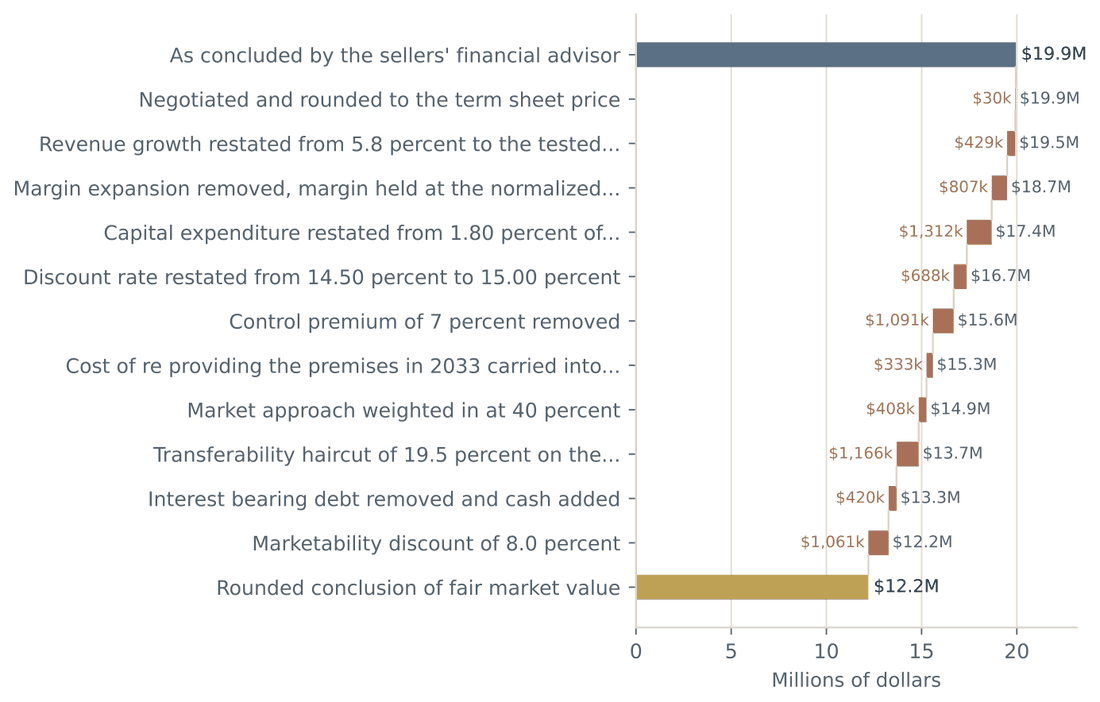
The four largest differences, in order, are capital expenditure restated from 1.80 percent of revenue to 2.35 percent at $1,311,704; transferability haircut of 19.5 percent on the intangible component at $1,165,801; control premium of 7 percent removed at $1,091,466; marketability discount of 8.0 percent at $1,061,230. Not one of them is a disagreement about the quality of this company or the ability of the people who run it. Every one is a disagreement about method.
The sellers' analysis is not incompetent. It is a conventional business valuation applied to a company that is not conventional: its principal asset reverts to a landlord in seven years, its earnings depend on a certificate that does not transfer, and its growth is limited by a labor market it does not control. A method that ignores those three facts will overstate the value of an aviation service business every time, and the amount by which it overstates it rises with the proximity of the lease expiry.
28. The Warrants
The term sheet grants the sellers warrants for 18 percent of the fully diluted equity in exchange for a reduction in the seller note rate. That trade should be priced rather than assumed, and it should be priced from the plan's side.
Exhibit 55. What the warrants take
| Struck at the proposed price | Struck at fair market value | |
|---|---|---|
| Strike | $19,500,000 | $12,200,000 |
| Equity value in year 10 at 6 percent growth | $21,848,342 | $21,848,342 |
| Intrinsic value at exercise | $2,348,342 | $9,648,342 |
| Value transferred from participants to sellers | $422,702 | $1,736,702 |
| Share of the participants' ten year gain | 4.4 percent | 18.0 percent |
Struck at fair market value the warrants take 18.0 percent of everything the participants build over ten years, which is what a warrant for 18 percent of the equity is designed to do. Struck at the proposed price they take much less, because the proposed price is so far above value that the company has to grow into it before the warrants are worth anything. That is not a defence of the proposed price. It is an illustration of how far above value it sits.
The withdrawn Department of Labor proposal would have excluded any transaction with seller warrants from its safe harbor, and its stated concern was excessive dilution of the plan. We are not aware of authority holding that warrants are unlawful. We are aware that a trustee that grants them should be able to say what they cost the participants and what the plan received in exchange. Section 30 states what we recommend.
29. Fairness of the Transaction to the Plan
The published process standard requires the valuation analysis to address whether the transaction is fair to the plan from a financial point of view, whether it is fair to the plan relative to all the other parties, and whether the financing terms are market based, commercially reasonable, and in the plan's best interests. We address each.
Exhibit 56. Fairness, item by item
| Question | Assessment | Basis |
|---|---|---|
| Is the transaction fair to the plan from a financial point of view, as proposed? | No | The price exceeds fair market value by $7,300,000. A plan that pays more than fair market value has not received fair value for its money, whatever else is true of the transaction |
| Would it be fair at fair market value? | Yes, subject to the structure | At $12,200,000 the price is supported by two approaches that differ by 7.2 percent, and the company clears its covenant in every projected year. Section 24 identifies the residual risk and Exhibit 50 shows the trade involved in reducing it |
| Is it fair to the plan relative to the other parties? | Not as proposed | The sellers receive a price above value, a note at 9.50 percent against senior debt at 8.15 percent, warrants for 18 percent of the equity, and a continuing above market lease on the Tolliver Regional Airport building. The plan receives the residual |
| Are the financing terms market based and commercially reasonable? | The senior debt, yes. The seller note, on balance yes. The warrants, not as proposed | The senior terms were quoted competitively. The seller note spread of 135 basis points over senior is within the range for subordinated seller paper. The warrants transfer 18.0 percent of the participants' ten year gain if struck at value, and the plan received a rate concession worth materially less |
| Can the company service the debt? | Not at the proposed price. Yes at fair market value, with the caveat in Section 24 | Sections 23 and 24 |
| Has the repurchase obligation been reflected? | Yes, in the projections and in the marketability discount | Section 22 models it and Section 21 explains why the discount is at the upper end of the customary range rather than the lower |
A fairness opinion that says yes is worth having only from an adviser that would have said no. This one says no as proposed, and sets out what would have to change for the answer to be different. Section 30 is that list.
30. What We Recommend to the Trustee
Exhibit 57. Recommendations, in the order we would take them
| No. | Recommendation | Why |
|---|---|---|
| 1 | Do not approve the transaction at $19,500,000. The plan may not pay more than fair market value, and Section 25 concludes fair market value is $12,200,000 | Section 3(18)(B) and section 406. This is not discretionary |
| 2 | If the price is renegotiated, obtain a bring down of this opinion as of the closing date | The opinion speaks as of June 30, 2026. A transaction that closes materially later rests on stale evidence |
| 3 | Consider restructuring the debt along the lines of Exhibit 50, and decide the trade consciously rather than by default | It moves the probability of a covenant breach from 23.9 percent to 19.1 percent and the probability that cash does not cover all three claims from 50.7 percent to 53.4 percent. Section 24 sets out the trade |
| 4 | Obtain a written opinion of aviation counsel on certificate continuity through the change of ownership, and a documented conversation with the principal maintenance inspector | Section 8. The transferability haircut is 7.8 percent of enterprise value and rests on facts we could not resolve |
| 5 | Obtain signed employment and non competition agreements from the accountable manager, the chief inspector, and the director of maintenance, effective at closing | Two of the three are not under contract beyond closing, and one is a selling shareholder |
| 6 | Obtain written consents from the two manufacturers whose service authorizations terminate on a change of control | They support 18.5 percent of revenue. Without them the haircut in Section 18 is understated |
| 7 | Commission a Phase I environmental site assessment with a scope covering the plating line, the paint booth, and foam fire suppression | Section 3 records this as an extraordinary assumption. It is the item most likely to change the answer |
| 8 | Either terminate the Tolliver Regional Airport building lease at closing on market terms, or reprice it to market with a term matching the seller note | The plan should not own a company paying an above market rent to the people who sold it the company, for a term shorter than the note it owes them |
| 9 | Decline the warrants, or obtain a rate concession on the seller note worth at least what Exhibit 55 shows the warrants take | Section 28. The trade as proposed is not priced in the plan's favour |
| 10 | Document the review of this report in the form Section 31 describes, and retain the file for at least six years | The good faith prong is the trustee's alone. No appraisal discharges it |
What we could not resolve
Four items in this engagement could not be resolved and each is disclosed rather than assumed away. Certificate continuity through a change of stockholder ownership is a matter of administrative judgment and we obtained no legal opinion. The two manufacturer consents were not obtained. No environmental assessment was performed. And the company's largest customer declined an interview, so the durability of 18.4 percent of revenue rests on management's account rather than on the customer's. Any of the four could
move the conclusion, and the first and the fourth could move it materially.
31. Process Documentation Against the Published Standard
The process agreement the Department of Labor published in 2014 binds only its signatories, and the Department has said so. It is nonetheless the most detailed public statement of what a prudent process looks like, and a trustee that can show its file against it is in a materially better position than one that cannot. This section records what this engagement did.
Exhibit 58. The engagement against the published process requirements
| Requirement | What was done |
|---|---|
| Hire a qualified valuation advisor, investigate its qualifications prudently, and determine that reliance is appropriate | The trustee circulated a request to four firms, interviewed three, checked references with two prior clients of each, and documented the basis for its selection in a memorandum dated April 2, 2026 |
| The advisor has no relationship with the sponsor, any counterparty, or any party structuring the transaction, and no familial or corporate relationship to them | Confirmed in writing at engagement and again at delivery. Section 2 records the substance |
| Audited financial statements for the preceding five fiscal years | Obtained for the five years ended June 30, 2026, all with unqualified opinions |
| Critically assess the reasonableness of any projections against the company's five year history on return on assets, return on equity, EBIT margin, EBITDA margin, capital expenditure ratios, revenue growth, and free cash flow | Exhibit 18 runs all seven. Section 13 explains which fail and why the test does not catch the failure that matters most here |
| Identify who prepared the projections and any conflict of interest they hold | Management prepared them in support of the transaction. Both preparers are selling shareholders. Section 13 says so |
| Where the projection meets or exceeds historical performance, document the material assumptions and why they are reasonable | Requested. Management provided a narrative rather than assumptions. Section 13 records that the request was made and what was received |
| Where projections are unreasonable, adjust them | Section 14 replaces them with a projection built from capacity |
| Explain the weighting of the valuation methods | Exhibit 30, with the reasoning stated in Section 17 |
| Consider the plan documents and participant demographics affecting the repurchase obligation | Section 22. The census, the vesting schedule, and the distribution policy are all inputs |
| Analyze the sponsor's ability to service debt, the fairness of the transaction, the financing terms, and the financial impact | Sections 23, 24, 28, and 29 |
| Document the treatment of marketability discounts, control premiums, discount rates, and adjustments | Sections 15, 20, and 21, each with the itemized support |
| The trustee's personnel read the report, question its assumptions, and certify that they did | For the trustee to complete. This report is written to make it possible: every assumption is stated, every calculation shown, and Section 30 lists what remains open |
| Consider whether a claw back or purchase price adjustment is appropriate | Recommended in Section 30 in respect of the two manufacturer consents |
| Do not cause the plan to purchase for more than fair market value, and do not let debt principal exceed fair market value | Section 25 states fair market value. Section 26 states the feasibility ceiling. Both are below the price proposed |
| Retain the file for at least six years | For the trustee. Our workpapers are retained for the same period and are available |
32. What the Annual Update Will Look Like
If the transaction proceeds, the plan will need an independent valuation every year for as long as it holds the stock. The annual update is a different engagement from this one and it is worth saying now what it is and what it is not.
Exhibit 59. Formation against annual update
| This engagement, at formation | The annual update | |
|---|---|---|
| Purpose | To determine whether the consideration proposed is adequate consideration | To carry the value forward for participant accounts, distributions, and repurchases |
| Effective date | The transaction date | The plan year end |
| Litigation exposure | Highest. This is where the money changes hands | Lower, but it compounds. An error at formation repeats in every update that follows |
| Method | Developed from first principles | The same method as the prior year, so that a change in value reflects the business rather than the appraiser |
| What changes each year | Not applicable | The normalizations, the projection, and the market evidence are refreshed and reconciled against the prior year's expectations |
| Trustee's process | Full. Selection, independence, projections, fairness, financing | Lighter but not absent. Read the report, test last year's projection against what actually happened, confirm the method has not changed, and document the review |
| The thing that draws scrutiny | The price | An unexplained change in method or an unexplained swing in value. Consistency across years is itself a mark of defensibility |
| The debt overlay | Modelled as proposed | Modelled as it actually stands. Value rises as the acquisition debt amortizes, and the repurchase obligation rises with it |
Two things about this company will make its updates harder than most. The ground lease shortens by a year every year, so the terminal value falls even if the business improves, and by the fifth update the trustee will be
valuing a company with two years of tenure at its principal facility. And the repurchase obligation crosses the debt service line somewhere around plan year eight on the projection in Section 22, which is the point at which participants start competing with lenders for the same cash. Both are foreseeable today, and an appraiser that has not thought about them at formation will be surprised by them at the fifth update.
The most common cause of a defensibility problem in an annual update is not an error. It is a change of appraiser followed by a change of method, producing a swing in value that nobody can explain by reference to the business. Whoever performs the updates, the trustee's interest is in continuity of method and in a file that shows why any change was made.
33. Certification
We certify that, to the best of our knowledge and belief:
- The statements of fact in this report are true and correct.
- The reported analyses, opinions, and conclusions are limited only by the reported assumptions and limiting conditions and are our impartial and unbiased professional analyses, opinions, and conclusions.
- We have no present or prospective interest in the company or its securities and no personal interest with respect to the parties involved.
- We have no relationship with either selling shareholder, with the company, or with any party structuring or financing the transaction.
- We have performed no services regarding the subject company within the three year period immediately preceding acceptance of this assignment.
- We have no bias with respect to the company or to the parties involved.
- Our engagement was not contingent upon developing or reporting predetermined results.
- Our compensation is not contingent upon the development or reporting of a predetermined value, the amount of the value opinion, the attainment of a stipulated result, the closing of the transaction, or the occurrence of a subsequent event directly related to the intended use of this assignment.
- We made a personal inspection of both facilities and of the equipment.
- No one provided significant assistance to the persons signing this certification.
34. About Valuation Takes Flight
Valuation Takes Flight LLC is an aeronautical valuation advisory firm. We value aircraft hangars, fixed base operations, repair stations, charter and management companies, flight schools, and the airport leaseholds they sit on, and we do it nationwide. The practice is remote first, with site work performed wherever the engagement calls for it.
What we do
Business valuations for employee stock ownership plan formations and annual updates. Adequate consideration and fairness opinions for trustees. Market value and market rent opinions on hangars and FBO facilities. Ground lease and reversion analysis. Partner and shareholder buyout valuations. Estate and gift valuations of aviation holding entities. Property tax appeal support. Litigation support and expert testimony. Portfolio level review for lenders and institutional owners.
Who leads the work
Dr. Carter, DBA, CFA, FRM, CAIA, CIPM, is the founder and principal. He is the author of Valuing Aircraft Hangars: A Textbook for Real Estate Appraisers and serves as Assistant Professor at an aeronautical university in Daytona Beach, Florida. His research covers hangar valuation method, ground lease economics, capitalization rate determination for aviation leaseholds, and the valuation of aviation service businesses, including published work on adequate consideration in aviation employee stock ownership plans. Before founding the firm he worked in institutional investment analysis, performance measurement under the Global Investment Performance Standards, and risk modeling for private assets.
Why the competency question matters here
An aviation ESOP valuation sits at the intersection of two specialties that rarely reside in the same practitioner. One is business valuation, with its command of income methods, guideline analysis, and the plan specific adjustments. The other is aviation real property and regulatory analysis: what a ground lease reversion does to a terminal value, what a repair station certificate is and is not, and what a sponsor's consent right does to the meaning of control. A trustee should ask any candidate how it satisfies both, and should accept a documented collaboration between two firms as readily as a single practitioner. What it should not accept is silence on the question.
How we scope an engagement
Every proposal states the scope, the intended use and users, the deliverable, and the delivery date before work begins. Fees are fixed and are never contingent on the value reported or on a transaction closing. Where an intended use requires a credential we do not hold, we say so at the proposal stage and structure the engagement accordingly.
If you are a trustee choosing an adviser, three questions separate the field. Who will actually build the model. How does the firm satisfy the competency requirement in both directions. And can it show you a report where it told the client no.
35. Addendum: Terms Used in This Report
| Term | As used here |
|---|---|
| Adequate consideration | Under ERISA section 3(18)(B), the fair market value of an asset with no generally recognized market, determined in good faith by the fiduciary. Two requirements, not one. |
| Accountable manager | The individual accepted by the Administrator as responsible for the repair station's compliance. Named to the certificate and not freely replaceable. |
| Company specific risk premium | The addition to a discount rate for risks particular to the subject that are not captured elsewhere. Itemized in Exhibit 23 so that a reader can test each element. |
| Enterprise value | The value of the operating business before financing, being equity plus interest bearing debt less cash. |
| Fixed charge coverage | Cash available after capital expenditure and working capital, divided by scheduled debt service. The senior covenant in this transaction is 1.20 times. |
| Internal loan | The loan from the company to the plan that funds the share purchase. Shares are released from suspense and allocated to participants as it is repaid. |
| Normalized EBITDA | Reported earnings before interest, taxes, depreciation, and amortization, restated to remove owner discretionary and nonrecurring items in both directions and to add the recurring costs the plan will create. |
| Prohibited transaction | A transaction between a plan and a party in interest that ERISA section 406 forbids. A purchase of employer stock for more than adequate consideration is one. |
| Put option | The right of a participant under IRC section 409(h) to require the company to buy their shares at fair market value. It is what compresses the marketability discount, and it is only as good as the company's ability to fund it. |
| Repurchase obligation | The company's cumulative duty to buy back shares from departing participants exercising the put. Contractual, growing, and absent from the balance sheet on the day of the transaction. |
| Reversion | The passing of leasehold improvements to the airport sponsor at expiration. Where the lease provides no compensation, the improvements have no terminal value to the company. |
| S corporation election | The election a one hundred percent employee owned company makes so that it pays no federal income tax. A benefit to this buyer, which is why it is used to test feasibility and not to set fair market value. |
| Three way liquidity claim | The competition among acquisition debt, mandatory facility capital, and the repurchase obligation for one stream of cyclical cash. Modelled in Section 23 rather than described. |
| Transferability haircut | An explicit reduction to the intangible component of value, calibrated to the degree of person dependence and regulatory contingency, and shown as a distinct step rather than buried in a multiple. |
36. Addendum: Index of Exhibits
This report is a sample prepared by Valuation Takes Flight LLC to show the format, method, and level of support our clients receive. Cardington Aviation Services, the airports, the named parties, and all financial and market data in it are illustrative. It is not an opinion of value for any real company, it is not an opinion on which any fiduciary may rely, and it should not be used for any transaction, filing, or proceeding.