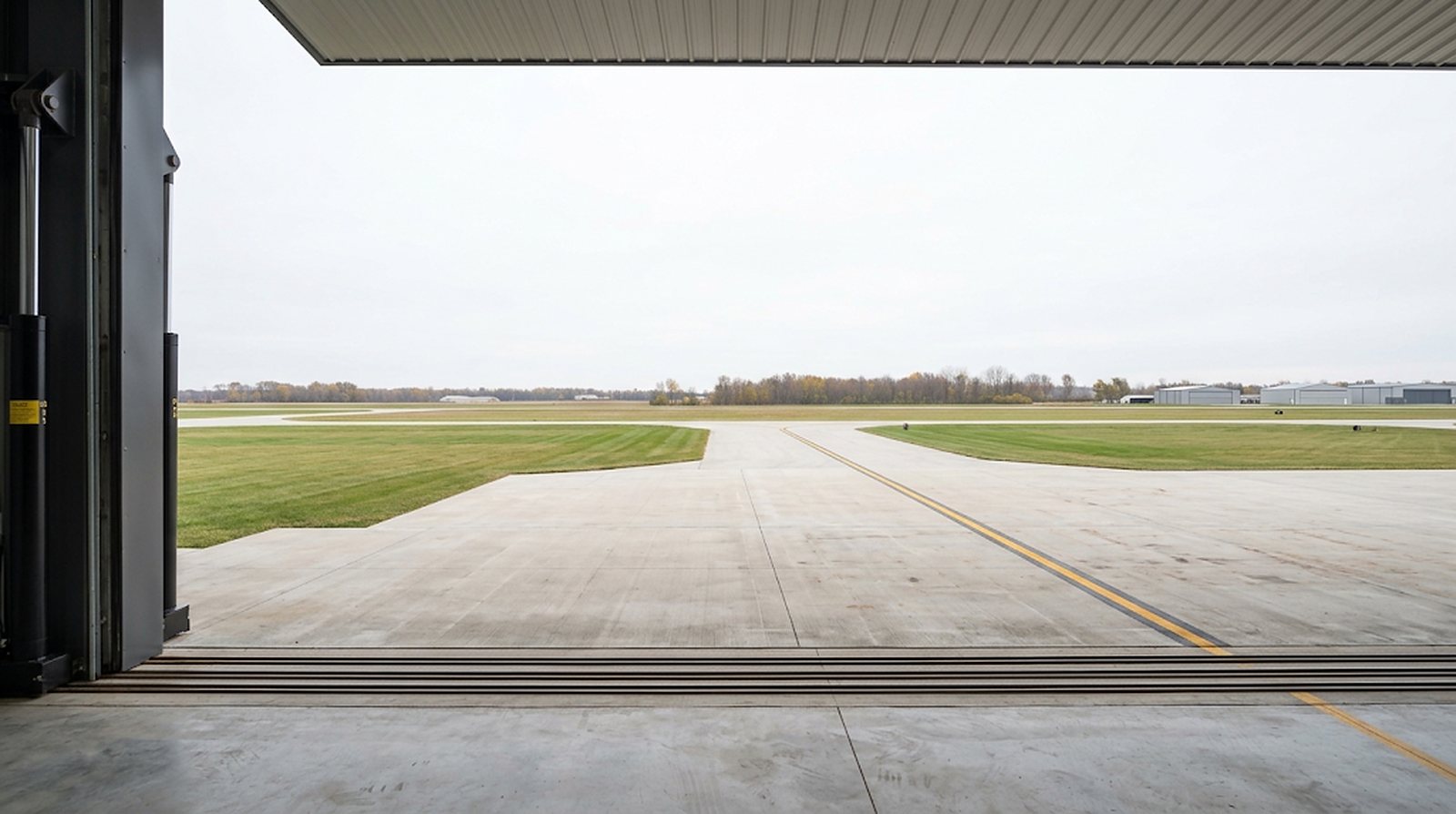
1. Transmittal and Scope of Engagement
This report states my opinion of the effect of reported per- and polyfluoroalkyl substance exposure on the value and marketability of a hangar ground leasehold at Portsmouth International Airport at Pease, in Portsmouth and Newington, New Hampshire.
The assignment is a market and valuation study. It is not an appraisal, and it is not an environmental site assessment. I reviewed publicly available regulatory, environmental and agency records as those records stood on the report date, identified each in Section 3, and analysed the effect on value through the four mechanisms set out in Section 5. I performed no sampling, no testing, no site reconnaissance and no subsurface investigation.
The intended use is to inform an owner, a prospective buyer or seller, a lender, an insurer or counsel about the direction and the measurability of the value effect at this airport. The intended users are the client and the client's professional advisers. The report is not intended for any other use and no other party should rely on it.
That conclusion is narrower than it may first appear, and the reason is specific to this airport. The remediation obligation here rests with the United States Air Force under a 2015 Environmental Protection Agency order, not with the airport sponsor or with its ground lessees. The cost mechanism that usually drives a value opinion of this kind is therefore substantially mitigated. What remains is the effect on financing and on marketability, and that effect does not depend on who ultimately pays.
Respectfully submitted,
Clay Carter, DBA, MBA, MS, CFA, FRM, CAIA
Valuation Takes Flight LLC
Summary of findings
| Item | Finding |
|---|---|
| Airport | Portsmouth International Airport at Pease (PSM), Portsmouth and Newington, New Hampshire |
| Sponsor and ground lessor | Pease Development Authority, a New Hampshire state agency |
| Interest studied | The lessee's interest in a corporate hangar on ground leased from the sponsor |
| Why the airport is in the exposure register | Former Pease Air Force Base. On the National Priorities List since February 21, 1990. PFAS reported in groundwater in 2013 and in a public supply well in 2014 |
| Stage of the cleanup | Treatment systems operating since 2018. Public water supply treated. Base wide Remedial Investigation not final |
| Party carrying the remedial obligation on the record | United States Air Force, under the 1990 Federal Facilities Agreement and the 2015 EPA Administrative Order |
| Federal indemnities on the record | Section 8056 of Public Law 101-511, specific to Pease, and Section 330 of Public Law 102-484, for closed installations generally. Their reach to a given lessee is a question for counsel |
| Remediation cost exposure | Mitigated |
| Lender and insurer caution | Adverse |
| Marketability and time on market | Adverse, probably modest |
| Lease and indemnity allocation | Indeterminate without the subject lease |
| Conclusion | An adverse effect on marketability and on credit terms. Not quantified |
| What would allow a magnitude | The subject lease, leasehold transfer history at the airport, lender terms, and the final Remedial Investigation report |
Exhibit 1. Summary of findings. Each line is developed in the section that follows it, and the sources are listed in Addendum B.
Work performed
I ran the record search in the order shown in Exhibit 6 and read each document listed in Addendum B in the form published on the report date. I traced every figure reproduced here to the document it came from. I read the federal statutes and agency policies that allocate responsibility at a closed military installation, the New Hampshire standards and notice statute, and one reported decision of the New Hampshire Supreme Court that describes an aviation ground lease at this airport. I then applied that record to the four mechanisms in Section 5.
Work not performed
I did not inspect the property or the airport, and I did not take or commission samples. I did not interview the sponsor, lessees, lenders or brokers. I did not review an executed lease, a title report or a survey, and I formed no opinion of market value or market rent. Section 7 states the conditions that follow from those limits.
2. Subject Property Identification
The subject is a leasehold interest in a corporate hangar situated on land ground leased from the airport sponsor at Portsmouth International Airport at Pease. The airport carries the identifiers PSM and KPSM and lies one nautical mile west of downtown Portsmouth, in Rockingham County, New Hampshire. It is a joint civil and military use airport. The sponsor is the Pease Development Authority, a New Hampshire state agency, which also holds and leases the surrounding land.
The interest studied is the lessee's interest: a building held on leased ground for a term, with the ground reverting to the sponsor at expiration under the lease terms. That is the interest most commonly transferred at this airport and the interest a lender takes as collateral.
| Item | What the record shows | Source |
|---|---|---|
| Sponsor | Pease Development Authority, created by the New Hampshire legislature as a body politic and corporate of the state | RSA 12-G:3, as quoted by the US District Court for New Hampshire in 2017 |
| Former use | Strategic Air Command base. Construction completed in 1956. Closed March 31, 1991 under the Base Realignment and Closure Act | New Hampshire DES |
| Federal listing | National Priorities List, February 21, 1990 | New Hampshire DES |
| Cleanup framework | Federal Facilities Agreement signed in 1990 by the Air Force, the EPA and New Hampshire DES. Eleven Records of Decision issued between 1993 and 1997 | US EPA, May 2018 |
| Transfer to the sponsor | Long term lease from the Air Force to the Authority in 1992, with 1,702 acres transferred for the airport. Transfer of the former base to the Authority completed in 1997 | US EPA, May 2018 |
| Restrictions | Land use restrictions limit land use and groundwater use at the site where necessary | US EPA, May 2018 |
| Water supply | The Pease Tradeport public water system, drawing on the Haven, Smith and Harrison wells and treated at the Grafton Road Water Treatment Facility, dedicated May 4, 2021 | City of Portsmouth |
Exhibit 2. The airport and the site, from the public record. Sources: New Hampshire Department of Environmental Services, Pease Air Force Base page; US EPA, Reuse and the Benefit to Community: Pease Air Force Base Superfund Site, May 2018; City of Portsmouth, Pease Tradeport Water System; Conservation Law Foundation v. Pease Development Authority, D.N.H., 2017.
How an aviation leasehold is held at this airport
The sponsor does not publish its lease form, but a reported decision describes one. In Appeal of Port City Air Leasing, Inc., decided December 24, 2024, the New Hampshire Supreme Court set out the terms of a lease under which an aviation lessee holds land and buildings from the Authority at this airport. The court wrote to decide a question of standing, and the leasehold it describes is not the subject. I cite the opinion for the form the instrument takes here, which Exhibit 3 summarizes.
| Provision | As the court describes it | Why it matters to this assignment |
|---|---|---|
| Permitted use | Aircraft related services named in the lease, among them aviation fuel sales, aircraft hangaring and supporting office space. Any other use needs the lessor's prior written consent | Alternative use is closed off, so the buyers for the interest are aviation users at this field |
| Improvements | Improvements and alterations need the lessor's approval | Work that disturbs soil passes through the sponsor |
| Term | Five years initially, with options to extend in five year increments to a maximum of thirty years | Sets the horizon over which any effect on income or financing is capitalized |
| Assignment and subletting | Generally need the lessor's approval, with limited exceptions | The sponsor stands in every transfer, which lengthens marketing time whatever the environmental record |
| Title | The lessee holds title to the buildings and improvements for the lease term only | The interest is finite and the ground is never the lessee's |
| Financing | The lessee may mortgage its leasehold | Leasehold lending is contemplated, so lender terms can be observed |
| Environmental indemnity | The lessee carries an environmental indemnity obligation to its lessor | An indemnity running from lessee to sponsor exists in at least one aviation lease at this airport. The opinion does not state its scope |
Exhibit 3. Terms of an aviation lease from the Pease Development Authority, as described by the New Hampshire Supreme Court. The lease described is not the subject lease. Source: Appeal of Port City Air Leasing, Inc., 2024 N.H. 71, decided December 24, 2024.
The exposure pathway at a hangar
The published studies of PFAS and property prices measure homes, and in each of them the effect runs through drinking water. That pathway is largely absent at the subject. A hangar is not occupied as a residence, and the Tradeport is served by a public water system whose wells are treated. The federal Agency for Toxic Substances and Disease Registry studied that system and concluded in March 2020 that drinking its water since June 2014 was not expected to harm the public. The same document found that exposures before that date could have increased the risk of harmful non-cancer health effects. What reaches a hangar leasehold is therefore not an effect on occupancy. It is the set of mechanisms analysed in Section 5.
Why this airport sits in the exposure register
The airport occupies the former Pease Air Force Base. The Air Force maintained military aircraft at the facility from the 1950s until 1991, and the former base was listed on the National Priorities List on February 21, 1990. The property is reported by the Environmental Protection Agency at approximately 4,000 acres, and by the Air Force Civil Engineer Center at approximately 4,365 acres. The Pease International Tradeport, the business park that now occupies the land alongside the airfield, is described in a 2025 property offering prepared for the Pease Development Authority as covering 3,000 acres and hosting more than 245 companies in roughly four million square feet of office and industrial space.
The combination that matters for this assignment is a long history of fire fighting foam use on an airfield, a federal Superfund listing, an active cleanup, and a working commercial leasehold market on the same land. Few airports present all four.
Nothing in this report characterizes the subject or any other property as contaminated. The report describes what a named source reported on a stated date, and then analyses what a market participant does with that information.
3. Exposure Record Reviewed
I searched the sources listed in Exhibit 6 and reviewed the record summarized below. Where a source reports a concentration or a cost, that figure appears in Exhibit 7 or Exhibit 8 with the source and date attached. Where the record is silent, this report says so rather than inferring.
| Date | Event in the public record | Source |
|---|---|---|
| February 21, 1990 | The former Pease Air Force Base is listed on the National Priorities List. | New Hampshire DES |
| 1990 | The Air Force, the EPA and New Hampshire DES sign a Federal Facilities Agreement setting out each party's responsibilities for the cleanup. | US EPA |
| November 5, 1990 | Section 8056 of the Department of Defense Appropriations Act, 1991 directs the Air Force to hold harmless, defend and indemnify the State of New Hampshire, its political subdivisions and their lenders, officers, agents and employees against claims arising from releases resulting from Department of Defense activities at Pease Air Force Base. | Public Law 101-511 |
| 1991 | Air Force aircraft maintenance operations at the facility end. Operations are reported to have begun in the 1950s. | US EPA |
| 1992 to 1997 | The Air Force leases and then transfers the former base to the Pease Development Authority, including 1,702 acres for the airport. | US EPA |
| 2013 | A groundwater sample at Site 8, the former Fire Department Training Area 2, reports PFOA and PFOS above the federal provisional health advisory then in place. | New Hampshire DES |
| April 2014 | Sampling of the three Pease Tradeport public water supply wells reports PFOS in the Haven Well above the advisory then in place. The Haven Well is shut down. | New Hampshire DES |
| May 12, 2014 | The date on which the federal health agency and the City of Portsmouth record the Haven Well going out of service. Samples of April and May 2014 report PFOS in the well at up to 2.5 micrograms per litre, against a provisional health advisory of 0.2. | ATSDR |
| 2015 | EPA issues the Air Force an Administrative Order under the Safe Drinking Water Act requiring it to investigate and remediate the sources, restore the aquifer, treat the water supply, and monitor and protect residential and municipal supply wells. | New Hampshire DES |
| 2016 | A base wide site investigation reports widespread PFAS in soil, in overburden groundwater and in bedrock groundwater. | New Hampshire DES |
| September 2016 | Activated carbon treatment begins on the Smith and Harrison wells as a demonstration project. | City of Portsmouth |
| 2017 to 2018 | The Site 8 groundwater extraction and treatment system is constructed and begins operating. An Airfield Interim Mitigation System captures and treats groundwater in the northern Haven aquifer. | New Hampshire DES |
| 2018 to 2019 | An Expanded Site Inspection is conducted. The final report is published in March 2020. Shellfish results do not exceed EPA screening levels for three PFAS and the state finds no consumption advisory warranted. | New Hampshire DES |
| 2020 onward | A Remedial Investigation begins under the CERCLA process, with field work in spring 2021 and a follow on phase in fall 2022. The Air Force anticipates the investigation will be finalized in 2026 following internal and regulatory review. | New Hampshire DES |
| May 4 and August 3, 2021 | The Grafton Road Water Treatment Facility is dedicated, and the Haven Well returns to service with its water treated there. | City of Portsmouth |
| December 24, 2024 | The New Hampshire Supreme Court holds that an aviation ground lessee at the airport is not a landowner for the purpose of appealing a wetlands permit issued for adjoining land. | 2024 N.H. 71 |
| January 1, 2025 | New Hampshire's statutory notice to buyers of real property begins to include PFAS. | RSA 477:4-a |
| February 19, 2026 | A wellhead sample at residential well RES22, taken ahead of its treatment system, reports PFOS at 18.1 nanograms per litre. | Air Force Civil Engineer Center |
| August 2026 | The Air Force publishes a final Engineering Evaluation and Cost Analysis for an alternate water supply at four residences and recommends a municipal water line connection. | Air Force Civil Engineer Center |
Exhibit 4. Chronology of the public record at the former Pease Air Force Base. Source: New Hampshire Department of Environmental Services, Pease Air Force Base PFAS page and fact sheet; US EPA Superfund site profile for Pease Air Force Base and its May 2018 reuse study; Agency for Toxic Substances and Disease Registry, Health Consultation, March 20, 2020; City of Portsmouth, Pease Tradeport Water System; Public Law 101-511; Appeal of Port City Air Leasing, Inc., 2024 N.H. 71; RSA 477:4-a; Air Force Civil Engineer Center, Final Engineering Evaluation and Cost Analysis for Alternate Water Supply, August 2026.
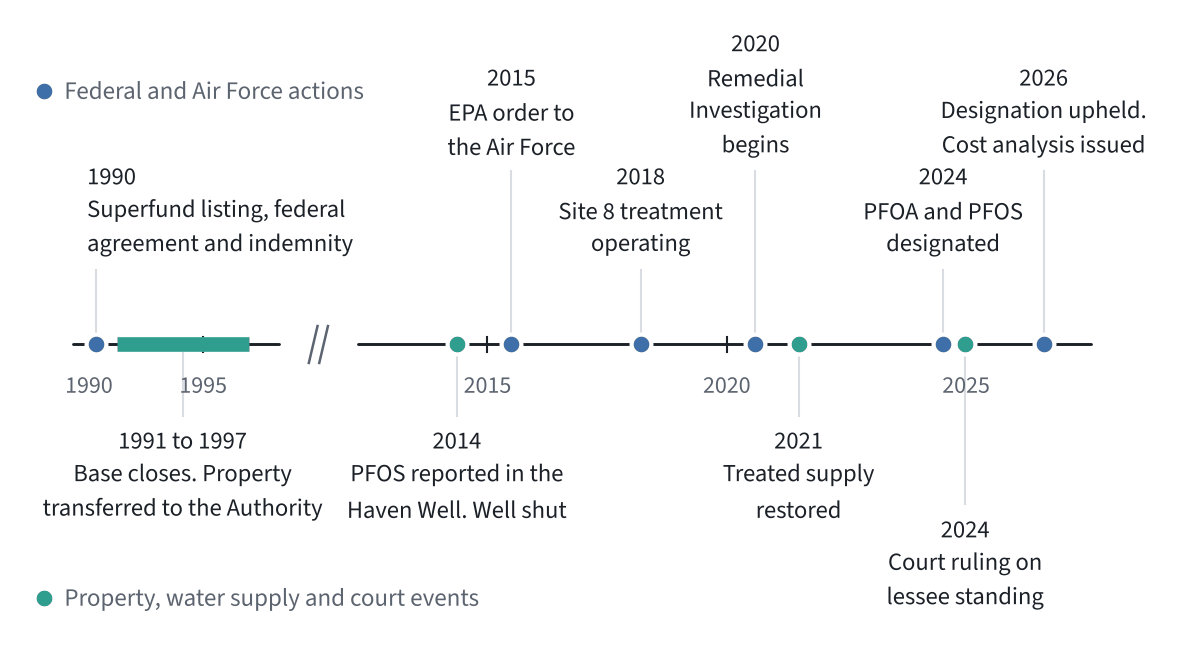
Three facts in this record carry most of the weight
The first is the identity of the responsible party. Every remedial action in Exhibit 4 is an Air Force action taken under a federal order. The Air Force built and operates the two groundwater treatment systems, and it financed the drinking water treatment facility that the City of Portsmouth designed and constructed. That allocation is recorded in the agency record rather than inferred.
The second is that groundwater use at the site is restricted. The EPA reports that restrictions limit groundwater use and that groundwater monitoring is ongoing. A recorded restriction on the use of groundwater is an encumbrance on land, and it is the kind of fact a title examination and a lender's environmental review both reach.
The third is that Congress addressed liability at this base by statute. Section 8056 of Public Law 101-511, enacted November 5, 1990, directs the Air Force to hold harmless, defend and indemnify the State of New Hampshire, its political subdivisions and their lenders, officers, agents and employees against claims arising from releases resulting from Department of Defense activities at Pease Air Force Base. Section 330 of Public Law 102-484 later provided indemnification for parties that acquire property at closing Department of Defense installations generally. The EPA, describing the reuse of the site in 2018, wrote that under the first of these the federal government stated that New Hampshire and any future Tradeport tenants would not be liable for site contamination. Whether either provision reaches a particular lessee, and for which claims, is a question for counsel. Section 4 sets out what each provides.
| Source searched | What it returned for this airport |
|---|---|
| State environmental agency PFAS site list, New Hampshire DES | The substantive record. A dedicated site page and a fact sheet revised February 2025, carrying the chronology in Exhibit 4. |
| EPA Superfund site profile and cleanup activity record | National Priorities List status, the operating history, the groundwater use restrictions, and confirmation that both treatment systems are operating and removing PFAS. |
| Department of Defense assessment reports and installation records | The August 2026 Engineering Evaluation and Cost Analysis, with the concentrations in Exhibit 7 and the cost figures in Exhibit 8. |
| EPA monitoring data for the public water systems serving the area | The Haven Well shutdown and the subsequent treatment of the Tradeport supply are documented in the state record above. No separate finding is relied on here. |
| FAA Part 139 CertAlerts and the fluorine free foam transition record | The federal framework in Section 4. The record searched does not state this airport's foam inventory or its transition status, so neither is reported here. |
| Federal statutes, regulations and agency policy on closed installations | Section 8056 of Public Law 101-511, Section 330 of Public Law 102-484 with its procedures at 32 CFR Part 175, and the EPA policy of June 13, 1997 on transferees of federal facilities. Set out in Exhibit 11. |
| Federal health agency record | The Agency for Toxic Substances and Disease Registry health consultation of March 20, 2020 on the Tradeport public water system, with the well concentrations of 2014 and its findings on exposure before and after June 2014. |
| Water utility record, City of Portsmouth | The dated history of the Tradeport water system, from the 2014 shutdown of the Haven Well to its return to service through treatment on August 3, 2021. |
| New Hampshire statutes | The state maximum contaminant levels at RSA 485:16-e and the notice to buyers of real property at RSA 477:4-a. |
| Litigation dockets and local reporting | One reported decision, Appeal of Port City Air Leasing, Inc., 2024 N.H. 71. A ground lessee appealed a wetlands permit issued for adjoining land that another party proposed to lease and build on, and the appeal was dismissed for want of standing. The opinion is cited for the lease terms it describes and for its holding. The court made no finding on environmental conditions. The search returned no case in which remedial cost was claimed against a lessee at this airport. Nothing in this section rests on a news account. |
Exhibit 6. Sources searched and what each returned. A source that returned nothing for this airport is listed as returning nothing rather than omitted, so the reader can see the search was run.
| Location | Analyte | Reported concentration | Sample date | Federal limit |
|---|---|---|---|---|
| RES22, residential well, wellhead ahead of treatment | PFOS | 18.1 ng/L | February 19, 2026 | 4.0 ng/L |
| RES14, residential well | PFOA | 11.3 ng/L | June 2025 | 4.0 ng/L |
| RES01, residential well | PFOS | At or above 12.0 ng/L | September 2017 | 4.0 ng/L |
| RES02, residential well | PFOA | Consistently above the limit | 2016 onward | 4.0 ng/L |
Exhibit 7. Concentrations reported in the agency record for the four residences addressed by the August 2026 cost analysis. The federal maximum contaminant level is 4.0 nanograms per litre each for PFOA and PFOS. The Air Force used 12.0 nanograms per litre, three times that limit, as a prioritization screen. The RES22 result is more than four times the limit. Source: Air Force Civil Engineer Center, Final Engineering Evaluation and Cost Analysis for Alternate Water Supply, RES01, RES02, RES14 and RES22, August 2026.
| Alternative in the cost analysis | Component | Amount |
|---|---|---|
| Alternative 1, municipal water line connection | Direct capital | $547,000 |
| Indirect capital | $219,000 | |
| Total | $766,000 | |
| Alternative 2, whole house treatment systems | Total present value | $1,744,000 |
| Undiscounted total, 30 year basis | $2,382,000 |
Exhibit 8. Cost figures as the Air Force reports them. The Air Force recommends Alternative 1, describing it as a permanent solution that does not rely on the operation and maintenance of treatment systems, and notes that the state and the community support it. Alternative 2 was costed over thirty years and assumes carbon replacement every other year and full system replacement after fifteen years. These are the source's figures for four residences. They are not an engineering estimate by the author, they are not a cost to the subject, and they are reproduced here only because they are the one place the record puts a number on remedial cost at this site. Source: Air Force Civil Engineer Center, August 2026.
What the record does not contain
A record search is as useful for what it fails to return as for what it returns. Each gap below limits a part of the analysis, and Section 6 sets out how a client under engagement closes most of them.
| Not in the public record | What it limits |
|---|---|
| Sampling results for the parcel under any one hangar leasehold | No statement can be made about conditions at a particular parcel, and none is made |
| An executed ground lease for the subject | The allocation of environmental risk between sponsor and lessee, analysed in 5.4 |
| Prices and terms of leasehold transfers at the airport | Any measurement of marketing time or price, analysed in 5.3 |
| Lender terms, conditions or declines on hangar collateral at the airport | Any measurement of the credit effect, analysed in 5.2 |
| A final Remedial Investigation report | The settled extent of impact, and whether the restrictions on any parcel will change |
| The airport's foam inventory and transition status | Not reported here. It bears on future discharge, and the legacy record is unaffected by it |
Exhibit 9. Gaps in the public record on the report date, and the part of the analysis each one limits.
4. Regulatory Posture as of the Report Date
The conclusions in this report are conditioned on the posture set out in this section as it stood on November 21, 2026. PFAS regulation is subject to active rulemaking and litigation, and a change in any of the items below could change the analysis in Section 5.
| Authority | Position on the report date | What a change would do to this analysis |
|---|---|---|
| Federal drinking water limits for PFOA and PFOS | In force at 4.0 parts per trillion each. Compliance due April 26, 2029. A proposal to allow two more years is not final | Changes the timing of water utility spending. It does not change who pays for the cleanup at this site |
| Limits for PFHxS, PFNA, HFPO-DA and the hazard index | In force. Proposed for rescission on May 20, 2026. Not final | Little effect here, where the reported results concern PFOA and PFOS |
| Court challenge to the 2024 drinking water rule | Before the D.C. Circuit, set for argument on September 18, 2026. No decision found on the report date | A ruling against the rule would unsettle the federal limits this report cites |
| CERCLA designation of PFOA and PFOS | In force. Upheld on August 18, 2026 | The designation is what makes cost recovery and contribution claims available for these substances. The 2015 order rests on the Safe Drinking Water Act and predates it |
| EPA enforcement discretion policy | Issued April 19, 2024 as a statement of policy. The search found no withdrawal | Matters to the sponsor more than to a lessee, whom the policy does not name |
| Statutory liability exemption for airports | Not enacted | Enactment would reduce the sponsor's exposure and, through the lease, the lessee's |
| FAA foam requirements | Fluorine free foam accepted. Transition not required | No effect on the legacy record |
| New Hampshire standards | 12, 15, 18 and 11 parts per trillion for PFOA, PFOS, PFHxS and PFNA | A change would move the state benchmark that applies alongside the federal limit |
Exhibit 10. The regulatory posture on November 21, 2026, and the bearing of each item on this analysis. This report does not predict the outcome of any pending item.
Drinking water limits
The EPA finalized the PFAS National Primary Drinking Water Regulation on April 10, 2024, setting enforceable maximum contaminant levels of 4.0 parts per trillion each for PFOA and PFOS, together with limits for four further PFAS. Public water systems were given until 2027 to complete initial monitoring and until April 26, 2029 to meet the limits.
The proposals published in May 2026
On May 18, 2026 the EPA announced two proposed rules, published in the Federal Register on May 20, 2026. The first would create a federal exemption framework under which an eligible system may request two further years, to April 26, 2031, to meet the PFOA and PFOS limits. The second would rescind the regulatory determinations and the limits for PFHxS, PFNA, HFPO-DA and the hazard index mixture of those three plus PFBS. The comment period for both closed on July 20, 2026. Neither has been finalized. Every limit set in 2024, and the original April 2029 compliance date, remain legally in effect. This report does not predict the outcome of either proposal.
The drinking water rule in court
The 2024 rule is also under review in the courts. In American Water Works Association v. EPA, No. 24-1188, a panel of the Court of Appeals for the District of Columbia Circuit denied the agency's motion to vacate the hazard index provisions in January 2026 and denied its motion to sever and hold those claims on March 19, 2026. The case was set for argument on September 18, 2026. My search found no decision on the report date. Until the court rules or the agency finalizes a rule, the limits stand as written.
CERCLA liability
PFOA and PFOS, including their salts and structural isomers, are hazardous substances under section 102(a) of CERCLA. A unanimous panel of the Court of Appeals for the District of Columbia Circuit denied every petition challenging that designation on August 18, 2026, leaving it in force. The designation carries a release reporting obligation and makes cost recovery and contribution claims available. That is the mechanism by which cleanup cost reaches a present or former owner or operator of a parcel, and it is the reason the identity of the responsible party at this airport matters as much as it does.
The enforcement discretion policy and its limits
On April 19, 2024 the EPA issued its PFAS Enforcement Discretion and Settlement Policy Under CERCLA. The policy names five kinds of party that the agency does not intend to pursue for PFAS response actions or costs, and publicly owned airports and local fire departments are one of the five.
Three limits decide how much weight it carries in a value opinion. It is a policy and not a rule, and the Congressional Research Service noted in October 2026 that the agency may change or revoke it. It names publicly owned airports. It does not name their lessees, so a hangar tenant or a fixed base operator takes nothing from it directly. And it restrains the agency only. It does not bar a state, a private claimant, or another responsible party seeking contribution.
Congress has considered a statutory exemption for airport sponsors and other parties that received PFAS without making it. The Congressional Research Service reported on October 7, 2026 that no such bill had been enacted.
Protections a lessee, a buyer or a lender may hold
Federal law provides several protections that bear on a party acquiring or financing an interest at a site of this kind. Exhibit 11 reports what each provides and where it stops. Whether any of them applies to a particular party is a legal question that this report does not decide.
| Protection | Source | What it provides | Where it stops |
|---|---|---|---|
| Lessee as bona fide prospective purchaser | CERCLA section 101(40), as amended in 2018 | A lessee may qualify where the owner is a bona fide prospective purchaser, where the owner lost that status through no fault of the lessee, or where the lessee meets the criteria itself | In the third case the lessee must make all appropriate inquiries before it acquires the leasehold, and must exercise appropriate care afterward |
| All appropriate inquiries | 40 CFR Part 312 and ASTM E1527-21 | The inquiry that supports the landowner defenses. PFOA and PFOS came within its scope on July 8, 2024, when their designation took effect | A report prepared before that date, or to older guidance, may not have screened for them |
| Secured creditor exemption | CERCLA section 101(20) | A lender that holds a security interest and does not participate in management is not an owner or operator, and may foreclose if it then acts to divest | It protects the lender from liability. It does not protect the value of the collateral |
| Federal facility transferee policy | US EPA, June 13, 1997 | The EPA will not take enforcement action against a party, including a lessee, that acquires federal facility property carrying a statutory covenant or the Section 330 indemnity, for conditions existing when it acquired the interest | A statement of policy. Withheld from a party that causes, contributes to or worsens a release |
| Indemnity for closed installations | Section 330, Public Law 102-484, with procedures at 32 CFR Part 175 | The Secretary of Defense is to hold harmless, defend and indemnify parties that acquire ownership or control of property at a closed installation against third party claims arising from releases caused by Department of Defense activities | The rule calls for notice to the Department within 15 days of receiving a claim and a request within two years after the claim accrues |
| Indemnity specific to Pease | Section 8056, Public Law 101-511 | The Air Force is to hold harmless, defend and indemnify the State of New Hampshire, its political subdivisions and their lenders, officers, agents and employees against claims arising from releases caused by Department of Defense activities at the base | The text names the State and its subdivisions. Whether a lessee stands within it is a question for counsel |
Exhibit 11. Protections on the public record that bear on a lessee, a buyer or a lender at this airport. Sources: US EPA, Bona Fide Prospective Purchasers; US EPA, CERCLA Lender Liability Exemption: Updated Questions and Answers, July 2007; US EPA, Policy Towards Landowners and Transferees of Federal Facilities, June 13, 1997; 32 CFR 174.15 and Part 175; Public Law 101-511, section 8056.
State law in New Hampshire
New Hampshire set its own standards before the federal rule. State law fixes maximum contaminant levels of 12 parts per trillion for PFOA, 15 for PFOS, 18 for PFHxS and 11 for PFNA, and the Department of Environmental Services applies the same figures as ambient groundwater quality standards. The federal limits for PFOA and PFOS are lower, at 4.0.
Since January 1, 2025 the state's statutory notice to buyers of real property has included PFAS. The notice is general. It tells a buyer that PFAS have been found in New Hampshire and says nothing about the property being sold, and the statute provides that a seller who fails to give it incurs no liability. It applies before a contract for the purchase and sale of an interest in real property that includes a building. Whether the assignment of a hangar leasehold falls within it is a question for counsel. Its bearing on value is that a buyer of real property in this state is now told about PFAS as a matter of routine, which makes the record at this airport easier to find.
What the FAA requires of a certificated airport
The FAA does not require a certificated Part 139 airport to transition from aqueous film forming foam to fluorine free foam. It treats foams on the Department of Defense Qualified Product List as acceptable for satisfying Part 139 requirements. CertAlert 24-11, dated December 31, 2024, requires an output based foam test on each index vehicle once that vehicle has completely transitioned. CertAlert 26-03, dated August 5, 2026, addresses testing of both foam types under 14 CFR 139.319 and cancels CertAlert 21-01. CertAlert 26-05, dated October 26, 2026, permits a surrogate liquid in place of foam in an output based apparatus test. Section 762 of the FAA Reauthorization Act of 2024 requires the FAA to report to Congress on the national transition every 180 days until it is complete, and to include the quantity of foam held at each Part 139 airport.
Federal funding
The cleanup at this site is funded by the Air Force, and it sits inside a national program with no published end date. The Congressional Research Service reported in October 2026 that the Department of Defense had completed preliminary assessments and site inspections at 703 of 723 identified locations as of March 31, 2025, that 573 of those were proceeding to a remedial investigation, and that the Department had not given a completion date for remediation at any installation. At Pease, treatment has operated since 2018 and the investigation has been under way since 2020. An open ended federal program is nonetheless the setting in which a lender reads the words active cleanup.
An airport's own costs are a separate matter, and two funding facts bear on them. Section 767 of the FAA Reauthorization Act of 2024 authorizes not more than $350 million over five fiscal years to reimburse airports holding a Part 139 certificate for replacing fluorinated foam, cleaning or replacing equipment and disposing of the old product. It funds the transition. It does not fund cleanup. FAA Program Guidance Letter 26-03, dated January 6, 2026, confirms that stand-alone environmental remediation is not eligible for Airport Improvement Program funding.
Transition to fluorine free foam addresses what an airport discharges from here on. It does not address what decades of earlier discharge left in soil and groundwater, and it does not retire a liability already attached to a parcel. An airport that has finished its changeover still carries the legacy record, and at this airport that record is the subject of an active federal cleanup.
5. Analysis of the Effect on Value
Reported exposure reaches value through four mechanisms. They are not alternatives and they do not aggregate. Each operates on a different party and on a different part of the transaction, and at any given site some are live and some are not. I take each in turn against the record in Section 3.
How the analysis is built
Three ideas from the published literature on property value and environmental conditions organize what follows.
The first is that an effect on value has separable parts: the cost of responding to the condition, any limit the condition places on the use of the property, and the market's response to risk and uncertainty, which the literature calls stigma. The four mechanisms in this report are those parts as they present on leased airport land. The lease is treated as a mechanism of its own because on an airport it decides who bears the other three.
The second is that the effect changes with the stage of the cleanup. Risk is priced hardest between discovery and a settled remedy, and it eases as a remedy is selected, built and shown to work. The record places this site in the middle of that sequence. Treatment systems have operated since 2018 and the public water supply has been treated since 2021, while the base wide investigation is not final.
The third is that the market's response to risk has to be read from evidence in the market concerned. A percentage taken from a study of another place and another kind of property is not evidence about this one, and 5.3 explains why the published studies do not transfer to a hangar.
| Part of the effect | Where it is analysed | What would measure it |
|---|---|---|
| Cost of response | 5.1, and 5.4 where the lease reallocates it | The agency record on who must pay, the federal indemnities, and the lease |
| Limits on use | 5.1 and 5.4 | The land use and groundwater restrictions on the parcel, and the sponsor's approval rights over construction |
| Market response to risk | 5.2 and 5.3 | Lender terms, insurance terms, marketing time and failed transactions at this airport |
Exhibit 12. The parts of a value effect, the mechanism that carries each one on leased airport land, and the evidence that would measure it.
5.1 Remediation cost exposure
The question is not whether a cost exists but whether it can reach the interest being valued. At this airport the answer available from the public record is unusually clear. The remedial obligation runs to the United States Air Force under the 2015 Administrative Order and the CERCLA process that followed it. The Air Force constructed and operates the Site 8 extraction and treatment system and the Airfield Interim Mitigation System, it financed the drinking water treatment facility the City of Portsmouth built, and the August 2026 cost analysis in Exhibit 8 is an Air Force document proposing that the Air Force fund an alternate water supply.
For a hangar leasehold on this land, that materially mitigates the cost mechanism. A lessee holding a building on ground leased from the sponsor is not the party the federal order addresses, and the record identifies no instance of remedial cost being allocated to a Tradeport lessee. I say mitigated rather than eliminated for three reasons. The Remedial Investigation is not final, so the extent of impact is not settled. CERCLA liability attaches to owners and operators by status rather than by fault, and a lessee can be an operator. And a lease may allocate environmental risk to the lessee by contract regardless of what the federal order says, which is the subject of 5.4.
Three further items on the public record support that reading. The cleanup has run since 1990 under a Federal Facilities Agreement among the Air Force, the EPA and the state. Congress directed the Air Force in the same year to indemnify the State of New Hampshire and its subdivisions against claims arising from releases caused by Department of Defense activities at the base, and Section 330 of Public Law 102-484 extended a comparable indemnity to parties that acquire property at closed installations. And the EPA's 1997 policy on transferees of federal facilities states that the agency will not take enforcement action against a party, including a lessee, that acquires such property with those protections, for conditions that existed when it acquired the interest. Exhibit 11 gives the terms and the limits of each.
One part of the effect reaches a lessee whoever pays for the cleanup. The EPA reports that land use restrictions limit land use and groundwater use at the site where necessary, and the lease form in Exhibit 3 requires the sponsor's approval for improvements. A restriction on groundwater is of little consequence to a hangar on a treated public supply. Where a restriction on a parcel conditions excavation or the handling of soil and groundwater, it is of more consequence to a lessee who intends to build, because it adds steps, time and cost that an existing building has already absorbed. This part of the effect therefore falls more heavily on a development site than on a finished hangar.
Direction: mitigated, and to an unusual degree. Measurable from the public record as to who carries the obligation. Not measurable as to residual risk while the investigation is open.
5.2 Lender and insurer caution
This is where the live effect sits, and it is indifferent to who pays for the cleanup. A lender underwriting a leasehold on a parcel inside a National Priorities List site, with recorded restrictions on groundwater use and a Remedial Investigation that is not yet final, is working from a file that contains all three of those facts. The ordinary responses are to require the borrower's own environmental assessment, to add representations and an indemnity, to shorten the term, to reduce the advance rate, to require a reserve, or to decline the collateral and leave the borrower to a lender with a different appetite.
None of those responses requires a finding that the subject is impaired. They follow from the file. Each of them narrows the set of buyers who can actually close at a given price, and a narrower set of financeable buyers is a value effect whether or not a dollar of remediation is ever charged to the property. The same logic applies to environmental coverage, where the common outcome is an exclusion rather than a surcharge.
The public record does not quantify this. Lender terms are not published, declines are not published, and the one place the effect would show up, a paired comparison of financing terms on Tradeport leasehold transfers before and after April 2014, requires transaction level data that is not in the public record.
The caution persists even though the lender itself is well protected. CERCLA excludes from owner and operator liability a lender that holds a security interest without participating in management, and the EPA's guidance confirms that such a lender may foreclose and remain within the exemption if it then acts to divest. The exemption protects the lender from the liability. It does nothing for the value of the collateral or for the borrower's capacity to carry a claim, and the credit decision turns on those.
Two changes since 2023 have made the file harder to clear. PFOA and PFOS came within the scope of the standard Phase I environmental site assessment on July 8, 2024, when their designation took effect. An assessment performed to the current standard should now address them, and one performed earlier may not have. The standard form liability exclusion published for the insurance industry in May 2023 reaches the presence or suspected presence of any PFAS, which makes cover for the exposure difficult to place. A borrower who cannot insure an exposure that the lender can see is a weaker credit at any advance rate.
From loan terms to value
Lender terms convert to value by arithmetic once they are known. Exhibit 13 shows the conversion on a hypothetical hangar leasehold. It starts from the rate build in the sample hangar report the firm publishes for a fictional airport: a 60 percent advance at 6.85 percent over 25 years, an 8.75 percent equity dividend rate, and a premium of 200 basis points for the leasehold, which together give an overall rate of 10.52 percent. Each line changes one term and holds income constant.
| Financing terms | Overall rate | Change in rate | Change in indicated value |
|---|---|---|---|
| Terms as published | 10.52 percent | ||
| Advance rate cut from 60 to 50 percent | 10.56 percent | 4 basis points | -0.4 percent |
| Interest rate 50 basis points higher | 10.75 percent | 23 basis points | -2.1 percent |
| Amortization shortened from 25 to 20 years | 11.02 percent | 50 basis points | -4.5 percent |
| Equity dividend rate 100 basis points higher | 10.92 percent | 40 basis points | -3.7 percent |
| All four together | 11.65 percent | 113 basis points | -9.7 percent |
Exhibit 13. Financing terms converted to an overall rate and to value, on hypothetical inputs. The table is arithmetic. It is not a finding, and it is not an estimate of the effect at the subject or at this airport. Source: computed from the rate build in the Valuation Takes Flight sample hangar report for a fictional airport.
I have no term sheet for this airport, and the table says nothing about which of these changes, if any, a lender would make here. It also leaves out the effect of an outright decline, which works through the number of buyers able to close, a channel the rate does not capture. The use of the table is that a client who brings a term sheet can see at once what it implies.
Direction: adverse. Not measurable from the public record.
5.3 Marketability and time on market
A documented and disclosed exposure record tends to lengthen marketing periods and to widen the gap between asking terms and closing terms. Where it is not disclosed early, it tends to surface in diligence and to reprice or to end the transaction late. The symptom is usually time and transaction failure rate rather than a discount visible in a closed price, which is why a price based study of this mechanism commonly finds nothing and concludes wrongly that there is no effect.
Two features of this site cut against the usual severity. The drinking water supply has been treated, with the Air Force funding the facility, so the most visible impairment to an occupier has been addressed. And the Tradeport is a functioning market: the 2025 offering cited in Section 2 describes more than 245 companies in roughly four million square feet, and current listings in the park quote office space from ten to thirty one dollars per square foot depending on building and basis. A park with that much occupancy and active leasing is not a market that has priced itself to zero on environmental grounds.
What the record does not provide is the counterfactual. There is no published series of Tradeport leasehold transfers with terms, and no way from public data to separate a PFAS effect from the many other things that moved this market between 2014 and 2026.
What the published studies show
Three studies have measured PFAS against property prices, and one earlier study pooled non-residential cases involving other substances. The firm reviews them in its research paper on PFAS, firefighting foam and hangar value, and Exhibit 14 summarizes them.
| Study | Market and property type | Reported effect | Bearing on a hangar |
|---|---|---|---|
| Marcus and Mueller, 2024 | Homes on one public water system in Paulsboro, New Jersey | Prices about 31 to 42 percent lower after PFAS in the supply became public in 2013, with no rebound after the affected well was taken off line | The effect runs through drinking water. It does not transfer |
| Islam and Heintzelman, working paper | Single family sales in two Pennsylvania counties, 2010 to 2022 | About 2.8 percent lower inside an affected water system service area | Drinking water again. Not peer reviewed |
| Wang, 2026 | Residential land in Japan, 2015 to 2024 | 1.3 to 6.4 percent lower, emerging as media coverage grew | Shows the part played by attention. Residential |
| Saginor, Simons and Throupe, 2011 | 106 non-residential observations involving a range of substances | About a third of the cases showed no loss | Non-residential but not PFAS. Shows that a loss is not automatic |
| Aviation property | No study published | None | Stated as a finding |
Exhibit 14. Published studies of environmental conditions and property prices, and their bearing on a hangar leasehold. Source: Marcus and Mueller, Journal of Environmental Economics and Management 125 (2024); the other studies as reviewed in the Valuation Takes Flight research paper cited above.
The spread in that table, from no loss to 42 percent, is the finding. Every one of the PFAS studies measures homes, and in every one the effect runs through the water a household drinks. A figure borrowed from any of them would not survive examination here. In Alexander v. Halliburton Energy Services, a federal court in Oklahoma excluded damages testimony that relied on a published analysis pooling studies of this kind, finding that it did not give the value of the properties at issue.
The search returned one item on time that is specific to this airfield, and it is indirect. A proposal to lease land at the airport and build an aviation services facility received a state wetlands permit in June 2022. A neighbouring lessee appealed, and the New Hampshire Supreme Court decided the appeal on December 24, 2024, thirty months later. The lessee's stated concern, as the court recorded it, was that construction could disturb existing contaminants. One dispute is not a series, and the decision turned on standing. It does show that environmental conditions are raised when property changes hands or is developed on this airfield, and that they take time to resolve.
Direction: adverse, and probably modest at this site given the treated supply and the occupancy evidence. Not measurable from the public record.
5.4 Lease and indemnity allocation
On airport land the building and the ground beneath it are usually held by different parties, so the operative question is what the lease says. The provisions that decide the answer are the environmental representations and warranties, the indemnity and its direction, the surrender and restoration obligation, the reversion terms, the assignment consent right, and any obligation to comply with environmental law at the lessee's cost.
The Pease Development Authority is a public body and its ground leases are negotiated instruments. A 2025 offering for a Tradeport property states that longer ground lease terms may be available from the authority, which confirms that ground leasing is the structure in use, but the authority's standard environmental provisions are not published and I did not review an executed lease. This mechanism is therefore unresolved on the public record, and it is the one with the widest range of outcomes: a lease that indemnifies the lessee against pre-existing conditions and a lease that obliges the lessee to comply with environmental law at its own cost produce materially different value conclusions on identical facts.
The public record is not silent on the form of the instrument. Exhibit 3 sets out the lease terms that the New Hampshire Supreme Court described in 2024, and one of them is an environmental indemnity that the lessee owes to the Authority. The opinion does not state its scope. An indemnity limited to releases the lessee causes is ordinary and carries little weight here. An indemnity that reaches conditions on the premises whatever their origin would place the lessee between the Authority and the Air Force, relying on the federal indemnities in Exhibit 11 to be made whole. Those are different positions, and only the lease distinguishes them.
The same decision bears on what a lessee can do to protect its interest. The court held that a ground lessee at this airport was not a landowner under the state wetlands statute, because its lease did not give it interests tantamount to fee ownership, and so could not appeal a permit issued for construction on adjoining land. A lessee's procedural rights against neighbouring development are narrower than an owner's, and a buyer of a leasehold is buying the narrower position.
Exhibit 15 lists the provisions that decide the allocation and what to read each one for. It is the checklist applied to the subject lease under engagement.
| Provision | What to read for | Effect on the conclusion |
|---|---|---|
| Disclosure by the lessor | Whether the Authority discloses the status of the site and the restrictions on the parcel | Disclosure at signing supports the lessee's position that conditions predate it |
| Baseline condition | Whether the lease fixes the condition of the premises at commencement, by a baseline assessment or by reference to the agency record | Without a baseline, later findings are harder to attribute |
| Direction and scope of the indemnity | Whether the lessee indemnifies only for releases it causes, or for conditions on the premises generally | The provision with the widest effect on value |
| Pre-existing and migrating conditions | Whether conditions attributable to the Air Force, or arriving from off the premises, are excluded from the lessee's obligations | Aligns the lease with the federal allocation, or departs from it |
| Compliance with environmental law | Whether compliance is at the lessee's cost without limit | An open obligation moves the cost of regulatory change onto the lessee |
| Surrender and restoration | The condition in which the premises must be returned, and whether it is measured against the baseline | Decides the exposure at the end of the term |
| Construction and soil management | Who bears the cost of handling soil and groundwater during building work | Matters to a development site more than to a finished hangar |
| Access for the Air Force and regulators | Rights of entry for monitoring and treatment, and any rent relief for interference | Affects use of the premises while the cleanup continues |
| Assignment and leasehold mortgage | The consent standard, and whether a buyer or a lender takes the same allocation | Decides whether the protection survives a sale or a foreclosure |
| Notice and cooperation on claims | Whether the lease obliges the parties to give the notices the federal indemnity procedure requires | The procedure sets short deadlines, and a party that settles a claim without notice can lose the indemnity |
Exhibit 15. Lease provisions that decide how environmental risk is allocated between an airport sponsor and a ground lessee, and what each is read for.
Direction: indeterminate. Not measurable without the lease.
| Mechanism | Direction at this airport | Measurable from the public record |
|---|---|---|
| Remediation cost exposure | Mitigated, because the obligation runs to the Air Force | Yes as to allocation. No as to residual risk. |
| Lender and insurer caution | Adverse | No |
| Marketability and time on market | Adverse, probably modest | No |
| Lease and indemnity allocation | Indeterminate | No |
Exhibit 16. The four mechanisms applied to the subject interest. Direction is stated for each. Magnitude is stated only where the record supports it, and here it does not.
6. Conclusion
In my opinion the reported PFAS exposure at Portsmouth International Airport at Pease has an adverse effect on the marketability of a hangar ground leasehold at the airport and on the terms available to finance it. The effect is concentrated in the lender and insurer mechanism and in marketing time. It is not concentrated in remediation cost exposure, because the remedial obligation documented in the public record runs to the United States Air Force rather than to the airport sponsor or to its ground lessees.
I am not able to state that effect as a percentage of value, and I decline to estimate one. The public record contains no transaction evidence at this airport that isolates a PFAS effect from other value drivers, no published financing terms, and no executed ground lease. A percentage derived without those inputs would not survive examination, and a figure that cannot be defended is worse for the client than an honest range of outcomes.
What would make the effect measurable
| Information needed | Where it comes from | What it would support |
|---|---|---|
| The executed ground lease, with its environmental, indemnity, surrender and reversion provisions, read with the environmental terms of the Air Force conveyance it sits under | The client, or the airport sponsor as counterparty | Resolution of mechanism 5.4, which currently carries the widest range of outcomes. This is the single highest value input. |
| Leasehold transfer history inside the business park, with dates, terms and consideration | Sponsor records and the county registry of deeds | A paired analysis of marketing time and terms before and after April 2014, which is the only route to a defensible magnitude for mechanism 5.3. |
| Lender term sheets, conditions or declines on comparable collateral at this airport | The client's own financing file, or a short survey of lenders active in the market | A quantified estimate of mechanism 5.2, expressed in rate, term and advance rate rather than in a value discount. |
| The final Remedial Investigation report | The Air Force, once finalized | The settled extent of impact, and whether the institutional controls on the parcel change. |
Exhibit 17. The four inputs that would move this conclusion from a direction to a magnitude, in order of value to the analysis. Three of the four are ordinarily available to a client under engagement and none requires sampling.
With the first and second of those inputs in hand I would expect to be able to state the effect as a range with the basis named. Without them, the direction stated above is the defensible limit of what the record supports, and it is stated as my opinion on that basis.
How each input becomes a measurement
Exhibit 18 sets out the method applied to each input in Exhibit 17, the unit the result is stated in, and the evidence it needs. The units differ by mechanism, and they are not added together.
| Input | Method | Unit of the result | Evidence needed |
|---|---|---|---|
| The lease | Read each provision in Exhibit 15 and place the lessee's position between full protection and full exposure | A direction for 5.4, and the share of any response cost that could reach the lessee | The executed lease and its amendments |
| Transfer history | Compare marketing time, asking terms against closing terms, and failed transactions before and after April 2014, and against leaseholds at comparable airports with no reported record | Months of marketing time and a rate of failed transactions. A price effect only if the sample supports one | Transfer dates and terms from the sponsor's consent records and the registry of deeds |
| Lender terms | Convert the difference in advance rate, interest rate, amortization and required equity return into an overall rate, as in Exhibit 13 | Basis points on the overall rate, and the percentage of value that implies | Term sheets, conditions or declines on this collateral or its near equivalent |
| Final investigation report | Read the record again for the settled extent of impact and any change to the restrictions on the parcel | A revised stage of cleanup and a revised 5.1 | The Air Force's final report and any decision document that follows it |
Exhibit 18. How each input is turned into a measurement under engagement.
Events that would change this conclusion
The conclusion is conditioned on the record and the posture as they stood on the report date. Exhibit 19 lists the events that would move it and where each would be published. An annual update runs the search again against this list and states whether anything has changed.
| Event | Where it would appear | Effect on the analysis |
|---|---|---|
| A final Remedial Investigation report, and any proposed plan or decision document for PFAS | Air Force administrative record | Moves the site toward the later stage of cleanup, where risk is priced less heavily, or enlarges the affected area |
| A final rule on either May 2026 proposal | Federal Register | Changes the drinking water limits set out in Section 4 |
| A decision in American Water Works Association v. EPA | D.C. Circuit | Confirms or unsettles the 2024 limits |
| A change to the EPA enforcement discretion policy, or a statutory exemption for airports | US EPA and Congress | Changes the sponsor's position and, through the lease, the lessee's |
| A claim against the sponsor or a lessee at this airport under CERCLA or state law | Court dockets | Would be the first item on the record showing cost reaching a party other than the Air Force |
| A leasehold sale or financing at the airport with disclosed terms | Registry of deeds and the sponsor's records | Supplies the market evidence this report lacks |
Exhibit 19. Events that would change the conclusion, and where each would be published.
7. Assumptions and Limiting Conditions
This report is an opinion of the effect of reported per- and polyfluoroalkyl substance exposure on the value and marketability of the subject property. It relies on publicly available regulatory, environmental and agency records identified in Section 3, as those records stood on the report date. No sampling, testing, site reconnaissance or subsurface investigation was performed. This report is not an environmental site assessment. It does not satisfy ASTM E1527 Phase I or ASTM E1903 Phase II requirements, and it does not establish or satisfy any all appropriate inquiries standard. The author is not an environmental professional as that term is defined at 40 CFR Part 312, and offers no opinion on the presence, extent, concentration, migration or remediation of any substance. Any remediation cost referenced is drawn from the source cited and is not an engineering estimate by the author. PFAS regulation is subject to active rulemaking and litigation, and the conclusions stated here are conditioned on the regulatory posture set out in Section 4 as of the report date.
Further conditions specific to this assignment
- The records cited were accurate as published. I verified that each cited document exists, that it says what this report says it says, and that each figure reproduced matches the source. I did not audit the underlying sampling or the methods behind any agency conclusion.
- No executed ground lease was reviewed. The analysis in 5.4 is accordingly stated as indeterminate rather than resolved.
- No interior or exterior inspection of any building was performed and no opinion is offered on physical condition, code compliance or capital need.
- This report states no opinion of market value, market rent or any other value conclusion for the subject. It addresses the effect of one factor. A value conclusion requires a separate assignment.
- The subject is a representative interest defined for this sample. A report issued under engagement identifies the actual parcel, the actual lease and the actual parties.
- Statements about statutes, regulations, agency policies and a court decision report what those sources provide. They are not legal advice. Whether any protection or obligation applies to a particular party is a question for counsel.
- The court opinion cited in Section 2 describes a lease that is not the subject lease. It is cited for the form of the instrument at this airport.
- Exhibit 13 is arithmetic on stated hypothetical inputs. It is not an estimate of the effect at the subject or at this airport.
- Possession of this report does not carry with it the right of publication, and it may not be used for any purpose by any person other than the client without written consent.
8. Certification
I certify that, to the best of my knowledge and belief, the statements of fact in this report are true and correct; that the reported analyses, opinions and conclusions are limited only by the assumptions and limiting conditions stated, and are my personal, impartial and unbiased professional analyses, opinions and conclusions; that I have no present or prospective interest in the property that is the subject of this report and no personal interest with respect to the parties involved; that I have performed no services regarding the subject property or this airport within the three year period immediately preceding acceptance of this assignment; that I have no bias with respect to the property or to the parties involved; that my engagement was not contingent upon developing or reporting predetermined results; and that my compensation is not contingent upon the development or reporting of a predetermined conclusion or direction in value, or upon the attainment of a stipulated result, or upon the occurrence of a subsequent event directly related to the intended use of this report.
I further certify that this report is a market and valuation study and not an appraisal, that it is not an environmental site assessment, and that no part of it should be read as an opinion on the presence, extent or remediation of any substance.
Clay Carter, DBA, MBA, MS, CFA, FRM, CAIA
Valuation Takes Flight LLC
November 21, 2026
9. Qualifications of the Author
Dr. Carter, DBA, CFA, FRM, CAIA, CIPM, is the founder and principal of Valuation Takes Flight LLC. He is the author of Valuing Aircraft Hangars: A Textbook for Real Estate Appraisers and serves as Associate Professor at an aeronautical university in Daytona Beach, Florida. His research covers hangar valuation method, ground lease economics, and capitalization rate determination for aviation leaseholds. Before founding the firm he worked in institutional investment analysis, performance measurement under the Global Investment Performance Standards, and risk modeling for private assets.
Valuation Takes Flight LLC is an aeronautical valuation advisory firm. It values aircraft hangars, fixed base operations and airport ground leases nationwide. The practice is remote first, with site work performed wherever the engagement calls for it.
Scope of practice on an assignment of this kind
Work of this type is scoped as a market and valuation study. Where an intended use requires a state certified general appraiser, that is stated at the proposal stage and the engagement is structured accordingly. Every proposal states the scope, the intended use and users, the deliverable and the delivery date before work begins.
A memo that supplies a figure the record does not support is the one that becomes a problem in a deposition. The firm carries an expert witness practice, and the standard applied to a published opinion is the standard that will be applied to a testimonial one. Where the record supports a figure, this product states it as a range and names the basis. Where it does not, it says so.
Addendum A. Terms Used in This Report
| Term | As used here |
|---|---|
| AFFF | Aqueous film forming foam, a firefighting foam for fuel fires. Formulations in long use contained PFAS. |
| Administrative Order | The 2015 EPA order under the Safe Drinking Water Act directing the Air Force to investigate, treat and restore at Pease. |
| All appropriate inquiries | The inquiry into prior ownership and use that supports the CERCLA landowner defenses, set out at 40 CFR Part 312. |
| Bona fide prospective purchaser | A party that acquires an interest after January 11, 2002 knowing of a condition, meets the statutory criteria, and so is not liable as an owner or operator. |
| CERCLA | The Comprehensive Environmental Response, Compensation, and Liability Act, the federal cleanup statute commonly called Superfund. |
| Direction | Whether a mechanism moves value down, leaves it unchanged, or cannot be determined. Stated in every memo. |
| Exposure record | What named public sources report about PFAS at or near an airport, each with its date. It is not a finding about any parcel. |
| Federal Facilities Agreement | The 1990 agreement among the Air Force, the EPA and New Hampshire that governs the cleanup at Pease. |
| Ground leasehold | The lessee's interest in a building on leased airport land for a term, with the ground staying with the sponsor. |
| Magnitude | The size of an effect. Stated only where market evidence at the airport supports it. |
| Maximum contaminant level | An enforceable limit on a substance in public drinking water. |
| Mechanism | One of the four routes by which a reported record reaches value: remediation cost exposure, lender and insurer caution, marketability, and lease allocation. |
| National Priorities List | The federal list of sites that qualify for long term cleanup under Superfund. |
| PFAS, PFOA and PFOS | Per- and polyfluoroalkyl substances, a class of persistent chemicals. PFOA and PFOS are the two with federal drinking water limits of 4.0 parts per trillion and a CERCLA designation. |
| Remedial Investigation | The stage of the Superfund process that establishes the nature and extent of a release before a remedy is selected. |
| Secured creditor exemption | The CERCLA provision under which a lender holding a security interest without participating in management is not an owner or operator. |
| Stigma | The market's response to risk and uncertainty about a property, over and above the cost of responding to the condition. |
Addendum B. Sources
Every source relied on in this report is listed below with its publisher and date. Each was read on the report date in the form then published.
The site and the airport
- New Hampshire Department of Environmental Services. Pease Air Force Base, PFAS investigation page, and the Pease fact sheet revised February 2025.
- US Environmental Protection Agency. Superfund site profile, Pease Air Force Base, and National Priorities List site narrative.
- US Environmental Protection Agency, Region 1. Administrative Order for Response Action, Former Pease Air Force Base, Docket No. SDWA-01-2015-0061, 2015.
- US Environmental Protection Agency. Reuse and the Benefit to Community: Pease Air Force Base Superfund Site, May 2018.
- Agency for Toxic Substances and Disease Registry. Health Consultation: Per- and Polyfluoroalkyl Substances (PFAS) in the Pease Tradeport Public Water System, March 20, 2020.
- City of Portsmouth, New Hampshire. Pease Tradeport Water System, history and timeline.
- Air Force Civil Engineer Center. Final Engineering Evaluation and Cost Analysis for Alternate Water Supply, RES01, RES02, RES14 and RES22, former Pease Air Force Base, August 2026.
- Property offering for a Pease International Tradeport parcel, prepared for the Pease Development Authority, 2025.
Statutes, regulations and agency policy
- Department of Defense Appropriations Act, 1991, Public Law 101-511, section 8056, November 5, 1990.
- National Defense Authorization Act for Fiscal Year 1993, Public Law 102-484, section 330, as amended, with 32 CFR 174.15 and 32 CFR Part 175.
- US Environmental Protection Agency. Policy Towards Landowners and Transferees of Federal Facilities, June 13, 1997.
- US Environmental Protection Agency. Bona Fide Prospective Purchasers, including the 2018 amendment for lessees.
- US Environmental Protection Agency. CERCLA Lender Liability Exemption: Updated Questions and Answers, July 2007.
- US Environmental Protection Agency. PFAS Enforcement Discretion and Settlement Policy Under CERCLA, April 19, 2024.
- US Environmental Protection Agency. Designation of PFOA and PFOS as CERCLA Hazardous Substances, final rule, 89 FR 39124, published May 8, 2024, effective July 8, 2024.
- US Environmental Protection Agency. PFAS National Primary Drinking Water Regulation, final rule, April 10, 2024, and the proposed rules announced May 18, 2026.
- Federal Register. Rescission of Regulatory Determinations and Removal of Related Provisions for Four PFAS Substances, proposed rule, May 20, 2026.
- Federal Aviation Administration. Fluorine Free Foam (F3) Transition for Aircraft Firefighting; Part 139 CertAlerts 24-11, 26-03 and 26-05; Program Guidance Letter 26-03, January 6, 2026.
- FAA Reauthorization Act of 2024, Public Law 118-63, sections 762 and 767, May 16, 2024.
- New Hampshire Revised Statutes Annotated, RSA 485:16-e, maximum contaminant levels, and RSA 477:4-a, notification required, as amended effective January 1, 2025.
- Congressional Research Service. Environmental Remediation of Per- and Polyfluoroalkyl Substances (PFAS), October 7, 2026.
Court decisions
- Appeal of Port City Air Leasing, Inc., 2024 N.H. 71, New Hampshire Supreme Court, December 24, 2024.
- Conservation Law Foundation v. Pease Development Authority, No. 16-cv-493-SM, US District Court for the District of New Hampshire, 2017.
- American Water Works Association v. EPA, No. 24-1188, US Court of Appeals for the District of Columbia Circuit, pending on the report date.
- Alexander v. Halliburton Energy Services, US District Court for the Western District of Oklahoma, 2015.
Research
- Marcus, M., and R. Mueller. 2024. Unregulated Contaminants in Drinking Water: Evidence from PFAS and Housing Prices. Journal of Environmental Economics and Management 125: 102987. doi.org/10.1016/j.jeem.2024.102987.
- Carter, C. PFAS, firefighting foam and hangar value. Valuation Takes Flight research paper, which reviews the studies by Islam and Heintzelman, Wang, and Saginor, Simons and Throupe cited in Section 5.
- Valuation Takes Flight LLC. Sample hangar report for a fictional airport, the source of the rate build used in the conversion arithmetic in Section 5.